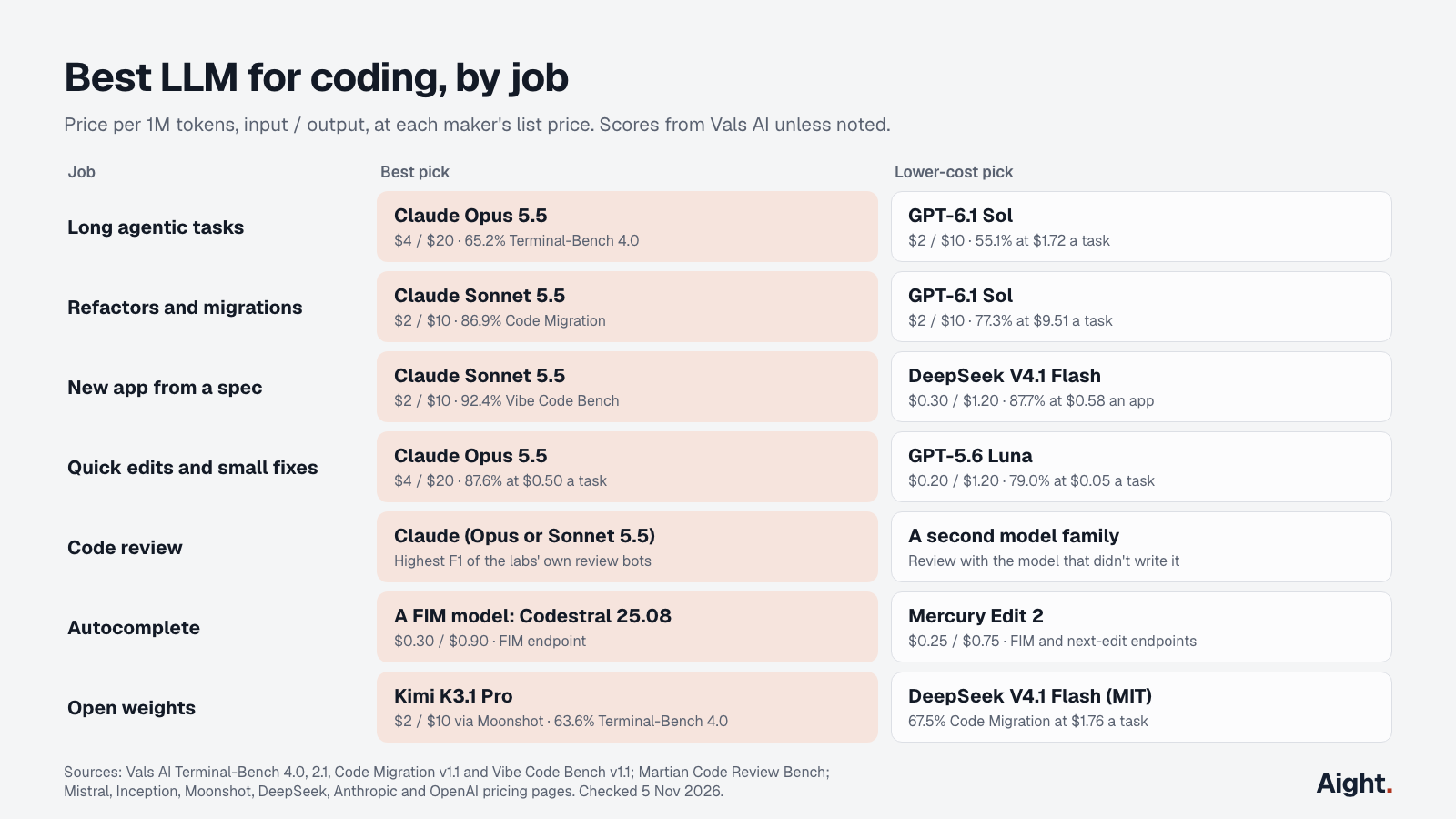
The best LLM for coding in November 2026 is Claude Opus 5.5 ($4 / $20 per million tokens) for long agentic work: it ties Claude Fable 5.2 for first on Terminal-Bench 4.0 at 65.2% for less per task, and leads ProgramBench at 18.5%. Claude Sonnet 5.5 ($2 / $10) is the better pick for large refactors and for building a new app from a spec, and GPT-6.1 Sol ($2 / $10) gets about 85% of Opus's agentic score for about a seventh of the cost per task.
The answer changes with the job. Autocomplete needs a small fill-in-the-middle model, not any of the above, and the best open-weight model, Kimi K3.1 Pro, now scores within two points of Opus on Terminal-Bench 4.0. Below are the scores and prices for each job, all checked on 5 November 2026. Prices are each maker's list price per million tokens, input / output.
Best LLM for coding, by job
- Long agentic tasks: Claude Opus 5.5. For a lower cost per task, GPT-6.1 Sol.
- Refactors and language migrations: Claude Sonnet 5.5, which beat Opus 5.5 on Vals AI's Code Migration benchmark (86.9% against 81.0%) at 61% of the cost per task.
- A new app from a spec: Claude Sonnet 5.5 (92.4% on Vibe Code Bench). DeepSeek V4.1 Flash scored 87.7% at $0.58 an app.
- Quick edits and small fixes: Claude Opus 5.5 passed 87.6% of Terminal-Bench 2.1's short tasks at $0.50 each. GPT-5.6 Luna passed 79.0% at $0.05.
- Code review: Anthropic's Claude review bot had the highest F1 of the three labs' own bots on Martian's live benchmark. Review with a different model family from the one that wrote the code.
- Autocomplete: a fill-in-the-middle model such as Mistral's Codestral 25.08 or Inception's Mercury Edit 2.
- In ChatGPT: GPT-6 at High thinking, or GPT-6.1 Sol and GPT-6 Astra in Codex.
- Open weights: Kimi K3.1 Pro for top scores, DeepSeek V4.1 Flash (MIT license) for cost.
Most lists of the best coding AIs mix models with the tools that run them. This post ranks models. For what each pick costs per task that passes its tests, and a router that tries a low-cost model before Claude, see Claude alternatives for coding, ranked by cost per passing task.
Best LLM for agentic coding
Agentic coding means the model runs commands, edits files and checks its own work over many steps. The most useful current test is Terminal-Bench 4.0 on Vals AI: 66 long tasks, the same minimal agent (mini-swe-agent) for all 59 models, three runs averaged, as of 11 November 2026.
| Model | Terminal-Bench 4.0 | Cost per task | Code Migration v1.1 | Price per 1M tokens |
|---|---|---|---|---|
| Claude Fable 5.2 | 65.15% | $14.56 | 83.27% | $8.00 / $40.00 |
| Claude Opus 5.5 | 65.15% | $12.04 | 81.01% | $4.00 / $20.00 |
| Claude Sonnet 5.5 | 64.14% | $10.75 | 86.88% | $2.00 / $10.00 |
| Kimi K3.1 Pro (open weights) | 63.64% | $4.57 | not run | $2.00 / $10.00 |
| Gemini 4 Carbon (limited access) | 63.13% | $7.45 | not run | $2.00 / $10.00 introductory |
| GPT-6 Astra | 59.60% | $9.58 | 80.58% | $10.00 / $50.00 |
| Gemini 4 Argon | 57.58% | $17.64 | 70.80% | $2.00 / $10.00 to 30 Nov, then $4.00 / $20.00 |
| GPT-6.1 Sol | 55.05% | $1.72 | 77.32% | $2.00 / $10.00 |
| GPT-6.1 Terra | 49.49% | $2.16 | not run | $1.00 / $5.00 |
| GLM 5.3 (open weights) | 38.89% | $9.37 | 55.07% | $1.40 / $4.40 |
| Claude Haiku 5.5 | 36.36% | $3.12 | 52.36% | $0.10 / $0.50 |
| DeepSeek V4.1 Flash 1017 (open weights) | 31.82% | $0.54 | 67.52% | $0.30 / $1.20 peak |
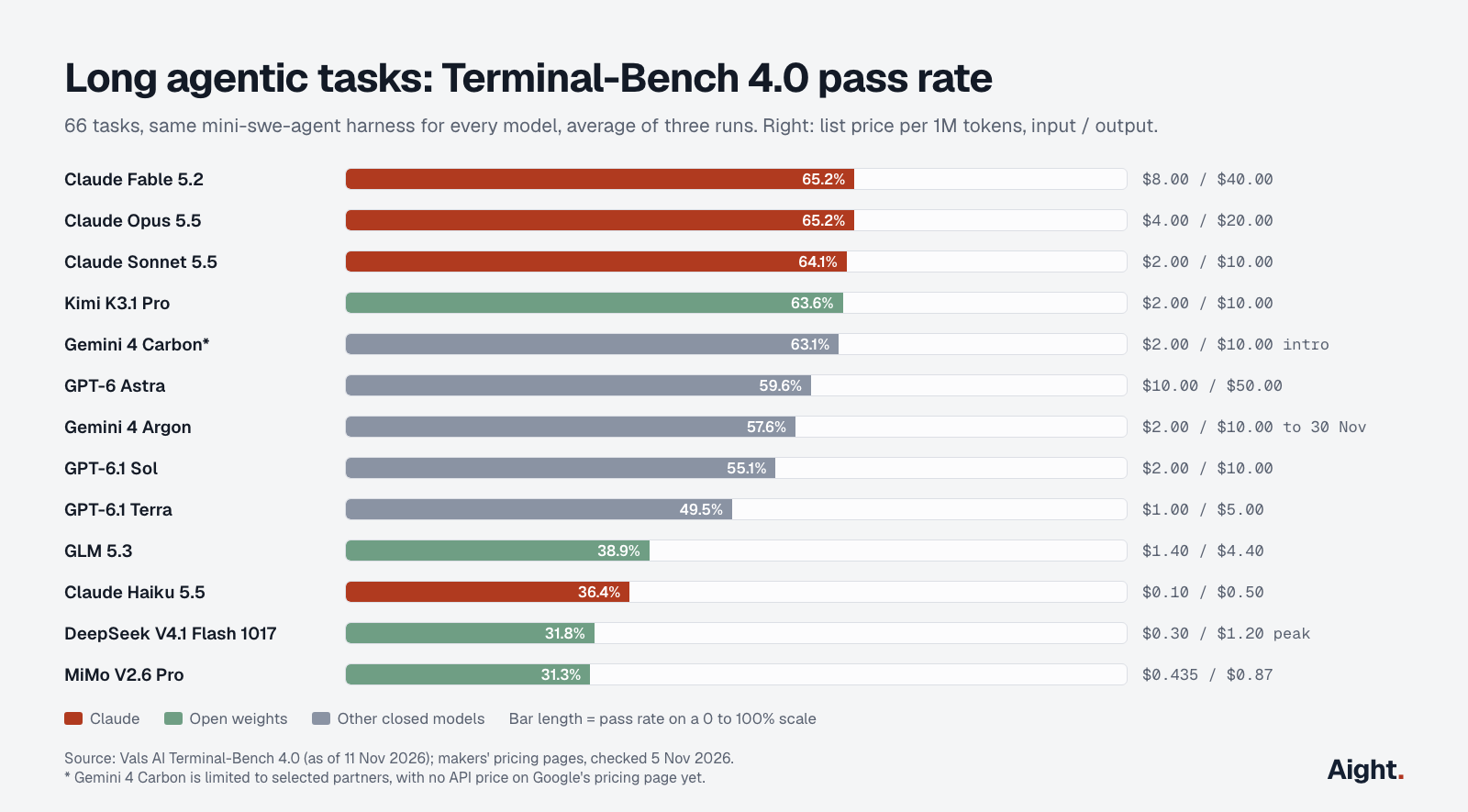
Vals lists both Gemini 4 models at $4 / $20; if its costs use that price, an Argon task through 30 November costs about half the figure shown. Google's Gemini 4 Carbon announcement (28 October) limits access to selected cyber defenders and partners for now, and Carbon has no line on Google's pricing page yet.
Three other results sharpen the ranking:
- On the official Terminal-Bench 4.0 leaderboard, where each maker runs its own agent, Claude Code with Opus 5.5 resolved 64.8% and Codex with either GPT-6 Astra or GPT-6.1 Sol 58.2%. The full GPT-6.1 Sol run cost $634, against $3,267 for Astra and $4,719 for Opus.
- On Vals' ProgramBench (updated 29 October), models rebuild a command-line program from its binary and a spec, and every hidden test must pass. Opus 5.5 solved 18.5%, more than double the next model (Claude Fable 5.1, 7.0%), at $68.05 a task.
- Code Migration v1.1 (30 October) ports 30 open-source programs into four other languages and 10 COBOL systems to Java. Sonnet 5.5 led at $43.88 a task, against $9.51 for GPT-6.1 Sol and $1.76 for DeepSeek V4.1 Flash 1017.
So: Opus 5.5 for the hardest, longest work, Sonnet 5.5 for large but well-specified jobs, GPT-6.1 Sol when cost per task matters more than the last ten points. Anthropic's pricing page bills the full 1M-token window at the standard rate, while OpenAI doubles input and raises output 1.5x on any request over 272,000 tokens, which matters for long agent sessions. The Claude API pricing guide covers cache reads, which are most of an agent's input.
One caveat: Preference Model reviewed 65 of the tasks in a 19 October post and found problems in 60 of them, including 44 that could be passed by cheating. On its fixed version Sonnet 5.5 passed 89.2% instead of 62.8%. Treat small gaps on Terminal-Bench 4.0 as ties.
New app from a spec
Vibe Code Bench v1.1 (Vals AI, 29 October) has each model build a web app from a written spec in the OpenHands agent, then an evaluator agent clicks through the app to check each requirement.
| Model | Score | Cost per app | Time per app | Price per 1M tokens |
|---|---|---|---|---|
| Claude Sonnet 5.5 | 92.39% | $31.25 | 1h01m | $2.00 / $10.00 |
| Gemini 4 Argon | 91.91% | $8.11 | 37m | $2.00 / $10.00 to 30 Nov |
| Claude Haiku 5.5 | 90.44% | $6.07 | 35m | $0.10 / $0.50 |
| Claude Opus 5.5 | 90.29% | $57.92 | 1h36m | $4.00 / $20.00 |
| GPT-6 Astra | 89.59% | $38.51 | 39m | $10.00 / $50.00 |
| GPT-6.1 Sol | 88.93% | $6.23 | 1h15m | $2.00 / $10.00 |
| DeepSeek V4.1 Flash 1017 | 87.73% | $0.58 | 16m | $0.30 / $1.20 peak |
| MiMo V2.6 Pro | 85.22% | $1.04 | 1h01m | $0.435 / $0.87 |
| GPT-6 Luna | 81.65% | $1.35 | 37m | $0.10 / $0.50 |
The spread on greenfield work is small: the top seven models here sit within five points. Claude Haiku 5.5, released 7 October, scored above Opus 5.5 for about a tenth of the cost per app, and DeepSeek V4.1 Flash came within five points of the leader for 2% of its cost. Haiku 5.5's price rises to $0.50 / $2.50 for any request whose prompt passes 100,000 tokens, so watch prompt sizes in long agent sessions.
Quick edits and small fixes
For a single bug fix or a contained change, the long-task benchmarks overstate what you need. Vals AI's Terminal-Bench 2.1 (89 shorter tasks, Terminus 2 agent) is closer. Vals archived it on 1 October, so GPT-6.1 Sol, Haiku 5.5 and the October DeepSeek build are missing.
| Model | Pass rate | Cost per task | Time per task | Price per 1M tokens |
|---|---|---|---|---|
| Claude Opus 5.5 | 87.64% | $0.50 | 6m23s | $4.00 / $20.00 |
| GPT-6 Astra | 87.27% | $1.34 | 4m34s | $10.00 / $50.00 |
| GPT-6 Sol | 83.15% | $0.37 | 4m59s | $2.00 / $10.00 |
| Claude Sonnet 5.5 | 83.15% | $0.63 | 7m46s | $2.00 / $10.00 |
| GPT-5.6 Luna | 79.03% | $0.05 | 5m56s | $0.20 / $1.20 |
| MiMo V2.6 Flash (open weights) | 76.40% | $0.02 | 13m30s | $0.14 / $0.28 |
| GPT-6 Luna | 73.03% | $0.03 | 7m05s | $0.10 / $0.50 |
| GLM 5.3 Flash (open weights) | 62.92% | $0.03 | 16m06s | $0.15 / $0.50 |
Opus 5.5 is both the most accurate and, per task, less expensive than Sonnet 5.5, at twice Sonnet's token price, so it gets there with far fewer tokens. GPT-5.6 Luna gives up nine points for a tenth of the cost and is fast. The small models fall apart on long work, though: GPT-6 Luna scored 13.6% on Terminal-Bench 4.0, so keep them for contained edits.
Code review
Public review benchmarks with current data compare review tools, not raw models. The most current is Martian's Code Review Bench, which scores review bots on fresh pull requests in open-source repositories. Precision is the share of a bot's comments that led to a fix, and recall is the share of later fixes the bot had flagged. Over the month to 5 November, across 15,614 scored pull requests:
| Review bot | F1 | Precision | Recall |
|---|---|---|---|
| Greptile (top tool) | 65.1% | 82.5% | 53.8% |
| Claude (Anthropic) | 60.6% | 71.1% | 52.8% |
| GitHub Copilot | 59.2% | 65.8% | 53.8% |
| ChatGPT Codex Connector (OpenAI) | 56.7% | 71.9% | 46.8% |
| Gemini Code Assist (Google) | 53.7% | 60.7% | 48.1% |
Among the labs' own bots, Claude catches the most real issues at about the same precision as Codex. Six independent tools, led by Greptile and Cubic, beat all three, so the review pipeline matters as much as the model. The leaderboard lists tools, not the models behind them.
Raising effort didn't help much. CodeRabbit tested Opus 5.5 at standard and maximum effort across its review pipeline and found the standard setting the better balance; its video summary says "Higher reasoning effort didn’t consistently deliver a better complete review."
For your own review step, use Opus 5.5 or Sonnet 5.5 at a standard effort setting rather than the maximum, and if an OpenAI model wrote the change, review it with Claude, or the other way round.
Autocomplete
Inline completion is a different job: the model sees the code before and after the cursor and must answer in a fraction of a second. Continue's documentation puts it plainly: "Chat models, though larger, will often perform poorly even with extensive prompting." You want a model trained on fill-in-the-middle (FIM) and an API that accepts a prefix and a suffix.
| Model | API endpoint | Price per 1M tokens | Context |
|---|---|---|---|
| Codestral 25.08 (Mistral) | /v1/fim/completions | $0.30 / $0.90 | 128K |
| Mercury Edit 2 (Inception) | /v1/fim/completions, /v1/edit/completions | $0.25 / $0.75 | 32K |
| DeepSeek V4.1 Flash, FIM beta | /beta completions with suffix | $0.30 / $1.20 peak, $0.15 / $0.60 off-peak | Output capped at 4K tokens |
Codestral 25.08 dates from July 2025 and is still Mistral's current code model. Mercury Edit 2 also serves next-edit suggestions. DeepSeek's FIM endpoint is still labeled beta. Public leaderboards don't cover autocomplete with current models, so try two of these in your editor for a day. GitHub's docs on changing the Copilot completion model don't name the default.
Best ChatGPT model for coding
In the ChatGPT app, choose GPT-6 and set the thinking slider to High, or Extra High on Pro, Business and Enterprise plans. According to OpenAI's help article, GPT-6 Sol powers Instant through Extra High, and the Pro level runs GPT-6 Pro, powered by GPT-6 Astra, on Pro $100, Pro $200, Business and Enterprise. Plus doesn't get Extra High or Pro.
For real coding work, use Codex rather than the chat window. GPT-6.1 Sol is a model option in Codex and ChatGPT Work, separate from the Chat picker, and Plus includes GPT-6 Astra there too. Free and Go plans get GPT-5.6 Luna in Chat and GPT-5.6 Terra in Codex. In the Codex CLI (version 0.166.0, released 29 October), choose the model with codex -m gpt-6.1-sol or codex -m gpt-6-astra; Astra needs version 0.153.0 or later.
On the API, GPT-6.1 Sol (released 29 September) is the one to start with:
| OpenAI model | Price per 1M tokens | Terminal-Bench 4.0 | Cost per task | Code Migration |
|---|---|---|---|---|
| GPT-6 Astra | $10.00 / $50.00 | 59.60% | $9.58 | 80.58% |
| GPT-6.1 Sol | $2.00 / $10.00 | 55.05% | $1.72 | 77.32% |
| GPT-6.1 Terra | $1.00 / $5.00 | 49.49% | $2.16 | not run |
| GPT-6 Sol | $2.00 / $10.00 | 44.44% | $5.79 | not run |
| GPT-6 Luna | $0.10 / $0.50 | 13.64% | $0.35 | 46.67% |
GPT-6.1 Sol costs the same per token as GPT-6 Sol, scores 11 points higher and costs less per task, so there's no reason to stay on 6 Sol. Astra adds about 4.5 points on Vals' run for 5.6 times the cost per task, and in Codex on the official leaderboard the two tied. OpenAI's models page still calls Astra its "flagship model for complex reasoning and coding", and it does lead on ProgramBench (5.5% against 3.0%), so keep it for the hardest problems. Two details for API users: GPT-6.1 Sol's model page says tool calling requires the Responses API, and Codex gives Sol a 500,000-token default context window. The OpenAI token pricing guide covers cached input and the long-context surcharge.
Best open-weight coding models
Open weights let you self-host, fine-tune or pick any provider. All of these have weights on Hugging Face; prices are each maker's own API.
| Model | License | Size | Terminal-Bench 4.0 | Vibe Code Bench | Maker's API price |
|---|---|---|---|---|---|
| Kimi K3.1 Pro | Kimi K3.1-Pro License | 2.8T total, 104B active | 63.64% | 84.89% | $2.00 / $10.00 |
| GLM 5.3 | GLM-5.3 License | about 753B | 38.89% | 78.13% | $1.40 / $4.40 |
| GLM 5.3 Flash | MIT | 320B total, 18B active | 37.37% | 30.76% | $0.15 / $0.50 |
| DeepSeek V4.1 Flash 1017 | MIT | 552B backbone | 31.82% | 87.73% | $0.30 / $1.20 peak |
| MiMo V2.6 Pro | MIT | 1.02T total, 42B active | 31.31% | 85.22% | $0.435 / $0.87 |
| MiniMax M3.1 Flash | MiniMax Community License | about 428B total, 23B active | 25.25% | 73.94% | $0.15 / $0.60 |
| MiMo V2.6 Flash | MIT | 309B total, 15B active | 24.24% | 78.96% | $0.14 / $0.28 |
| Qwen3.8-27B | Apache 2.0 | 27B | not run | 64.85% | $0.50 / $3.00 |
Kimi K3.1 Pro is the only open model within two points of Claude on Terminal-Bench 4.0, at half Opus's token price on Moonshot's API. Its weights went up on 2 November. At 2.8 trillion parameters it needs a multi-GPU server, and its license requires a separate agreement for model-as-a-service businesses with more than $20 million in revenue.
DeepSeek V4.1 Flash 1017 is the value pick: MIT-licensed, 67.52% on Code Migration for $1.76 a task, and half price on DeepSeek's API outside 01:00 to 04:00 and 06:00 to 10:00 UTC on weekdays. GLM 5.3 Flash scores well on terminal tasks but poorly on app building, so test it on your kind of work first. MiniMax's license asks commercial users to display "Built with MiniMax M3.1-Flash" and to notify MiniMax.
For a single machine, Qwen3.8-27B is the realistic option: 27 billion parameters against 309 billion to 2.8 trillion for the rest of the table, Apache 2.0, and quantized GGUF builds from Unsloth. It passed 58.43% of Terminal-Bench 2.1's short tasks, against 87.64% for Opus 5.5.
Why SWE-bench Verified, LiveCodeBench and Aider aren't in the ranking
Benchmarks that many "best coding LLM" lists still quote have no current models:
| Leaderboard | Latest data | Includes Opus 5.5 or GPT-6.1 Sol |
|---|---|---|
| SWE-bench Verified on Vals AI | Archived 1 Sep 2026 as saturated | No |
| swebench.com | Newest entry 26 Feb 2026 | No |
| SWE-Bench Pro, Scale AI public set | No date shown; top entry Muse Spark 1.1 | No |
| LiveCodeBench on Vals AI | Archived 1 Sep 2026 | No |
| LiveCodeBench official site | Newest models from 2025 | No |
| Aider polyglot | Last updated 20 Nov 2025 | No |
| Terminal-Bench 2.1 on Vals AI | Archived 1 Oct 2026 | Opus 5.5 only |
| Terminal-Bench 4.0, Vibe Code, Code Migration on Vals AI | 29 and 30 Oct 2026 | Both |
When Vals retired SWE-bench Verified, the top score was 97.0%, so it no longer separates strong models. Rankings built on these boards miss every model released since September.
What developers report
- A Hacker News commenter whose team ran 100 coding environments wrote: "Both Astra and 6.1-Sol are pretty comfortably ahead of Opus 5.5" (Hacker News, 30 Sep 2026, link)
- Another commenter in the same thread reported the opposite for systems languages: "Astra was not good in writing go and c++ code." (Hacker News, 29 Sep 2026, link)
- A third, who makes Codex models and Claude models consult each other: "There are tasks that neither one can fully solve on their own" (Hacker News, 29 Sep 2026, link)
- A commenter who measured effort levels across about 300 tasks: "for GLM-5.3 Flash, the best $/pass was medium effort" (Hacker News, 3 Oct 2026, link)
- Wagtail core team member Thibaud Colas spent September on GLM 5.3 Flash, rated it highly for everyday work, and had to switch to DeepSeek V4.1 Flash and Qwen 3.8 Flash when providers ran short of capacity (Wagtail blog, 2 Oct 2026, link)
- Preference Model's review of the benchmark itself: "Terminal Bench 4 is closer to solved than its leaderboard suggests" (Preference Model, 19 Oct 2026, link)
The disagreement is the useful part: benchmark leads of a few points don't survive contact with every codebase. Before you standardize, run 30 to 50 recent tasks from your own repository, with tests, through your top two candidates.
Using these models through Aight
Aight serves several models from this post behind one OpenAI-compatible Chat Completions key: claude-opus-5-5 and claude-sonnet-5-5 at Anthropic's list prices, gpt-6.1-sol, gpt-6-astra and gpt-6-luna at OpenAI's, and DeepSeek-V4.1-Flash at a flat $0.30 / $1.20. That makes the side-by-side test above a change of model string.
Where another route works better:
- Claude Code speaks Anthropic's Messages API and Codex speaks OpenAI's Responses API, so neither works with Aight directly. For all-day use in those tools, compare a subscription first; the Claude Code pricing guide works through when a plan costs less than tokens.
- Aight has no fill-in-the-middle endpoint, so use Codestral or Mercury Edit 2 for autocomplete.
- DeepSeek's own API costs half off-peak, and Kimi K3 costs 10% more on Aight than at Moonshot. Kimi K3.1 Pro and GLM 5.3 aren't in the catalog yet.
- OpenAI requires the Responses API for GPT-6.1 Sol's tool calling, and maximum output varies by model, so check the models page before sending long diffs.
Every recharge adds 10% extra balance, about $0.94 per $1 of list-price usage after the 3% processing fee outside India, and each key can carry a monthly cap and a list of allowed models.
FAQ
Is Claude better than ChatGPT for coding?
On long agentic tasks, Claude leads: Opus 5.5 scored 65.2% on Vals AI's Terminal-Bench 4.0 against 59.6% for GPT-6 Astra, and Claude Code led Codex 64.8% to 58.2% on the official board. OpenAI wins on cost per task, with GPT-6.1 Sol at $1.72 against $12.04 for Opus. The Codex vs Claude Code comparison covers plans and limits.
What is the best free LLM for coding?
Google's free tier includes Gemini 3.8 Flash at no charge, and ChatGPT's Free plan gives GPT-5.6 Luna in Chat and GPT-5.6 Terra in Codex. Gemini 3.8 Flash scored 19.7% on Terminal-Bench 4.0, so free models suit small tasks. With no usage limits at all, run an open-weight model on your own hardware.
What is the best local LLM for coding?
Qwen3.8-27B, under Apache 2.0. At 27 billion parameters it's the smallest model in the open-weight table by a factor of ten, Unsloth publishes quantized builds, and it scored 64.85% on Vibe Code Bench and 58.43% on Terminal-Bench 2.1. The stronger open models, Kimi K3.1 Pro and DeepSeek V4.1 Flash, need server hardware.
Why do coding benchmarks disagree?
They test different jobs with different agents. Sonnet 5.5 beats Opus 5.5 on Code Migration and Vibe Code Bench, while Opus wins Terminal-Bench 4.0 and ProgramBench, and in this data the same model moves up to three points between Vals' minimal agent and its maker's own. Compare models within one benchmark, never across them.
How often does the best coding model change?
Often. Opus 5.5 (22 Sep), GPT-6.1 Sol (29 Sep), Claude Haiku 5.5 (7 Oct), Gemini 4 Argon on the Gemini API (13 Oct), DeepSeek V4.1 Flash 1017 (17 Oct), Kimi K3.1 Pro (23 Oct), GPT-6.1 Terra (26 Oct) and Gemini 4 Carbon (28 Oct) all arrived in under six weeks. Recheck the Vals leaderboards monthly, and price changes too: Gemini 4 Argon doubles on 1 December.
Sources
- Vals AI: Terminal-Bench 4.0, Terminal-Bench 2.1, Code Migration v1.1, ProgramBench, Vibe Code Bench v1.1, Vals Index, SWE-bench Verified, LiveCodeBench; model pages for Gemini 4 Carbon, Kimi K3.1 Pro and GLM 5.3
- Terminal-Bench: official Terminal-Bench 4.0 leaderboard
- Preference Model: Terminal Bench 4 is saturated
- Martian: Code Review Bench and methodology on GitHub
- CodeRabbit: Opus 5.5 review video; IT Brief, CodeRabbit says Opus 5.5 beats baseline on bug review
- Other leaderboards: swebench.com, Scale AI SWE-Bench Pro public, LiveCodeBench, Aider LLM leaderboards
- Anthropic: Pricing, Claude Haiku 5.5
- OpenAI: Pricing, Models, GPT-6.1 Sol, GPT-6 Astra, Changelog, GPT-6 and other models in ChatGPT, Codex models, Codex releases on GitHub, DevDay 2026 keynote
- Google: Gemini API pricing, Gemini 4 Carbon announcement
- Moonshot AI: Kimi pricing, Kimi K3.1 Pro on Hugging Face
- DeepSeek: Models and pricing, FIM completion, V4.1 Flash 1017, V4.1 Flash model card
- Z.ai: Pricing, GLM-5.3, GLM-5.3-Flash
- Xiaomi: MiMo API pricing, MiMo-V2.6-Pro, MiMo-V2.6-Flash
- MiniMax: Pay-as-you-go pricing, MiniMax-M3.1-Flash
- Alibaba Cloud: Model Studio pricing, Qwen3.8-27B, Unsloth GGUF builds
- Mistral: Codestral 25.08, FIM endpoint, Models overview
- Inception: Models and pricing
- Continue: Autocomplete model role
- GitHub: Change the completion model
- Hacker News threads: GPT 6.1 Sol, One month coding with GLM 5.3 Flash; Wagtail, One month on GLM 5.3 Flash
- Aight: Models and pricing, API reference, Refund policy
Checked on 5 November 2026. Updated 17 November 2026: Terminal-Bench 4.0 costs from Vals' 11 November board, Claude Fable 5.2, and Aight's current model list.