OpenCode Zen is OpenCode's pay-as-you-go model gateway: one prepaid balance and one key for about 70 paid coding models from Anthropic, OpenAI, Google, xAI, DeepSeek, Moonshot and others, plus about ten free ones. In October 2026 OpenCode began calling it OpenCode Console pay-as-you-go, and opencode.ai/zen now redirects to the Console models page. Most models cost the maker's list price, and OpenCode adds 4.6% plus $0.31 to every purchase of balance.
So on most models Zen costs about 5% more than your own key. Three exceptions matter for coding agents: Claude Sonnet 5.5 cache reads cost twice Anthropic's rate, Gemini 3.8 Flash costs twice Google's price until 1 January, and DeepSeek is billed at its peak rate around the clock. Everything below was checked on 5 November 2026 against OpenCode 2.2.5, including the data terms and the 17 October breach of provider keys stored in Console.
What OpenCode Zen is now
The rename happened in steps. On 12 October, pull request #54767 renamed the OpenCodeZen provider in OpenCode's code and moved its base URL from /zen/v1 to /inference/v1. By 5 November, both opencode.ai/zen and the old /docs/zen/ page redirected to Console pages that never use the word Zen. OpenCode's Terms of Service, effective 15 August 2026, still call it "the OpenCode Zen paid offering".
The product works the same way. Console is now the umbrella for everything OpenCode sells: the Console intro lists workspaces, SSO, policies, web search and spend caps alongside the models, with no seat fees.
| Name you'll see | What it is | ID in OpenCode config | Who bills you |
|---|---|---|---|
| OpenCode Zen, now Console pay-as-you-go | Curated models at per-token prices | opencode | OpenCode, from a prepaid balance |
| OpenCode Go | Subscription for open models and a few small ones | opencode-go | OpenCode: $10, $40, or $20 per member a month |
| Console providers | Your own provider keys, stored in Console and served through its gateway | Workspace name / provider | The provider |
| Local provider keys | Keys you add with /connect on your machine | anthropic, openai and so on | The provider |
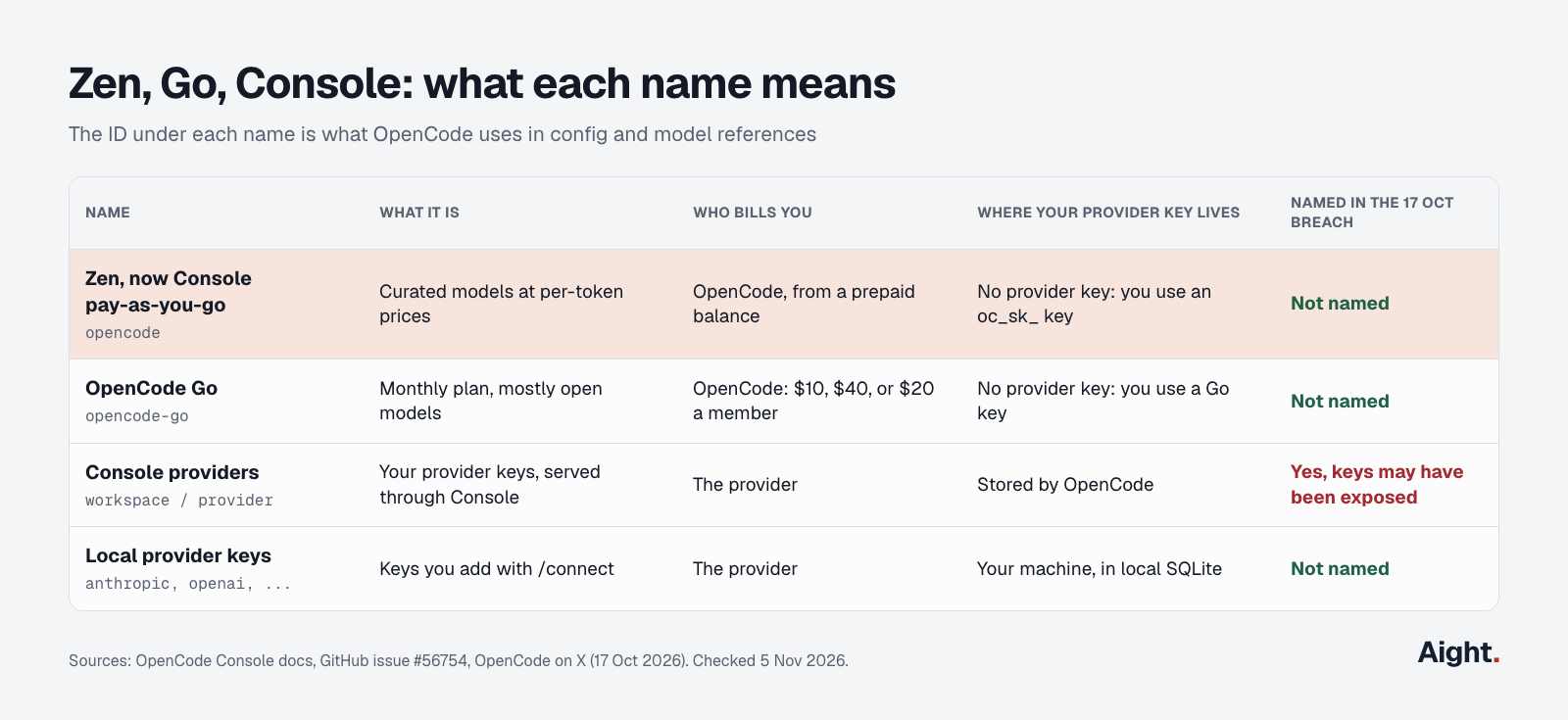
An open GitHub issue from 18 October counts four names for the same two paid products across the CLI, desktop app, docs and site.
OpenCode's docs explain the curated list: few models work well as coding agents, and the same model can behave differently on different hosts. OpenCode says it tests each pair and sells at cost, with a markup only for payment processing.
OpenCode Zen models and prices
The public model list at https://opencode.ai/inference/v1/models needs no key. On 5 November it returned 80 models: 70 paid and 10 free. The main coding models, against each maker's own price per million tokens:
| Model | On Zen: input / output, cache read | From the maker | Difference |
|---|---|---|---|
| Claude Opus 5.5 | $4 / $20, $0.20 | $4 / $20, $0.20 | Same |
| Claude Sonnet 5.5 | $2 / $10, $0.20 | $2 / $10, $0.10 | Cache reads cost 2x |
| Claude Haiku 5.5, prompts to 100K | $0.10 / $0.50, $0.01 | $0.10 / $0.50, $0.01 | Same |
| Claude Fable 5.1 | $10 / $50, $0.25 | $10 / $50, $0.25 | Same |
| GPT-6.1 Sol, prompts to 272K | $2 / $10, $0.10 | $2 / $10, $0.10 | Same |
| GPT-6 Luna | $0.10 / $0.50, $0.01 | $0.10 / $0.50, $0.01 | Same |
| Gemini 4 Argon | $2 / $10, $0.10 to 30 Nov | $2 / $10, $0.10 to 30 Nov | Same; both double on 1 Dec |
| Gemini 3.8 Flash | $1.50 / $7.50, $0.15 | $0.75 / $3.75, $0.075 to 31 Dec | 2x until 1 Jan 2027 |
| Grok 4.7, prompts to 200K | $2 / $6, $0.50 | $2 / $6 | Same input and output |
| DeepSeek V4.1 Flash | $0.30 / $1.20, $0.006 at all hours | Same at peak, half off-peak | Peak price all day |
| DeepSeek V4 Pro | $1.74 / $3.48, $0.145 | $1.32 / $3.96, $0.044 at peak | Different host and price |
Sources: Anthropic, OpenAI, Google, xAI and DeepSeek pricing pages, 5 November 2026.
Notes on the table:
- The Sonnet 5.5 cache-read price is $0.20 in both OpenCode's docs and its live API, against Anthropic's $0.10. Cache reads are most of an agent's tokens, so this gap matters more than it looks.
- DeepSeek's half-price off-peak hours cover a 9-to-5 working day from Eastern to Pacific time, but Zen charges the peak rate at all hours. Its DeepSeek models run on US and EU hosts, which is why V4 Pro is priced differently.
- Kimi K3 is $3 / $15, GLM-5.3 $1.40 / $4.40 and MiniMax M3 $0.30 / $1.20 on Zen.
- Long prompts cost more: above 272K tokens on GPT-6.1 Sol, 200K on Grok 4.7 and 100K on Haiku 5.5.
- Small models such as Haiku, Nano or Flash write session titles, so expect them in your usage history.
To check prices yourself before each purchase:
curl -s https://opencode.ai/inference/v1/models \
  | jq -r '.data[] | select(.cost.text.input.price > 0)
           | [.id, .cost.text.input.price, .cost.text.output.price, .cost.text.input.cache.read] | @tsv'
How Zen billing works
Zen bills a prepaid balance that belongs to a workspace, and every account starts with a Personal workspace. Under Settings › Billing you buy $10, $50, $100 or a custom amount, by card, Link, Alipay, UPI or WeChat Pay through Stripe. The billing docs add 4.6% plus $0.31 to each purchase: $50 of balance costs $52.61.
The fixed $0.31 makes small purchases cost more per dollar:
| Purchase | You pay on Zen | Per $1 of usage | OpenRouter, by card | Per $1 of usage |
|---|---|---|---|---|
| $10 | $10.77 | $1.077 | $10.80 | $1.080 |
| $20 | $21.23 | $1.062 | $21.10 | $1.055 |
| $50 | $52.61 | $1.052 | $52.75 | $1.055 |
| $100 | $104.91 | $1.049 | $105.50 | $1.055 |
| $500 | $523.31 | $1.047 | $527.50 | $1.055 |
OpenRouter charges 5.5% on card purchases, with a $0.80 minimum. Zen's fee is lower on purchases up to about $10 and from about $35 up.
The rest of the billing rules:
- Auto-recharge buys more when the balance falls below a level you set. If a charge fails, auto-recharge switches off.
- At zero, paid requests fail with HTTP 402 and
Insufficient account funds. The balance never goes negative. - Owners and admins can set monthly spend caps for the whole workspace, each member, members with a tag, or service accounts. Caps reset on the 1st at 00:00 UTC. A blocked request gets HTTP 429 with
Policy budget exceeded. Caps are checked when a request starts, so spend can end slightly over. Free models and Go usage within the plan don't count. - Every response reports what it cost in
usage.cost, withopencode.billing_sourceandopencode.list_costalongside. - Workspaces with a signed agreement can pay by monthly invoice, issued on the 1st and due 14 days later.
Two things are missing. Neither the docs nor the terms say whether unused balance can be refunded or whether it expires. And the workspace docs say that deleting a workspace forfeits whatever balance is left, so buy in amounts you expect to use.
Is OpenCode Zen free?
Partly. There's no subscription or seat fee, and about ten models cost nothing for a limited time. Every other model is paid per token from your balance.
The live list on 5 November: Big Pickle, Beam Free, Flint 40B Free, MiMo-V2.6-Flash Free, Nemotron 3.5 Super VL Free, Nemotron 3.5 Lightning Free, DeepSeek V4.1 Flash Free, GLM-5.3-Flash Free, Pulse Alpha Free and Crouton Alpha Free. It changes often, and the docs table didn't match it.
Free models come with conditions:
- They work only inside OpenCode. Other clients get HTTP 403, even with a Console key.
- Data terms vary by model. DeepSeek V4.1 Flash Free and GLM-5.3-Flash Free run on zero-retention providers that don't train on your data. Beam Free keeps data for 30 days but doesn't train on it. Big Pickle, Pulse Alpha, Flint 40B and MiMo may use your prompts to improve the model, and NVIDIA's Nemotron endpoints say not to submit personal or confidential data.
- The terms add that content from unpaid accounts may be used to develop OpenCode's services.
To hide free models for one machine, set OPENCODE_DISABLE_FREE_MODELS=1 on the OpenCode server process. For a whole team, an admin can switch free models off on the workspace's Models tab.
How to set up OpenCode Zen in OpenCode
These steps match OpenCode 2.2.5, released 30 October 2026. Note that npm install -g opencode-ai still installs version 1 (1.19.5); version 2 has its own packages.
- Install OpenCode 2 with
curl -fsSL https://opencode.ai/v2/install | bash,brew install anomalyco/tap/opencode-v2ornpm install -g @opencode/cli. - Sign in at opencode.ai/console, add a payment method under Settings › Billing, and buy some balance.
- Set a monthly spend cap under Controls before you start.
- Start
opencode, run/connect, pick OpenCode Console and choose the workspace in the browser. The models page describes pasting an API key at this step instead; both routes end at the same workspace. - Run
/modelsand pick a model. Zen models appear asopencode/<model-id>.
To make one the default, add it to opencode.jsonc:
{
  "$schema": "https://opencode.ai/config.json",
  "model": "opencode/gpt-6.1-sol"
}
For CI or one-off runs, the models docs say OPENCODE_API_KEY enables Zen's paid models when signed out. Use a service account key with its own spend cap:
opencode service set env OPENCODE_API_KEY oc_sk_...
opencode run --model opencode/deepseek-v4.1-flash "Explain why test_parse_dates fails"Using Zen from Claude Code, Codex and scripts
The same balance works outside OpenCode. Keys start with oc_sk_, can be set to expire, and can be limited to calling models only. For Claude Code, run /logout first if you're signed in to a Claude account, then:
export ANTHROPIC_BASE_URL="https://opencode.ai/inference/anthropic"
export ANTHROPIC_AUTH_TOKEN="oc_sk_..."   # AUTH_TOKEN, not ANTHROPIC_API_KEY
claude --model gpt-6.1-sol
Zen translates between API formats, so Claude Code can run GPT, Gemini or DeepSeek models this way. Codex, Hermes, Pi and Raycast have their own setup guides. For how the two agents compare, see OpenCode vs Claude Code. From your own code, https://opencode.ai/inference serves /openai/v1/chat/completions, /openai/v1/responses, /anthropic/v1/messages and Gemini's generateContent. A revoked, expired or made-up key returns HTTP 401.
OpenCode Zen vs your own keys vs other gateways
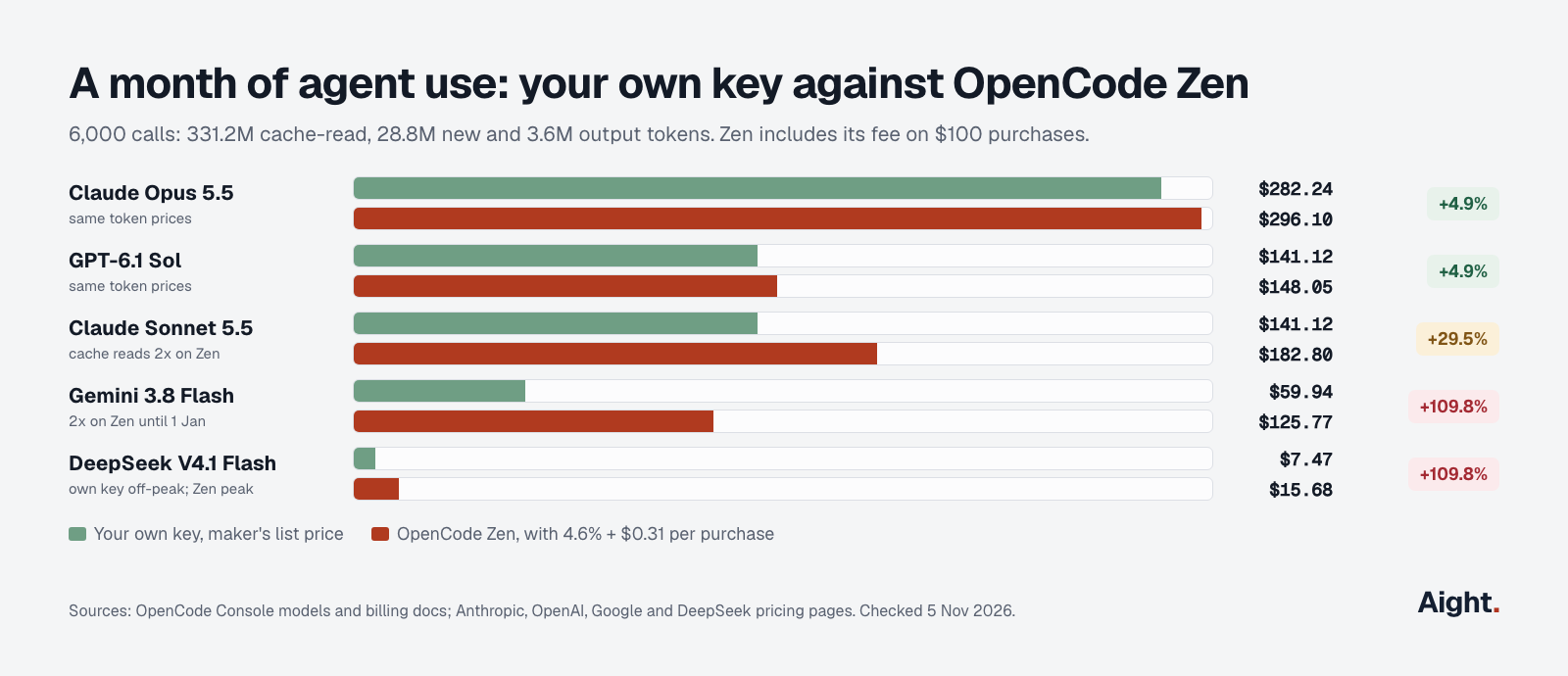
Take a month of steady agent use: 20 working days, 300 model calls a day, 60,000 tokens of context per call (92% of it cache reads and 8% new), and 600 output tokens per call. That's 331.2M cache-read tokens, 28.8M new tokens and 3.6M output tokens. Zen's column includes the fee on $100 purchases.
| Model | Your own key, direct | Zen | Difference |
|---|---|---|---|
| Claude Opus 5.5 | $282.24 | $296.10 | +4.9% |
| GPT-6.1 Sol | $141.12 | $148.05 | +4.9% |
| Claude Sonnet 5.5 | $141.12 | $182.80 | +29.5% |
| Gemini 3.8 Flash | $59.94 | $125.77 | +109.8% |
| DeepSeek V4.1 Flash | $7.47 off-peak, $14.95 peak | $15.68 | +4.9% to +109.8% |
Other routes for the same month:
- OpenRouter lists Opus 5.5, Sonnet 5.5 and GPT-6.1 Sol at the makers' prices, cache reads included, so with its 5.5% fee they come to $297.76, $148.88 and $148.88. Vercel AI Gateway adds no markup but leaves card processing fees to you. See OpenRouter alternatives for nine options compared, and what an AI gateway is for how they work.
- OpenCode Go at $10 a month covers the DeepSeek month several times over: it counts V4.1 Flash at DeepSeek's own prices against a $100 monthly allowance, with 5-hour and weekly limits at 20% and 50% of that. It doesn't include Sonnet, Opus or GPT-6.1 Sol.
- On 30 October, OpenCode posted that Claude subscriptions work in OpenCode again. Pro costs $20 a month and Max $100 on Anthropic's pricing page, against $296.10 for the Opus month on Zen, if a plan's limits hold your usage. The Claude Code pricing post works through those limits.
- OpenCode also supports signing in with ChatGPT, so usage counts against a ChatGPT plan instead of a balance.
When Zen is the better deal
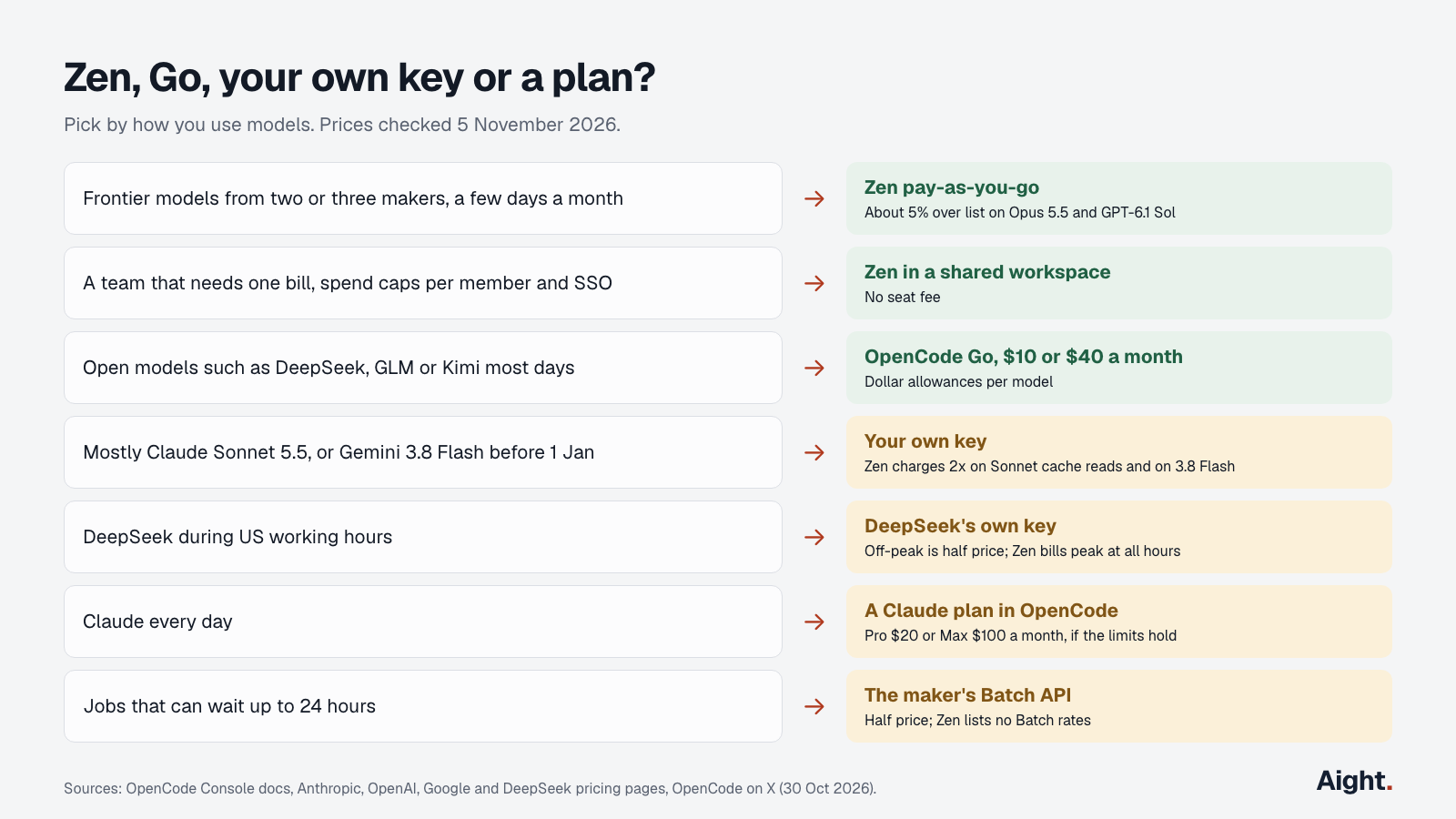
- You use frontier models from two or three makers, but not daily. Zen costs about 5% over list on Opus 5.5 and GPT-6.1 Sol, and replaces separate accounts and keys.
- A team needs one bill, per-member spend caps, SSO and SCIM, and control over which models members use.
- You want open models on US or EU hosts with zero retention, without vetting hosts yourself.
- You want Claude Code to run non-Anthropic models.
When your own key is the better deal
- Most of your work is on Claude Sonnet 5.5, where cache reads cost twice as much on Zen, or Gemini 3.8 Flash before 1 January.
- You run DeepSeek during US working hours, when DeepSeek's own API charges half.
- You can wait for results: Anthropic, OpenAI and Google halve prices through their Batch APIs, and Zen's price list has no Batch rates.
- You use Claude every day: a Pro or Max plan costs less than any per-token route, if its limits hold your usage.
OpenCode Zen data and privacy terms
The models docs say every Zen model is hosted in the US or EU, on providers that keep no data and don't train on it, with exceptions:
- Requests to OpenAI and Anthropic models are kept for 30 days under those companies' policies.
- Mistral doesn't train on prompts but keeps data under its own retention policy.
- Several free models may keep data or use it for training, as listed above.
Console's models page promises "Zero retention by default, with some exceptions", and lets an admin choose regions and whether any model may train on your data. Go's defaults block endpoints that train on data and allow only Europe and the United States, and its zero-retention agreement with DeepSeek renews monthly, currently through 30 November 2026.
The Terms of Service say OpenCode doesn't retain your content when it passes to third-party models, and the privacy policy, effective 6 March 2026, lists prompts as passed through to the upstream provider.
Where your provider keys live matters more after October. Keys you add with /connect stay on your machine, in OpenCode 2's local SQLite database (~/.local/share/opencode/opencode.db by default). Keys you add as Console providers are stored by OpenCode, which serves them through its gateway.
That second kind is what leaked. On 17 October, OpenCode said a breach "related to a large scale distillation attack" affected 1.4% of Console users, all of whom had linked external providers. Its email to them said provider keys saved in a workspace may have been exposed, and asked them to revoke and replace those keys at each provider. BleepingComputer reported that the earliest possible exposure was 17 October at 00:30 UTC, and that affected users reported unauthorized charges and suspended Google Cloud projects. No postmortem had appeared by 5 November, and Zen's own keys and local keys weren't named as affected. If you ever saved provider keys in Console, rotate them at the provider and put a spend limit on the new ones.
What developers report about Zen and Console
- "If you're just using the coding agent, you're not affected." (a Hacker News commenter separating Console from the CLI, 17 Oct 2026, link)
- Users reported unauthorized charges from several hundred dollars to $1,700 on leaked keys, and some had Google Cloud projects suspended (BleepingComputer, 19 Oct 2026, link)
- "The two paid products are named four different ways" (GitHub issue #56754, 18 Oct 2026, link)
- A Hacker News commenter said a $10 Go plan, used mostly with DeepSeek Flash, had never run out of usage (4 Nov 2026, link)
Using Aight as a provider in OpenCode
OpenCode 2 accepts any OpenAI-compatible endpoint as a custom provider, so Aight can sit next to Zen, configured as an OpenAI-compatible provider:
{
  "$schema": "https://opencode.ai/config.json",
  "model": "aight/claude-sonnet-5-5",
  "providers": {
    "aight": {
      "name": "Aight",
      "env": ["AIGHT_API_KEY"],
      "package": "@opencode/ai/providers/openai-compatible",
      "settings": { "baseURL": "https://api.getaight.ai/v1" },
      "models": {
        "claude-sonnet-5-5": {
          "capabilities": { "tools": true },
          "compatibility": { "cacheFormat": "anthropic" },
          "limit": { "context": 1000000, "output": 128000 }
        }
      }
    }
  }
}
Aight's models page lists Sonnet 5.5 at Anthropic's prices, cache reads at $0.10 included. A $100 recharge costs $103 and adds $110 of balance, so the Sonnet month above would come to $132.14 if cache reads bill as listed. Test that first: Aight's API reference documents only model, messages and stream for chat completions, and OpenCode depends on tool calls. Use a key with a monthly cap and an allowed-models list while you check.
Where Aight doesn't win: DeepSeek V4.1 Flash is a flat $0.30 / $1.20, DeepSeek's peak price, so Go or DeepSeek's own key off-peak is the better choice. And Claude Code can't use Aight, because it speaks Anthropic's Messages API.
FAQ
Is OpenCode Zen the same as OpenCode Console?
Yes, for the pay-as-you-go models. OpenCode moved Zen to the Console name during October 2026, and the config ID is still opencode. Console also names the wider dashboard, with workspaces, spend caps, Go and stored provider keys.
What's the difference between OpenCode Zen and OpenCode Go?
Zen charges per token from a prepaid balance and includes frontier models such as Claude Opus 5.5 and GPT-6.1 Sol. Go is a $10, $40 or $20-per-member monthly plan with dollar allowances per model, mostly for open models such as DeepSeek, GLM, Kimi and Qwen. With Extra Usage on, Go falls back to the Zen balance once a limit is reached.
Can OpenCode Zen be used outside OpenCode?
Yes, for paid models. Claude Code, Codex, Hermes, Pi and Raycast have setup guides, and any client can call the OpenAI, Anthropic or Gemini endpoints with an oc_sk_ key. Free models return HTTP 403 outside OpenCode.
Does the Zen balance expire, and can it be refunded?
OpenCode's billing docs and terms don't say either way. Deleting a workspace forfeits its remaining balance, so ask support before buying a large amount.
Was OpenCode Zen affected by the October breach?
OpenCode said the breach hit a legacy system, that third-party provider keys saved in Console workspaces may have been exposed, and that 1.4% of Console users were affected. It didn't name Zen's own keys or balances.
Sources
- OpenCode docs: Console intro, Console models, pricing and privacy, Billing, Spend caps, Go, Console providers, API keys, Inference API, Harnesses, Claude Code harness, Workspaces, Install, Provider accounts, Providers, Models, V1 intro
- OpenCode: Console models page, public model list, Changelog, Terms of Service, Privacy Policy
- GitHub, anomalyco/opencode: releases, PR #54767, issue #56754; opencode-ai on npm
- OpenCode on X: 17 Oct 2026, 30 Oct 2026
- BleepingComputer, OpenCode hack exposes API keys amid AI distillation attacks, 19 Oct 2026
- Hacker News: OpenCode Console breach thread, comment of 17 Oct 2026, comment of 4 Nov 2026
- Anthropic: API pricing, Plans and pricing
- OpenAI, API pricing; Google, Gemini API pricing; xAI, Models and pricing; DeepSeek, Models and pricing
- OpenRouter: Pricing, FAQ, models API
- Vercel: AI Gateway pricing, models API
- Aight: Models and pricing, API reference, Refund policy
Checked on 5 November 2026. Updated 17 November 2026: Aight's current model list.