The main OpenRouter alternatives are Requesty, Vercel AI Gateway, Cloudflare AI Gateway, Portkey, Straitly, LiteLLM (self-hosted), Eden AI, plain provider accounts and Aight. Which one fits depends on what is pushing you off OpenRouter: the 5.5% fee, the 24-hour refund window, where your prompts end up, or uneven quality between hosts of the same open-weight model. On fees alone, $1,000 of list-price usage costs $1,055 on OpenRouter, $1,050 on Requesty, $1,000 on Vercel or direct, $936 on Aight and $600 on Straitly.
OpenRouter is still a sound default for many teams: no markup on token prices, no charge for failed attempts, free use of your own provider keys up to $25,000 of list-price usage a month, and zero-data-retention routing on every plan. Every figure below comes from each company's pricing page, docs or terms on 5 November 2026. Aight publishes this blog and is one of the nine; where another option costs less or does more, the post says so.
OpenRouter alternatives compared
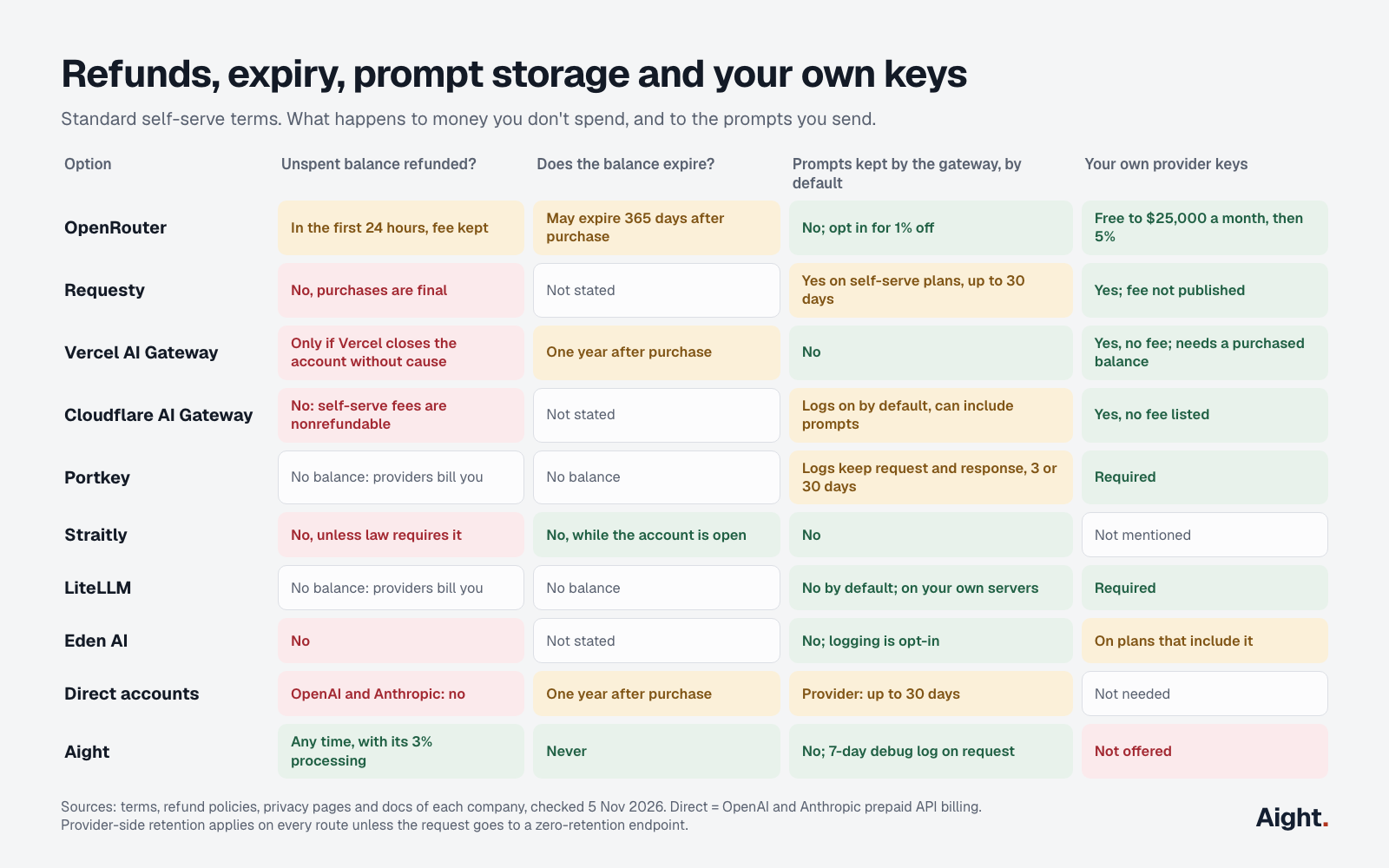
| Option | $1,000 of list-price usage costs | Unspent balance refunded? | Prompts kept by the gateway, by default | Your own provider keys | Models | Payment methods |
|---|---|---|---|---|---|---|
| OpenRouter (reference) | $1,055 | In the first 24 hours, fee kept; never for crypto | No (opt in for 1% off) | Free to $25,000 a month, then 5% | 600+ | Card, AliPay, USDC |
| Requesty | $1,050 | No, purchases are final | Yes on self-serve plans, up to 30 days | Yes, fee not published | 600+ | Card, iDEAL, UPI and five more; invoice on Enterprise |
| Vercel AI Gateway | $1,000 plus card processing | Only if Vercel closes the account without cause | No | Yes, no fee | 400+ | Card; invoice for volume deals |
| Cloudflare AI Gateway | $1,050 | No | Logs on by default, can include prompts | Yes, no fee listed | 272 in its catalog | Card only |
| Portkey | $1,000 plus plan ($0 or $49 a month) | No balance: providers bill you | Request and response logs, 3 or 30 days | Required | Whatever your keys reach | Your providers bill you |
| Straitly | $600 | No, unless law requires it | No | Not mentioned | 66 | Card (Stripe) |
| LiteLLM, self-hosted | $1,000 plus hosting | No balance | Off by default, on your servers | Required | 100+ providers | Your providers bill you |
| Eden AI | $1,055 | No | No (log retention is opt-in) | On plans that include it | About 1,000 | Card or bank transfer |
| Direct (OpenAI, Anthropic) | $1,000 | No | Provider keeps up to 30 days | Not needed | One maker each | Card; monthly invoicing for some accounts |
| Aight | $936 | Any time, with its 3% processing | No (7-day debug log on request) | Not offered | 126 from 16 makers | Card via Razorpay; UPI and bank in India |
Costs assume a card payment on the standard self-serve plan. Requesty, Cloudflare and Eden AI don't say whether a purchased balance expires. Model counts are each company's own claim; on 5 November, OpenRouter's public models API returned 454 models, and Straitly's models page showed 162 rows against 66 in its docs.
Why teams look for an OpenRouter alternative
OpenRouter's pricing page bills tokens at the provider's list price and charges its fee when you buy. Most reasons to leave come from the terms around that, not from token prices.
The fee, and its minimum
A card purchase on the Standard plan costs 5.5% extra with a $0.80 minimum, and crypto costs 5%, per the FAQ. The minimum fee is more than 5.5% on any purchase below $14.55, so a $5 purchase costs $5.80, 16% over list. The Business plan charges 8%, and it is the lowest plan with EU or US in-region routing (eu.openrouter.ai, us.openrouter.ai).
Refunds and expiry
OpenRouter's terms (section 4.1, updated 31 August 2026) allow a refund of unused balance for 24 hours after purchase. The platform fee is never refunded, crypto payments never are, and OpenRouter may expire unused balance 365 days after purchase. Section 9 refunds what's left when an account is terminated, unless OpenRouter terminated it for a terms violation, but the FAQ warns that deleting your account in settings forfeits the balance.
Where your prompts go
OpenRouter doesn't log prompts unless you opt in, which earns a 1% discount. But a request for an open-weight model can land on any of dozens of hosts, each with its own retention policy, so the zero-data-retention (ZDR) filter is the setting that matters. Two October changes affect it. From 18 October, Google requires Safety Retention for its models on Vertex AI, keeping prompts its classifiers flag for up to 90 days, so OpenRouter's ZDR guide no longer counts those endpoints as strict ZDR. From 27 October, OpenRouter screens every request, ZDR traffic included, for child sexual abuse material, and may keep flagged content.
Same model, different hosts
For open-weight models, the host matters as much as the model. Mo Moustafa, who runs an iMessage assistant on OpenRouter, pointed to OpenRouter's own per-host benchmark board on 7 September: DeepSeek V4 Flash 0731 scored 81% on TAU-Bench Airline from DeepSeek and 58% from DigitalOcean, same weights. OpenRouter's COO replied that it drops outlier hosts from default routing. Each host keeps its own prompt cache, so a fallback starts cold, and OpenRouter's Claude Code guide says it is only guaranteed with Anthropic as the provider.
Limits
Paid models have no plan-based rate limit; provider limits pass through. Free models are capped at 20 requests a minute and 50 a day, or 1,000 a day once you have bought $10, and failed attempts count. One purchase can't exceed $25,000.
Ownership
Stripe agreed to acquire OpenRouter on 19 August 2026. OpenRouter's announcement says the product, name and roadmap stay the same. Teams with vendor reviews may still need to redo them.
What $1,000 of usage costs on each
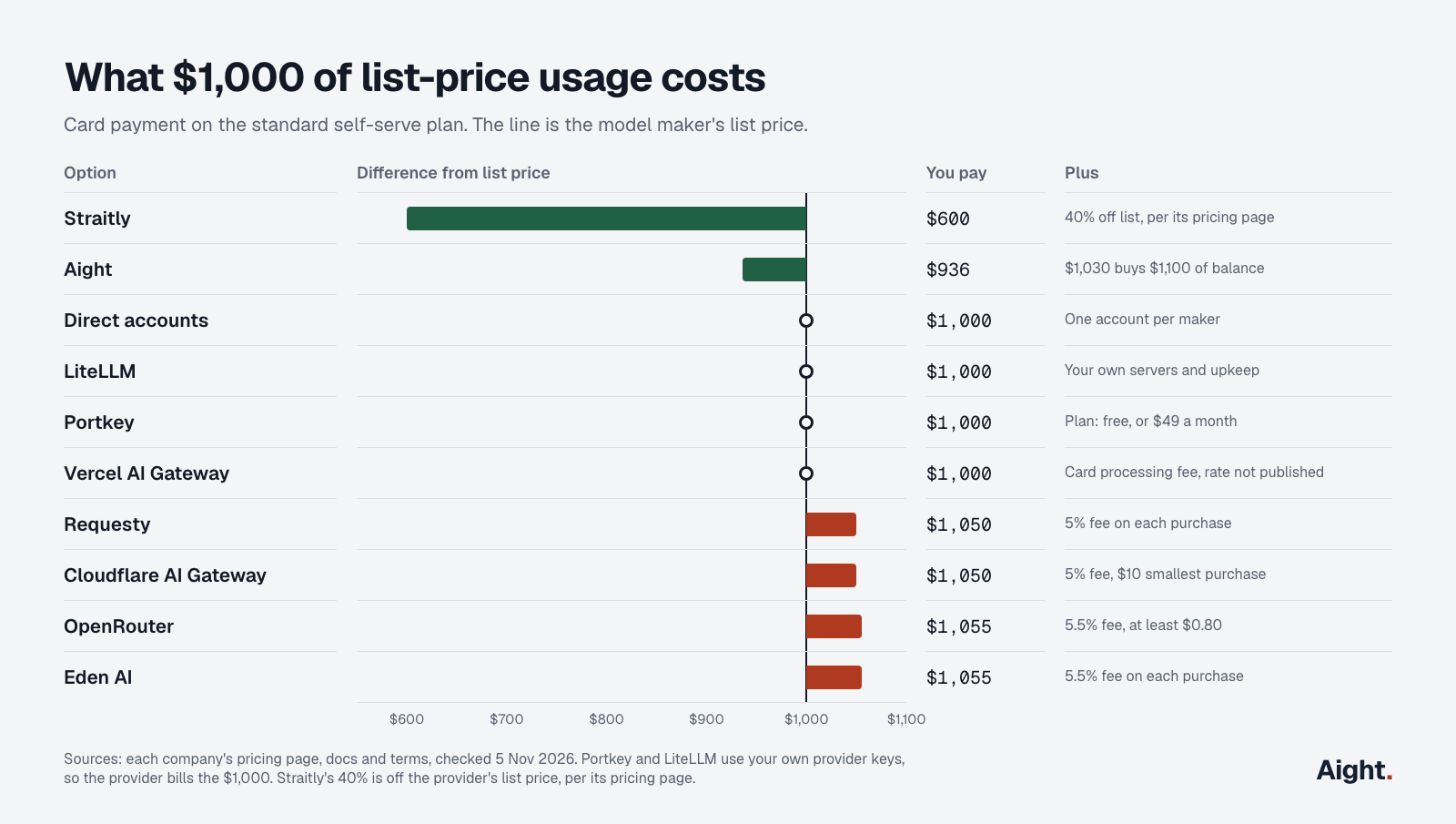
Token prices match the maker's list almost everywhere: on 5 November, Claude Sonnet 5.5 was $2.00 / $10.00 per million tokens, input / output, on OpenRouter, Requesty and Vercel, as on Anthropic's pricing page. The difference is what it costs to put money in:
- Straitly bills every model at 40% off list, per its pricing page, with no purchase fee. Claude Sonnet 5.5 is $1.20 / $6.00.
- Aight adds 10% extra to every recharge and charges 3% processing outside India, so $1,030 buys $1,100 of balance.
- Vercel adds no fee, but its pricing docs leave card processing fees to you, at an unpublished rate.
- Requesty and Cloudflare add 5%; OpenRouter and Eden AI add 5.5%.
- Portkey and LiteLLM run on your own keys, so the provider bills you. Portkey's Production plan is $49 a month for 100,000 logged requests, plus $9 per extra 100,000.
Two details move real bills. Requesty's models API listed cached Claude Sonnet 5.5 input at $0.20 per million, where Anthropic charges $0.10 for a cache hit. And batch work runs at half price direct (OpenAI's and Anthropic's Batch APIs) and on Vercel, which lists anthropic/claude-sonnet-5.5-batch at $1.00 / $5.00.
The alternatives, one by one
Requesty
A hosted router with 600+ models, a 5% purchase fee and the widest choice of payment methods here, from cards in five currencies to iDEAL, UPI and pay-by-invoice. It has an EU endpoint with data stored in Frankfurt, routing policies that pin providers, per-key spend limits, and the Anthropic Messages API for Claude Code. The catches are in its terms: all purchases are final, and prompt logging is on by default on self-serve plans, kept up to 30 days. Turn it off per key, or ask in writing for organization-wide zero retention. Suits EU teams that want OpenRouter's breadth with more routing control.
Vercel AI Gateway
No markup or platform fee on tokens, and none on your own keys, though BYOK needs a purchased balance and failed BYOK requests fall back to Vercel's keys at your expense. Vercel deletes prompts and responses once a request completes. Purchased balance expires a year after purchase and is refunded only if Vercel closes your account without cause, per its terms. It has 400+ models, an Anthropic-compatible endpoint for Claude Code and a Responses API for Codex. Suits teams already deploying on Vercel.
Cloudflare AI Gateway
The core gateway (analytics, caching, rate limiting) is free on every plan, and stored provider keys carry no listed fee. Unified Billing adds 5% to purchases of at least $10, by card only. Logs are on by default and can include prompts and responses; the cf-aig-collect-log-payload: false header keeps only metadata. Cloudflare's self-serve agreement says fees are nonrefundable. Suits teams on Workers that want a gateway in front of their own keys.
Portkey
A control plane rather than a reseller: you connect your own provider accounts and Portkey adds routing, fallbacks, guardrails, spend limits and logs. The Developer plan is free with 3-day log retention; Production is $49 a month with 30-day retention, and logs hold the full request and response. Palo Alto Networks completed its acquisition on 29 May 2026, and Portkey is now the AI gateway in Prisma AIRS. Suits companies with negotiated provider contracts and a security team that wants governance.
Straitly
The lowest per-token price here: 40% off list on Claude, GPT, Gemini and the rest, no fee on purchases from $5, and both Chat Completions and the Anthropic Messages API, with setup guides for Claude Code, Cursor and Codex. Its privacy policy says prompts and responses aren't stored. Purchases are non-refundable; the balance doesn't expire while the account is open but is forfeited if you delete it. Its terms, last updated 7 August 2026, still describe an earlier scheme (list rate, with 5% to 10% of spend returned to a separate balance) and name only Anthropic and OpenAI as providers, while its FAQ says it buys from a wider set of providers. Ask which terms govern the 40% price, and which host serves your models, before buying a large balance. Suits price-driven teams that start small.
LiteLLM, self-hosted
An open-source proxy (MIT, outside its enterprise directory) that puts 100+ providers behind an OpenAI-format endpoint on your own servers, with virtual keys, spend tracking and a /v1/messages route. Prompts stay out of its spend logs unless you set store_prompts_in_spend_logs. Version 1.108.0 shipped on 4 November. Self-hosting means owning patches: in March, PyPI releases 1.82.7 and 1.82.8 were compromised with credential-stealing code (the Docker image was not affected). Suits platform teams that want everything in their own cloud.
Eden AI
A gateway based in Lyon, France, with about 1,000 models from 80+ providers, a 5.5% fee, payment by card or bank transfer, and an EU endpoint. Request and response logs are off unless you turn them on. BYOK needs a plan that includes it, and prepaid amounts are non-refundable under section 3.3 of its terms. Suits European teams that also want OCR, speech and other non-LLM models behind one key.
Direct provider accounts
No gateway fee, the provider's own rate limits and Batch at half price. The trade is one account, key and balance per maker. OpenAI's prepaid billing starts at $5, expires after a year and is non-refundable except in narrow cases; Anthropic's purchases also expire after a year and are non-refundable. OpenAI keeps abuse-monitoring logs, which can include prompts, for up to 30 days, and Anthropic deletes API inputs and outputs within 30 days, with exceptions. Suits teams that spend most of their money with one or two makers.
Which OpenRouter alternative fits your team
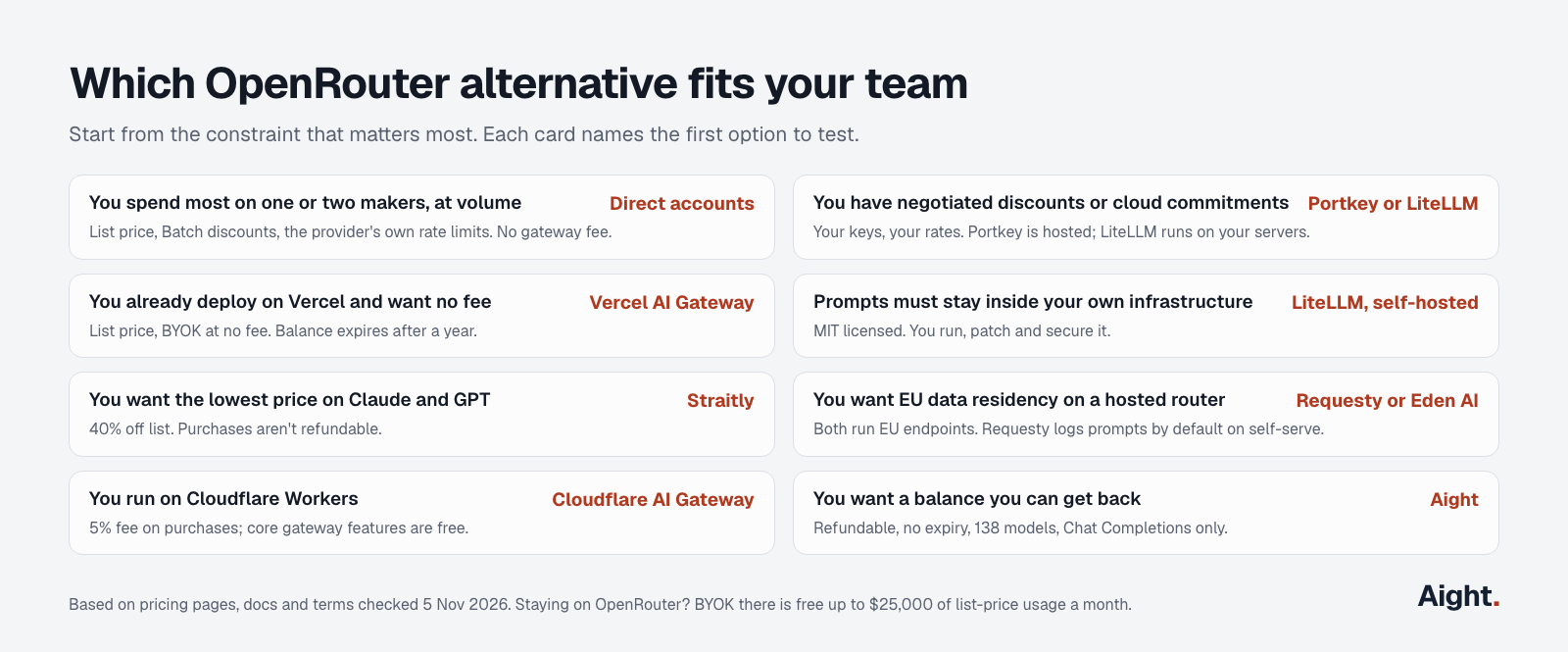
- Most of your spend goes to one or two makers: go direct for list price, Batch discounts and no fee.
- You have negotiated discounts or cloud commitments: Portkey (hosted) or LiteLLM (self-hosted) on your own keys.
- You already deploy on Vercel: Vercel AI Gateway has no fee, but its balance expires after a year.
- Prompts must stay inside your own infrastructure: self-host LiteLLM and plan time to patch it.
- The lowest per-token price on Claude and GPT matters most: test Straitly with a small purchase.
- You need EU data residency on a hosted router: compare Requesty and Eden AI, and check Requesty's logging default.
- You run on Cloudflare Workers: Cloudflare AI Gateway.
- You want a balance you can get back: Aight refunds unspent paid balance at any time.
Staying on OpenRouter is a fair answer too if you mostly need a large catalog of open-weight models: pin providers, enforce ZDR and use BYOK, free up to $25,000 a month.
How to switch from OpenRouter
Every option here accepts the OpenAI SDK, so moving is a base URL, a key and the model name:
| Option | Base URL | Model ID for Claude Sonnet 5.5 | Anthropic Messages API |
|---|---|---|---|
| OpenRouter | https://openrouter.ai/api/v1 | anthropic/claude-sonnet-5.5 | Yes |
| Requesty | https://router.requesty.ai/v1 | anthropic/claude-sonnet-5-5 | Yes |
| Vercel AI Gateway | https://ai-gateway.vercel.sh/v1 | anthropic/claude-sonnet-5.5 | Yes |
| Cloudflare AI Gateway | https://api.cloudflare.com/client/v4/accounts/<account_id>/ai/v1 | anthropic/claude-sonnet-5.5 | Through its Anthropic endpoint |
| Portkey | https://api.portkey.ai/v1 | @<your-anthropic-provider>/<model> | Yes |
| Straitly | https://api.straitly.ai/v1 | Bare IDs, e.g. claude-sonnet-5 in its docs | Yes |
| LiteLLM | http://localhost:4000 | The name in your config | Yes |
| Eden AI | https://api.edenai.run/v3 | anthropic/claude-sonnet-5-5 | Not documented |
| Aight | https://api.getaight.ai/v1 | claude-sonnet-5-5 | No, Chat Completions only |
Model IDs differ in small ways (a dot or a dash in 5.5), so copy them from each gateway's GET /v1/models list. OpenRouter-only request fields such as models (the fallback list) and provider (with order and allow_fallbacks) don't carry over; each gateway has its own routing settings.
import os
from openai import OpenAI

GATEWAYS = {
    "openrouter": ("https://openrouter.ai/api/v1", "OPENROUTER_API_KEY", "anthropic/claude-sonnet-5.5"),
    "requesty": ("https://router.requesty.ai/v1", "REQUESTY_API_KEY", "anthropic/claude-sonnet-5-5"),
    "vercel": ("https://ai-gateway.vercel.sh/v1", "AI_GATEWAY_API_KEY", "anthropic/claude-sonnet-5.5"),
}

def ask(gateway, prompt):
    base_url, key_env, model = GATEWAYS[gateway]
    client = OpenAI(base_url=base_url, api_key=os.environ[key_env])
    r = client.chat.completions.create(model=model, messages=[{"role": "user", "content": prompt}])
    return r.choices[0].message.content, r.usage

# Send the same sample of real prompts through both, then compare cost, latency and errors.
Run a slice of real traffic through the new gateway for a week before moving the rest, starting with the smallest purchase its terms allow.
Where Aight fits
Aight is one OpenAI-compatible API for 138 models from 16 makers, mostly at the maker's list price. Outside India, a $100 recharge costs $103 and adds $110 of balance, so $1,000 of list-price usage costs about $936.
Its case against OpenRouter is the terms. The balance never expires. Unspent paid balance is refundable at any time, with its 3% processing (the 10% extra isn't). Each key can carry a monthly cap, an expiry date and a list of allowed models. Prompts and outputs aren't stored unless you ask for 7-day debug logging, and the models page names where each model runs: Azure, AWS Bedrock, Google Vertex AI or Anthropic, and the region.
Where it falls short: 138 models against OpenRouter's 600+, no BYOK, no batch pricing, and a documented API limited to chat completions, embeddings and the model list, with no route documented for Claude Code or Codex CLI. Some prices sit above the maker's best rate: DeepSeek V4.1 Flash is $0.30 / $1.20 around the clock, DeepSeek's peak price and twice its off-peak price. Straitly charges less per token. Aight suits teams that want a refundable balance and per-key controls on mostly list-priced models. The aggregator price comparison has the full fee math, and one API key for every major LLM covers setup.
What developers report about OpenRouter
- "pain all the way down" is how Mo Moustafa sums up running production traffic on open models through OpenRouter (blog post, 7 Sep 2026, link).
- OpenRouter's co-founder and COO said it benchmarks live endpoints continuously and removes a provider from default routing if it strays more than a standard deviation from the median (Hacker News, 11 Sep 2026, link).
- "provider fallbacks are also expensive since you lost the prompt cache" (a Hacker News commenter, 11 Sep 2026, link).
- A Hacker News commenter recommended Requesty because it lets you pin providers and write your own routing policy (11 Sep 2026, link).
- "Just use the provider's API." (a Hacker News commenter on paying 5.5% when using only one or two providers, 27 Apr 2026, link).
FAQ
Does OpenRouter cost more than using the API directly?
Yes, for models from the big makers. OpenRouter charges the provider's list price plus 5.5% on each card purchase, so direct costs about 5% less and adds Batch pricing. For open-weight models it can come out lower: on 5 November its models API listed DeepSeek V4.1 Flash at $0.045 / $0.50, below DeepSeek's own off-peak $0.15 / $0.60, though low-priced hosts can differ in quality.
Can you get a refund from OpenRouter?
For 24 hours after a purchase, minus the platform fee, and never for crypto payments. After that, its terms refund what's left only when an account is terminated, unless OpenRouter terminated it for a terms violation.
Does OpenRouter store prompts?
Not by default: it logs request metadata, and prompt logging is opt-in for a 1% discount. The host that serves each request has its own policy, so enforce ZDR routing in your privacy settings if retention matters.
What is the difference between OpenRouter and LiteLLM?
OpenRouter is a hosted marketplace: you buy a balance and it routes to 80+ providers. LiteLLM is open-source software you run yourself, in front of your own provider keys, so there is no fee but you host, secure and update it. The AI gateway explainer covers the two models in more depth.
Is there a free OpenRouter alternative?
LiteLLM and Portkey's open-source gateway are free to self-host. Requesty's free tier allows 200 requests a day on free models, and Vercel includes a monthly free amount on a subset of models. OpenRouter itself offers 50 free-model requests a day, and the OpenRouter free usage guide explains the limits.
Sources
- OpenRouter: Pricing, FAQ, Terms of Service, Zero Data Retention guide, Claude Code guide, Model fallbacks, Provider routing, models API, OpenRouter is joining Stripe
- Stripe: Stripe agrees to acquire OpenRouter
- Requesty: Pricing, Billing docs, Bring your own keys, Data privacy, Terms of Service, docs index, models API
- Vercel: AI Gateway pricing, AI Gateway FAQ, BYOK, AI Gateway, Pro plan billing, Terms of Service, models API
- Cloudflare: Unified Billing, AI Gateway pricing, Logging, BYOK, Spend limits, Create purchase API, Model catalog, Self-Serve Subscription Agreement
- Portkey: Pricing, Logs, Universal API, gateway on GitHub; Palo Alto Networks, Completes Acquisition of Portkey
- Straitly: Home and FAQ, Pricing, Models, Quickstart, Terms of Service, Privacy Policy
- LiteLLM: GitHub repository and license, releases, security issue #24518, config settings, /v1/messages
- Eden AI: Pricing, Terms, Data retention, BYOK, First LLM call
- OpenAI: Prepaid API billing, Your data, Batch API
- Anthropic: Pricing, Paying for Claude API usage, How long Anthropic stores organization data
- DeepSeek: Models and pricing
- Mo Moustafa, So you want to use OpenRouter?
- Hacker News: discussion of that post, reply from OpenRouter's COO, comment on fallbacks and the prompt cache, comment recommending Requesty, comment on using provider APIs directly
- Aight: Models and pricing, API reference, Terms, Refund policy, Privacy
Checked on 5 November 2026. Updated 17 November 2026: Aight's current model list.