DeepSeek API pricing has two rates for every token: off-peak, and peak at exactly double. DeepSeek V4.1 Flash (deepseek-flash) costs $0.15 per million input tokens and $0.60 per million output tokens off-peak, or $0.30 / $1.20 at peak, with cache hits at $0.003 / $0.006. DeepSeek V4 Pro (deepseek-v4-pro) costs $0.66 / $1.98 off-peak and $1.32 / $3.96 at peak.
Peak runs 01:00 to 04:00 and 06:00 to 10:00 UTC on weekdays. Until 14 March 2027 that is 8 to 11 pm and 1 to 5 am Eastern, so a 9-to-5 workday anywhere in the US pays the off-peak rate.
That makes DeepSeek easy to cost out for daytime work, but it's no longer the automatic low-price pick: GPT-6 Luna and Claude Haiku 5.5 list lower input and output prices than DeepSeek's off-peak rate. All prices below are list prices in US dollars, checked on 5 November 2026.
DeepSeek API pricing, official 2026 rates per 1M tokens
DeepSeek sells two models through its API, and both use the same peak and off-peak split. From the models and pricing page:
| V4.1 Flash | V4 Pro | |
|---|---|---|
| Model name | deepseek-flash | deepseek-v4-pro |
| Version served | DeepSeek-V4.1-Flash-1017 | DeepSeek-V4-Pro-0813 |
| Input, cache hit (off-peak / peak) | $0.003 / $0.006 | $0.022 / $0.044 |
| Input, cache miss (off-peak / peak) | $0.15 / $0.30 | $0.66 / $1.32 |
| Output (off-peak / peak) | $0.60 / $1.20 | $1.98 / $3.96 |
| Context window / max output | 1M / 384K | 1M / 384K |
| Image input | Yes | No |
| Concurrency limit per account | 2,500 | 500 |
What else lands on the bill:
- Thinking is on by default at
higheffort, and reasoning tokens are billed as output insidecompletion_tokens. Turn it off for extraction or classification (thinking mode guide). - Caching is automatic, best effort and free to write; unused entries are usually cleared within hours to days (context caching). DeepSeek says
user_idisolates the cache per user, so one per end user splits a shared system prompt into separate caches. - Search and Fetch cost $0.75 per 1,000 successful requests each, including, since 16:00 UTC on 31 October, the searches DeepSeek runs server-side for Claude Code, Codex and DeepSeek Harness (Search and Fetch guide).
- There's no batch discount and no volume tier: the FAQ says "There is a unified pricing standard and no tiered plans."
Traffic spread evenly over the week hits peak in 35 of 168 hours (20.8%), so the average DeepSeek API price for V4.1 Flash works out to $0.181 per million input tokens and $0.725 per million output tokens.
Peak hours in US time zones
DeepSeek's peak windows fall on US evenings and overnight, Sunday to Thursday nights, which leaves the American working day at half price.
| Time zone | Until 13 March 2027 | From 14 March 2027 |
|---|---|---|
| Eastern | 8 to 11 pm, 1 to 5 am | 9 pm to midnight, 2 to 6 am |
| Central | 7 to 10 pm, midnight to 4 am | 8 to 11 pm, 1 to 5 am |
| Mountain | 6 to 9 pm, 11 pm to 3 am | 7 to 10 pm, midnight to 4 am |
| Arizona | 6 to 9 pm, 11 pm to 3 am | No change |
| Pacific | 5 to 8 pm, 10 pm to 2 am | 6 to 9 pm, 11 pm to 3 am |
Evening windows run Sunday to Thursday; overnight windows cover Monday to Friday mornings, starting the night before in Mountain and Pacific time.
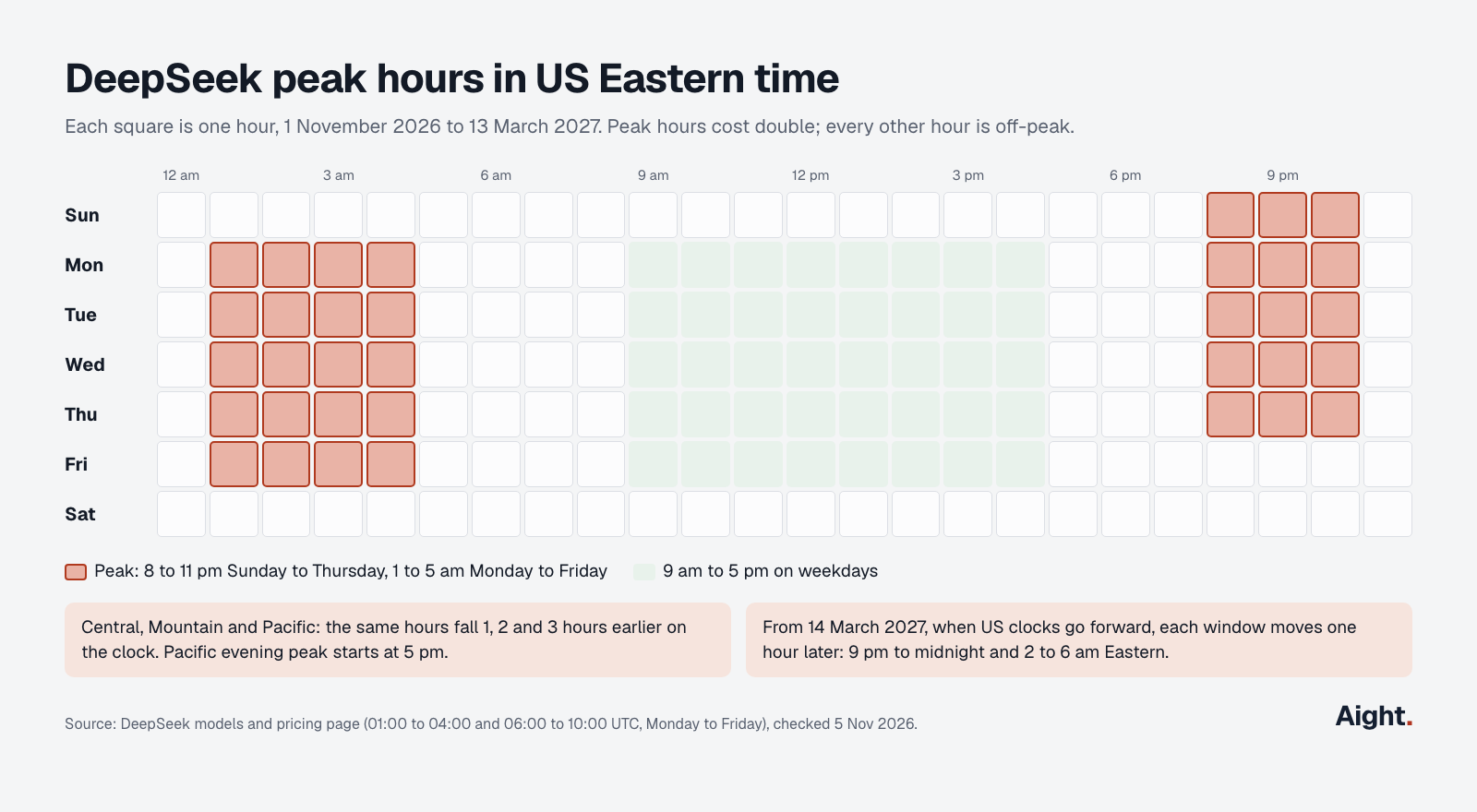
- Until 14 March, a Pacific team working past 5 pm Monday to Thursday crosses into peak.
- Sunday evening is peak in the US, because it's Monday morning in Beijing. The longest off-peak stretch, 63 hours from 5 am Friday to 8 pm Sunday Eastern, suits a weekly batch.
- Chinese public holidays are off-peak all day. China hadn't announced its 2027 holidays by 5 November; the 2026 schedule came out on 4 November 2025.
- Jobs scheduled in UTC don't drift against the windows when US clocks change.
Which model names route where
Only two names reach distinct models now, deepseek-flash and deepseek-v4-pro. Older names either reroute to V4.1 Flash or fail.
| Name you send | What serves it | Billed as |
|---|---|---|
deepseek-flash | V4.1-Flash-1017 | Flash |
deepseek-v4-flash, deepseek-v4-flash-vision-exp | V4.1-Flash-1017 (the old models retired on 10 September) | Flash |
deepseek-v4-pro | V4-Pro-0813 | V4 Pro |
deepseek-chat, deepseek-reasoner | Nothing: retired at 15:59 UTC on 24 July 2026 | |
claude-opus-* (Anthropic format) | V4-Pro-0813 | V4 Pro |
Other claude-* names (Anthropic format) | V4.1-Flash-1017 | Flash |
| Any other name (Anthropic format) | A 400 error |
The base URL is https://api.deepseek.com for OpenAI-format requests, including the Responses API, and https://api.deepseek.com/anthropic for Anthropic-format requests (Anthropic API guide).
Two of these cost money if you miss them. In Claude Code pointed at DeepSeek, anything that asks for Opus runs on V4 Pro at 4.4 times Flash's input price; DeepSeek's own Claude Code setup avoids that by setting every model variable to deepseek-flash. And DeepSeek's 10 September announcement still says V4 Pro requests reroute to Flash, but the change log and pricing page say Pro stayed, billed at its own price. On the Responses API, the web_search tool works only with deepseek-v4-pro (Responses API guide).
How DeepSeek pricing changed in 2026
DeepSeek pricing changed three times this year: higher rates with a peak split on 16 August, a lower Flash price with V4.1 on 10 September, and Search and Fetch fees from 17 October.
| Date | Flash: hit / miss / output | V4 Pro: hit / miss / output |
|---|---|---|
| 2 June 2026 (archived copy) | $0.0028 / $0.14 / $0.28, all day | $0.003625 / $0.435 / $0.87, all day |
| 16 August, 16:00 UTC | $0.007 / $0.22 / $0.66 off-peak, double at peak | $0.022 / $0.66 / $1.98 off-peak, double at peak |
| 10 September, 04:00 UTC | $0.003 / $0.15 / $0.60 off-peak (V4.1 Flash) | Unchanged |
| 17 October | Unchanged for the 1017 build | Unchanged |
The figures come from Wayback Machine copies of the pricing page on 2 June, 28 August and 15 September, and DeepSeek's change log.
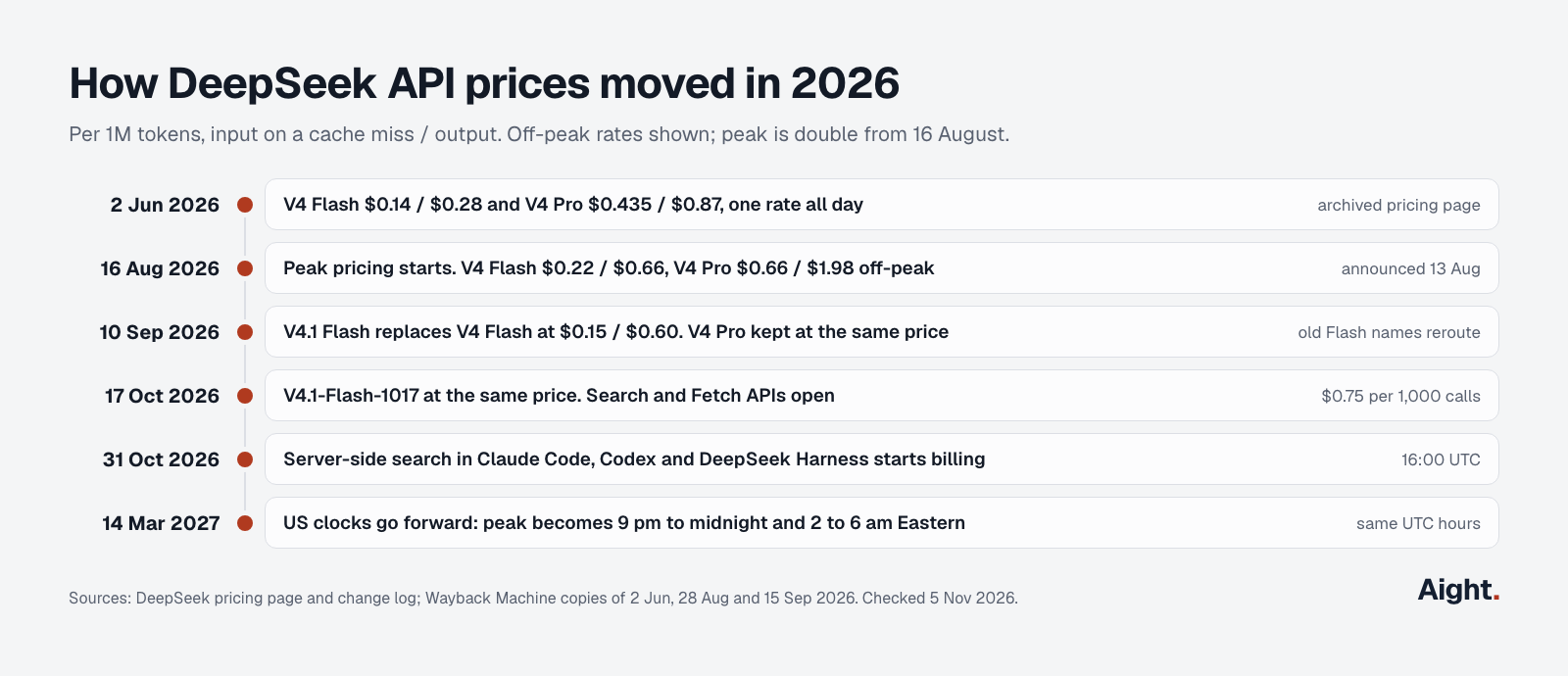
Off-peak Flash output still costs over twice what it did in June, and V4 Pro output 2.3 times as much off-peak, 4.6 times at peak. DeepSeek published the August prices on 13 August, three days before they took effect, and its terms let it adjust fees as its business requires, so plan for days of warning, not months.
What a US company pays, and how
A US company pays the US dollar list prices above out of a prepaid balance, funded by card or PayPal.
- DeepSeek's FAQ lists PayPal, bank card, Alipay and WeChat Pay. Its Chinese-language FAQ opens corporate bank transfer only to enterprise accounts registered with a +86 (China) phone number.
- Requests stop with a 402 "Insufficient Balance" error when the balance runs out (error codes). The balance doesn't expire, and any balance DeepSeek grants you is spent first.
- Unused balance is refundable from the Billing page, where invoices are also issued. The terms say a refund covers everything left, in one lump sum, after handling fees.
- Concurrency is counted per account, so extra keys don't add capacity; going over returns a 429, and DeepSeek raises the limit free on request (rate limits).
- Usage per key can be exported, but the docs describe no per-key spending cap; the prepaid balance is the ceiling.
- A signed agreement is available on request, as a standard framework agreement that can't be modified.
Data location, terms and the federal order
DeepSeek's own API runs under Chinese law and stores account data in China. If that rules it out, Microsoft Azure sells the same models with processing kept in the US, at a flat rate above DeepSeek's peak.
- DeepSeek's privacy policy, updated 10 February 2026, says it collects, processes and stores personal data in the People's Republic of China, and treats your company as the controller of your end users' data.
- The Open Platform terms, effective 29 April 2026, are governed by the law of mainland China, with disputes heard by a court where Hangzhou DeepSeek is registered. Liability is capped at the fees you paid over the previous 12 months, and outputs are assigned to you.
- On 20 October 2026 the Department of Homeland Security published an order excluding DeepSeek products from federal civilian purchasing and removing them, along with "third-party products and services developed using DeepSeek implementations", from agency systems. Haynes Boone notes that it reaches contractors through FAR 52.204-30, and that it neither defines a DeepSeek implementation nor says whether a model on a US cloud counts. If you sell to federal civilian agencies, ask counsel before building on any DeepSeek model.
The US-hosted route, from Azure's retail price list on 5 November, per 1M tokens:
| Route | V4.1 Flash: input / output / cached | V4 Pro: input / output / cached |
|---|---|---|
| DeepSeek direct, off-peak | $0.15 / $0.60 / $0.003 | $0.66 / $1.98 / $0.022 |
| DeepSeek direct, peak | $0.30 / $1.20 / $0.006 | $1.32 / $3.96 / $0.044 |
| Azure Global, all hours | $0.30 / $1.20 / $0.006 | $1.74 / $3.48 / $0.145 |
| Azure US Data Zone, all hours | $0.33 / $1.32 / $0.0066 | $1.91 / $3.83 / $0.16 |
A Global deployment may process requests in any Azure region; a US Data Zone deployment keeps processing inside the US (deployment types). Microsoft says prompts and outputs of the models it sells aren't available to the model's maker or used to train it (data privacy). Azure has no off-peak rate, so daytime US traffic on the US Data Zone costs 2.2 times DeepSeek direct. Microsoft's model list, updated 29 October, doesn't show V4.1 Flash yet though its price meters exist, so confirm it's offered in your region. Amazon Bedrock's US East price list (2 November) has no V4 model, only DeepSeek V3.1, V3.2 and R1.
Monthly cost: DeepSeek vs GPT-6 Luna, Gemini Flash and Claude Haiku
For daytime US traffic, DeepSeek V4.1 Flash costs about the same as GPT-6 Luna and Claude Haiku 5.5, and a fraction of Gemini 3.8 Flash. It costs less than Luna only when most of the input is cached, and less than Haiku when prompts pass 100,000 tokens.
The workloads, per month:
- A support chatbot: 300,000 requests of 4,000 input tokens with 70% cache hits, and 400 output tokens including reasoning, the same traffic as the chatbot in how much an LLM API costs per month.
- A coding agent: 66,000 calls of 50,000 input tokens with 90% cache hits, and 1,500 output tokens.
- Long-document review: 10,000 documents of 150,000 tokens with nothing reused, and 2,000 output tokens.
GPT-6 Luna is $0.10 / $0.50 with cache hits at $0.01, and by default writes uncached input to its cache at $0.125 (OpenAI pricing). Claude Haiku 5.5 has the same prices with caching turned on, rising to $0.50 / $2.50 for prompts over 100,000 tokens (Anthropic pricing). Gemini 3.8 Flash is $0.75 / $3.75 with cached input at $0.075 until 31 December, then double (Gemini API pricing).
| Model and route | Support chatbot | Coding agent | Long-document review |
|---|---|---|---|
| DeepSeek V4.1 Flash, off-peak | $128.52 | $117.81 | $237.00 |
| DeepSeek V4.1 Flash, peak | $257.04 | $235.62 | $474.00 |
| DeepSeek V4 Pro, off-peak | $493.68 | $479.16 | $1,029.60 |
| V4.1 Flash on Azure, US Data Zone | $282.74 | $259.18 | $521.40 |
| GPT-6 Luna | $113.40 | $120.45 | $197.50 |
| Claude Haiku 5.5 | $113.40 | $120.45 | $800.00 |
| Gemini 3.8 Flash, to 31 December | $1,350.00 | $841.50 | $1,200.00 |
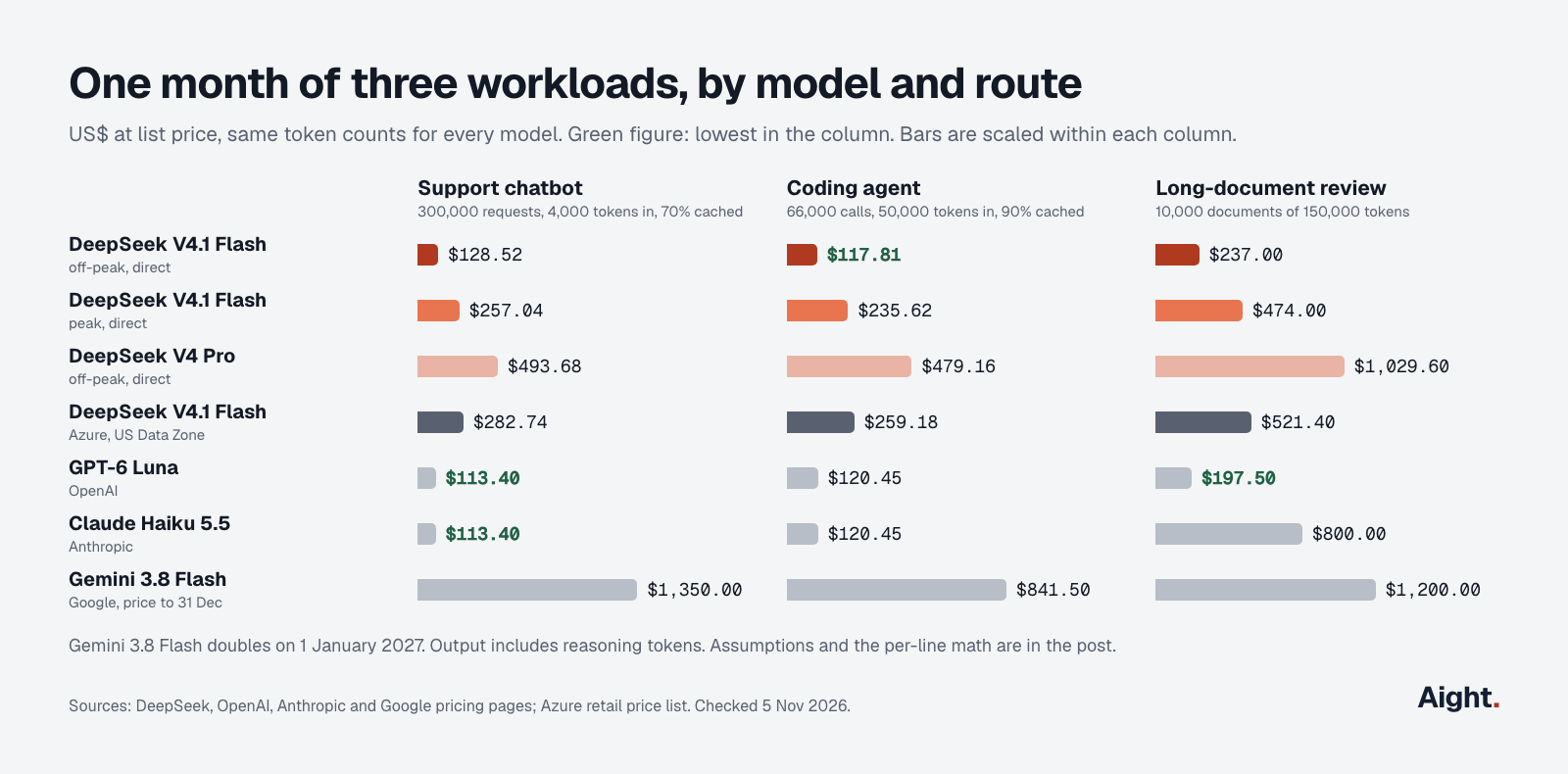
Why the order changes from column to column:
- On the chatbot, DeepSeek's off-peak input ($0.15) and output ($0.60) cost more than Luna's cache writes ($0.125) and output ($0.50), so it comes out $15.12 higher. On the agent, 90% of input is cache hits, priced at $0.003 against Luna's $0.01, and DeepSeek edges ahead.
- Long prompts reorder everything. Haiku 5.5 switches to its higher rate above 100,000 tokens, Luna's long-context rate starts at 272,000, and DeepSeek charges the same up to 1M. On Luna, explicit cache mode with no breakpoint skips the write charge: $160.00.
- Time of day doubles DeepSeek's line. Run the coding agent at 1 am Eastern and the month is $235.62.
- Gemini 3.8 Flash's implicit cache needs requests of at least 4,096 tokens, so the chatbot gets no hits there; even at 70% hits it would cost $783.00. From 1 January every Gemini figure doubles.
- Tokenizers differ (DeepSeek estimates 0.3 tokens per English character, per its token usage page), so measure your own prompts before trusting a comparison to the dollar.
V4 Pro costs about four times as much as Flash on every workload; the V4 Pro vs V4.1 Flash comparison explains why few teams need it.
Price per token vs price per finished task
A model that fails more often, or writes more tokens per task, costs more per finished job than its token price suggests. Vals AI publishes the cost of each attempt:
| Model | Terminal-Bench 2.1 pass rate | Cost per attempt | Terminal-Bench 4.0 pass rate | Cost per attempt | Cost per passing task, 4.0 |
|---|---|---|---|---|---|
| DeepSeek V4.1 Flash | 74.5% (September build) | $0.10 | 31.8% (1017 build) | $0.54 | $1.70 |
| GPT-6 Luna | 73.0% | $0.03 | 13.6% | $0.35 | $2.57 |
| Claude Haiku 5.5 | Not run | 36.4% | $3.12 | $8.58 | |
| Gemini 3.8 Flash | 81.3% | $1.54 | 19.7% | $8.65 | $43.91 |
| DeepSeek V4 Pro | 54.7% | $0.20 | 14.1% | $3.31 | $23.41 |
On the everyday terminal tasks of Terminal-Bench 2.1 (updated 1 October), GPT-6 Luna nearly matched V4.1 Flash's pass rate at under a third of the cost per attempt. On the long, hard tasks of Terminal-Bench 4.0 (updated 29 October), V4.1 Flash had the lowest cost per passing task of the five by a wide margin. Vals doesn't state whether it priced DeepSeek at peak or off-peak rates. Route routine work by token price and hard agent work by cost per pass; Claude alternatives for coding applies the method to larger models.
For a hands-on run with the bill shown:
Check the rate on every request
The usage block gives the token counts and the clock gives the multiplier. This prices a request and finds the next off-peak hour for a job that can wait:
from datetime import date, datetime, timedelta, timezone

# Off-peak list prices, US$ per 1M tokens, checked 5 Nov 2026. Peak is double.
OFF_PEAK = {
    "deepseek-flash":  {"hit": 0.003, "miss": 0.15, "out": 0.60},
    "deepseek-v4-pro": {"hit": 0.022, "miss": 0.66, "out": 1.98},
}
PEAK_HOURS_UTC = [(1, 4), (6, 10)]   # Monday to Friday
CN_HOLIDAYS: set[date] = set()       # add China's 2027 public holidays once published


def is_peak(t: datetime) -> bool:
    t = t.astimezone(timezone.utc)
    # Peak is 09:00-18:00 Beijing time, so the UTC date and weekday match Beijing's.
    if t.weekday() >= 5 or t.date() in CN_HOLIDAYS:
        return False
    return any(start <= t.hour < end for start, end in PEAK_HOURS_UTC)


def next_off_peak(t: datetime) -> datetime:
    t = t.astimezone(timezone.utc)
    if not is_peak(t):
        return t
    t = t.replace(minute=0, second=0, microsecond=0)
    while is_peak(t):
        t += timedelta(hours=1)
    return t


def request_cost(model: str, usage, sent_at: datetime) -> float:
    p = OFF_PEAK[model]
    hits = usage.prompt_tokens_details.cached_tokens  # same as prompt_cache_hit_tokens
    misses = usage.prompt_tokens - hits
    cost = (hits * p["hit"] + misses * p["miss"] + usage.completion_tokens * p["out"]) / 1e6
    return cost * (2 if is_peak(sent_at) else 1)
With the OpenAI Python SDK (3.45.0, released 4 November):
import os
from openai import OpenAI

client = OpenAI(base_url="https://api.deepseek.com", api_key=os.environ["DEEPSEEK_API_KEY"])
sent_at = datetime.now(timezone.utc)
r = client.chat.completions.create(
    model="deepseek-flash",
    messages=[{"role": "user", "content": "Label this ticket: refund request for order 1182"}],
    extra_body={"thinking": {"type": "disabled"}},  # no reasoning tokens to pay for
)
print(f"${request_cost('deepseek-flash', r.usage, sent_at):.6f}")
For one coding-agent call with 50,000 input tokens (45,000 cached) and 1,500 output tokens, request_cost returns $0.001785 at noon Eastern on a Tuesday and $0.003570 at 1 am, and next_off_peak moves the 1 am job to 5 am. Times 66,000 calls, that's the $117.81 and $235.62 above. The pricing page doesn't say which rate applies to a request that straddles a boundary, so keep jobs clear of the edges.
What developers report about the bill
- "peak hours are work hours in China, night in the US and Europe" (a Hacker News commenter on DeepSeek's pricing update, 14 Aug 2026, link)
- A Hacker News commenter who paid in $21.20 in early September still had balance left in October: "Their off-peak reduced token cost truly is amazing." (9 Oct 2026, link)
- "DeepSeek Flash is fine when run via DeepSeek." The same commenter found the model far worse through two third-party hosts, even with exact routing set (Hacker News, 27 Oct 2026, link)
- A Hacker News commenter put DeepSeek's own cache hit rate above 99%, against up to 98% on a third-party host, and said the gap can double or triple the cost of long tasks (2 Oct 2026, link)
- DeepSeek reports "overall revenue of US$38 per GPU-hour (at the off-peak price)" on a cluster serving 155 trillion tokens a day (DeepInfer documentation, October 2026, link)
DeepSeek through Aight
Aight serves DeepSeek V4.1 Flash and V4 Pro from Microsoft Azure's Global deployment at Azure's rates, around the clock: V4.1 Flash at $0.30 / $1.20 with cached input at $0.006, V4 Pro at $1.74 / $3.48 with cached input at $0.145 (models page). For Flash that's DeepSeek's peak price, so for US daytime traffic DeepSeek direct costs about half. Even with the 10% extra on every recharge, net of the 3% processing fee, the chatbot above comes to about $240.68 a month through Aight against $128.52 direct.
The models page lists a 1M-token context window for V4.1 Flash but 128K for V4 Pro, so the 150,000-token document job runs on Flash only; send V4 Pro prompts that long direct.
Aight fits when you want DeepSeek on Azure rather than DeepSeek's servers, on the same key and US dollar balance as GPT-6 Luna and Claude, with a monthly cap and an allowed-model list per key. GPT-6 Luna is at OpenAI's list price there, about $106.18 for the chatbot. Global means Azure may process a request in any region; for US-only processing, deploy on Azure's US Data Zone yourself.
FAQ
Is the DeepSeek API free?
No. It's prepaid, and requests fail with a 402 error once the balance is empty. The pricing page lists no free tier, though any balance DeepSeek grants you is used before the balance you paid for.
Does DeepSeek charge for thinking tokens?
Yes, at the output price, counted in completion_tokens. Thinking is on by default at high effort; set reasoning_effort to low, or turn thinking off, for simple tasks.
Does the DeepSeek API cost less than OpenAI's?
Not per token against GPT-6 Luna, at $0.10 / $0.50 against DeepSeek's $0.15 / $0.60 off-peak. DeepSeek costs less on cache-heavy agent work and per passing task on hard benchmarks. Every larger OpenAI model, from GPT-6.1 Terra at $1 / $5 up, costs more than V4.1 Flash even at peak; OpenAI API alternatives compares more options.
Is there a DeepSeek batch discount?
No. DeepSeek's docs list no batch API, and off-peak hours play that role: anything that can wait for the US daytime or the weekend runs at half price. OpenAI's Batch API halves prices instead, putting GPT-6 Luna at $0.05 / $0.25.
Can a US company use the DeepSeek API?
The 20 October DHS order covers federal civilian agencies' purchases and systems, and their contractors through FAR 52.204-30; it doesn't regulate private use. For everyone else the questions are account data stored in China and Chinese law in the terms. Azure's US Data Zone runs the same models inside the US at a higher, flat price.
Sources
- DeepSeek: Models and pricing, Change log, news posts for 24 April, 13 August, 10 September and 17 October
- DeepSeek guides: Thinking mode, Context caching, Search and Fetch, Anthropic API, Responses API, Claude Code, Rate limits, Token usage, Error codes, Create chat completion
- DeepSeek: FAQ, Open Platform terms of service, Privacy policy, DeepInfer deployment notes
- Internet Archive: DeepSeek pricing page on 2 June, 28 August and 15 September 2026
- OpenAI: Pricing, GPT-6 Luna, Prompt caching, openai on PyPI
- Anthropic: Pricing, Prompt caching
- Google: Gemini API pricing, Context caching
- Microsoft: Azure Retail Prices API (product "Azure Deepseek Models"), Foundry Models sold by Azure, Deployment types, Data, privacy and security for models sold by Azure
- Amazon Web Services: Bedrock price list, US East (N. Virginia)
- US Department of Homeland Security: Federal Register notice 2026-21447
- Haynes Boone: DHS issues DeepSeek exclusion and removal order; TechCrunch: US orders federal agencies to remove China's DeepSeek AI
- Vals AI: Terminal-Bench 2.1, Terminal-Bench 4.0
- Hacker News threads: 14 August, 2 October, 9 October, 27 October
- Xinhua: China's 2026 public holiday schedule
- Aight: Models and pricing, Refund policy
Checked on 5 November 2026. Updated 17 November 2026: Aight's current model list.