The main alternatives to OpenAI API are Anthropic's Claude, Google's Gemini, xAI's Grok, DeepSeek, Mistral and Moonshot's Kimi, plus open-weight models such as gpt-oss-120b on Groq, Together or Fireworks, and gateways such as OpenRouter that resell many of them. All of them accept the OpenAI SDK: change base_url, the API key and the model name, and a basic chat completion works. What differs is the price of a job, from $0.65 to $26.00 for the same 1,000 requests, and what stops working once you use more than basic chat.
Every price below was checked on the provider's own page on 5 November 2026. The sections cover the cost of one standard job on each, the code that switches between them, the features each compatibility layer drops, and which one fits which workload.
Alternatives to OpenAI API at a glance
The cost column is one standard job: 1,000 requests with 4,000 input tokens and 500 output tokens each, at list price, with no caching or Batch discount.
| Provider | Model to try first | Price per 1M tokens, in / out | 1,000 requests | OpenAI-compatible base URL |
|---|---|---|---|---|
| OpenAI (baseline) | gpt-6.1-sol | $2.00 / $10.00 | $13.00 | https://api.openai.com/v1 |
| OpenAI (baseline) | gpt-6.1-terra | $1.00 / $5.00 | $6.50 | same |
| OpenAI (baseline) | gpt-6-luna | $0.10 / $0.50 | $0.65 | same |
| Anthropic | claude-opus-5-5 | $4.00 / $20.00 | $26.00 | https://api.anthropic.com/v1/ |
| Anthropic | claude-sonnet-5-5 | $2.00 / $10.00 | $13.00 | same |
| Anthropic | claude-haiku-5-5 | $0.10 / $0.50 | $0.65 | same |
| gemini-3.8-flash | $0.75 / $3.75 to 31 Dec | $4.88 | https://generativelanguage.googleapis.com/v1beta/openai/ | |
| gemini-4-argon | $2.00 / $10.00 to 30 Nov | $13.00 | same | |
| xAI | grok-4.7 | $2.00 / $6.00 | $11.00 | https://api.x.ai/v1 |
| DeepSeek | deepseek-flash (V4.1 Flash) | $0.30 / $1.20, half off-peak | $1.80, or $0.90 | https://api.deepseek.com |
| Mistral | mistral-large-4 | $0.70 / $2.10 | $3.85 | https://api.mistral.ai/v1 |
| Moonshot | kimi-k3.1-pro | $2.00 / $10.00 | $13.00 | https://api.moonshot.ai/v1 |
| Groq, Together, Fireworks | gpt-oss-120b | $0.15 / $0.60 | $0.90 | see the code below |
| OpenRouter | any of the above | list price, plus 5.5% when you pay | +5.5% | https://openrouter.ai/api/v1 |
Two prices change soon. Google's Gemini 4 Argon doubles to $4.00 / $20.00 on 1 December, which takes the standard job to $26.00, and Gemini 3.8 Flash doubles to $1.50 / $7.50 on 1 January 2027, or $9.75 a job. Google announced Gemini 4 Carbon on 28 October at the same $2 / $10 introductory price, but it isn't open to developers yet.
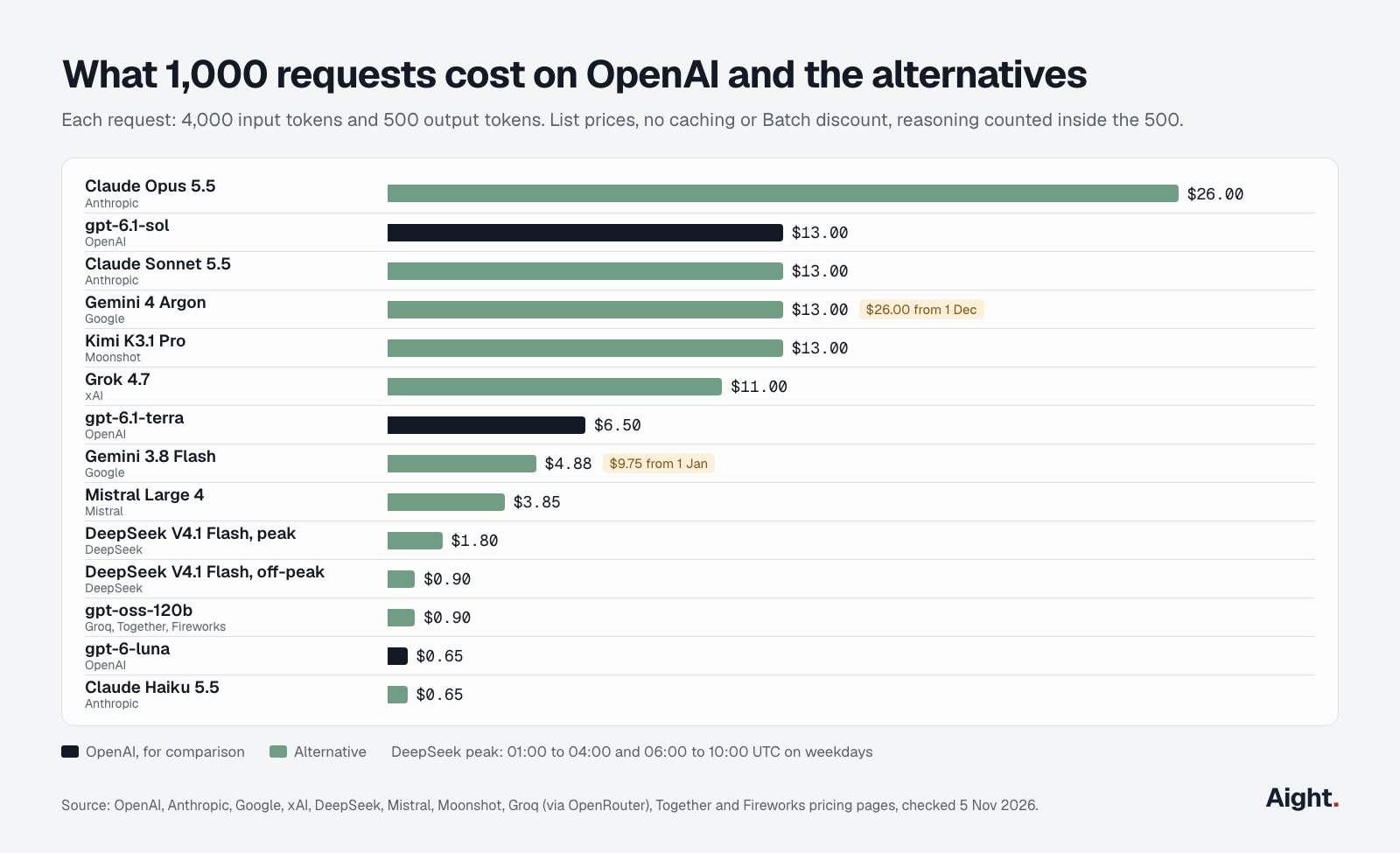
What one job really costs
The table above is token arithmetic: 4,000 × the input price plus 500 × the output price, per million tokens, times 1,000 requests. Three things move the real bill away from it.
- Reasoning tokens are billed as output, and several alternatives think by default. Claude 5 models think by default even through Anthropic's compatibility layer, DeepSeek runs at
higheffort unless told otherwise, Kimi K3.1 Pro defaults tomax, and Google says thinking can't be turned off on Gemini 3 models. Treat the 500 output tokens in the job above as a floor. - Cached input changes the input side. DeepSeek V4.1 Flash bills a cache hit at $0.006 per million at peak, about 2% of its input price, while Anthropic's OpenAI-compatible endpoint doesn't support prompt caching at all.
- Long prompts reprice the whole request. Grok 4.7 goes to $4.00 / $12.00 once a prompt reaches 200,000 tokens, and Claude Haiku 5.5 goes to $0.50 / $2.50 above 100,000.
To see the effect of the first point, look at what a whole task costs when the model thinks as much as it wants. Artificial Analysis runs every model through the same evaluations and publishes its Intelligence Index with the cost of one task at the maker's prices:
| Model (effort setting) | Intelligence Index | Cost per task |
|---|---|---|
| Claude Opus 5.5 (high) | 52 | $3.46 |
| GPT-6.1 Sol (high) | 50 | $0.59 |
| Gemini 4 Argon (high) | 50 | $7.68 |
| Kimi K3.1 Pro | 46 | $3.68 |
| Claude Sonnet 5.5 (high) | 42 | $1.64 |
| GPT-6.1 Terra (high) | 42 | $0.26 |
| Grok 4.7 (high) | 35 | $6.18 |
| Gemini 3.8 Flash (high) | 31 | $7.77 |
| Claude Haiku 5.5 (high) | 30 | $0.16 |
| DeepSeek V4.1 Flash (high) | 29 | $0.46 |
| Mistral Large 4 (high) | 26 | $2.06 |
| GPT-6 Luna (high) | 21 | $0.07 |
Gemini 3.8 Flash is the clearest warning. Artificial Analysis prices it at $0.75 / $3.75, under 40% of Claude Sonnet 5.5's token prices, yet one task cost $7.77 against Sonnet's $1.64, because it spends far more tokens. The other lesson is less comfortable for this post: on this measure, OpenAI's own GPT-6.1 Sol and Terra are hard to beat. If cost is the only reason to leave, try a smaller OpenAI model first, as the cheapest way to use the OpenAI API explains.
Among the alternatives, Claude Haiku 5.5 and DeepSeek V4.1 Flash stand out on cost per task, Claude Opus 5.5 on the hardest work (it scores 59 at max effort, for $10.04 a task), and Kimi K3.1 Pro is the highest-scoring open-weight model on the board.
How much code changes when you switch
For a basic chat call, three values: the base URL, the key and the model name. This works with the OpenAI Python SDK 3.45.0 (released 4 November), and every base URL comes from the provider's own docs:
import os
from openai import OpenAI

# provider: (base_url, key variable, model, extra fields). Checked 5 Nov 2026.
PROVIDERS = {
    "openai":     ("https://api.openai.com/v1", "OPENAI_API_KEY", "gpt-6.1-terra", {}),
    "anthropic":  ("https://api.anthropic.com/v1/", "ANTHROPIC_API_KEY", "claude-sonnet-5-5", {}),
    "gemini":     ("https://generativelanguage.googleapis.com/v1beta/openai/", "GEMINI_API_KEY",
                   "gemini-3.8-flash", {"reasoning_effort": "low"}),
    "xai":        ("https://api.x.ai/v1", "XAI_API_KEY", "grok-4.7", {}),
    "deepseek":   ("https://api.deepseek.com", "DEEPSEEK_API_KEY", "deepseek-flash", {}),
    "mistral":    ("https://api.mistral.ai/v1", "MISTRAL_API_KEY", "mistral-large-4", {}),
    "moonshot":   ("https://api.moonshot.ai/v1", "MOONSHOT_API_KEY", "kimi-k3.1-pro",
                   {"reasoning_effort": "low"}),  # default is max
    "groq":       ("https://api.groq.com/openai/v1", "GROQ_API_KEY", "openai/gpt-oss-120b", {}),
    "together":   ("https://api.together.ai/v1", "TOGETHER_API_KEY", "openai/gpt-oss-120b", {}),
    "fireworks":  ("https://api.fireworks.ai/inference/v1", "FIREWORKS_API_KEY",
                   "accounts/fireworks/models/gpt-oss-120b", {}),
    "openrouter": ("https://openrouter.ai/api/v1", "OPENROUTER_API_KEY", "anthropic/claude-sonnet-5.5", {}),
    "aight":      ("https://api.getaight.ai/v1", "AIGHT_API_KEY", "claude-sonnet-5-5", {}),
}

# US$ per 1M tokens, input / output, from each pricing page on 5 Nov 2026
PRICES = {"openai": (1.00, 5.00), "anthropic": (2.00, 10.00), "deepseek": (0.30, 1.20)}


def ask(provider, messages, **client_options):
    base_url, key_var, model, extra = PROVIDERS[provider]
    client = OpenAI(base_url=base_url, api_key=os.environ[key_var], **client_options)
    return client.chat.completions.create(model=model, messages=messages, **extra)


def cost(provider, usage):
    price_in, price_out = PRICES[provider]
    return (usage.prompt_tokens * price_in + usage.completion_tokens * price_out) / 1e6


r = ask("deepseek", [{"role": "user", "content": "Summarize: the invoice was paid twice."}])
print(r.choices[0].message.content)
print(f"${cost('deepseek', r.usage):.6f}")  # overstates a little: cache hits cost less
Each URL above was checked against the SDK with a mocked HTTP transport: every client posts to <base_url>/chat/completions, which matches each provider's documented endpoint. The SDK also reads OPENAI_BASE_URL and OPENAI_API_KEY from the environment, so code that never sets them can be switched without editing a line.
If your code calls client.responses.create, the move is bigger. xAI, DeepSeek, Moonshot, Together, Fireworks and OpenRouter accept the Responses API, and Mistral has it in public preview. Anthropic's and Google's compatibility docs cover Chat Completions only. OpenAI itself says Chat Completions "remains supported", but GPT-6.1 Sol and Terra need the Responses API for tool calling. The plain guide to the OpenAI API covers both APIs from the OpenAI side.
For xAI, the Responses API is the one to use. Its docs call Chat Completions a legacy endpoint, and the same OpenAI client works:
import os
from openai import OpenAI

client = OpenAI(base_url="https://api.x.ai/v1", api_key=os.environ["XAI_API_KEY"],
                timeout=3600)  # xAI's example allows an hour for reasoning models
r = client.responses.create(model="grok-4.7", input="Classify this ticket: refund not received.",
                            store=False)  # xAI keeps responses for 30 days by default
print(r.output_text)
What breaks beyond basic chat
The compatibility layers accept the same request shape but not the same fields. This is what each provider's own documentation says, and the first thing that tends to fail:
| Provider | Status of its OpenAI-compatible chat | Responses API | Batch discount | First thing that breaks |
|---|---|---|---|---|
| Anthropic | Mainly for testing; "not considered" production-ready | No | 50% (native API) | temperature below 1 returns 400 on Claude 4.7 and later |
| Beta | Not documented | 50% | Thinking can't be turned off on Gemini 3 models | |
| xAI | Legacy | Yes, recommended | 20% | No reasoning content returned on Chat Completions |
| DeepSeek | Supported | Yes | None; off-peak is half price | Thinking is on by default; temperature is ignored while thinking |
| Mistral | Supported | Public preview | 50% | mistral-large-latest still points at Large 3, deprecated on 31 Oct |
| Moonshot | Supported | Yes | 40% | reasoning_effort defaults to max; sampling fields are fixed |
| Together | Supported | Yes | Up to 50% (own batch API) | Model IDs are namespaced; the cached-token field moves by model |
| Fireworks | Supported | Yes | 50% | max_tokens is quietly trimmed to fit the context window |
| Groq | Supported | Not checked | Not checked | Unsupported fields return 400 |
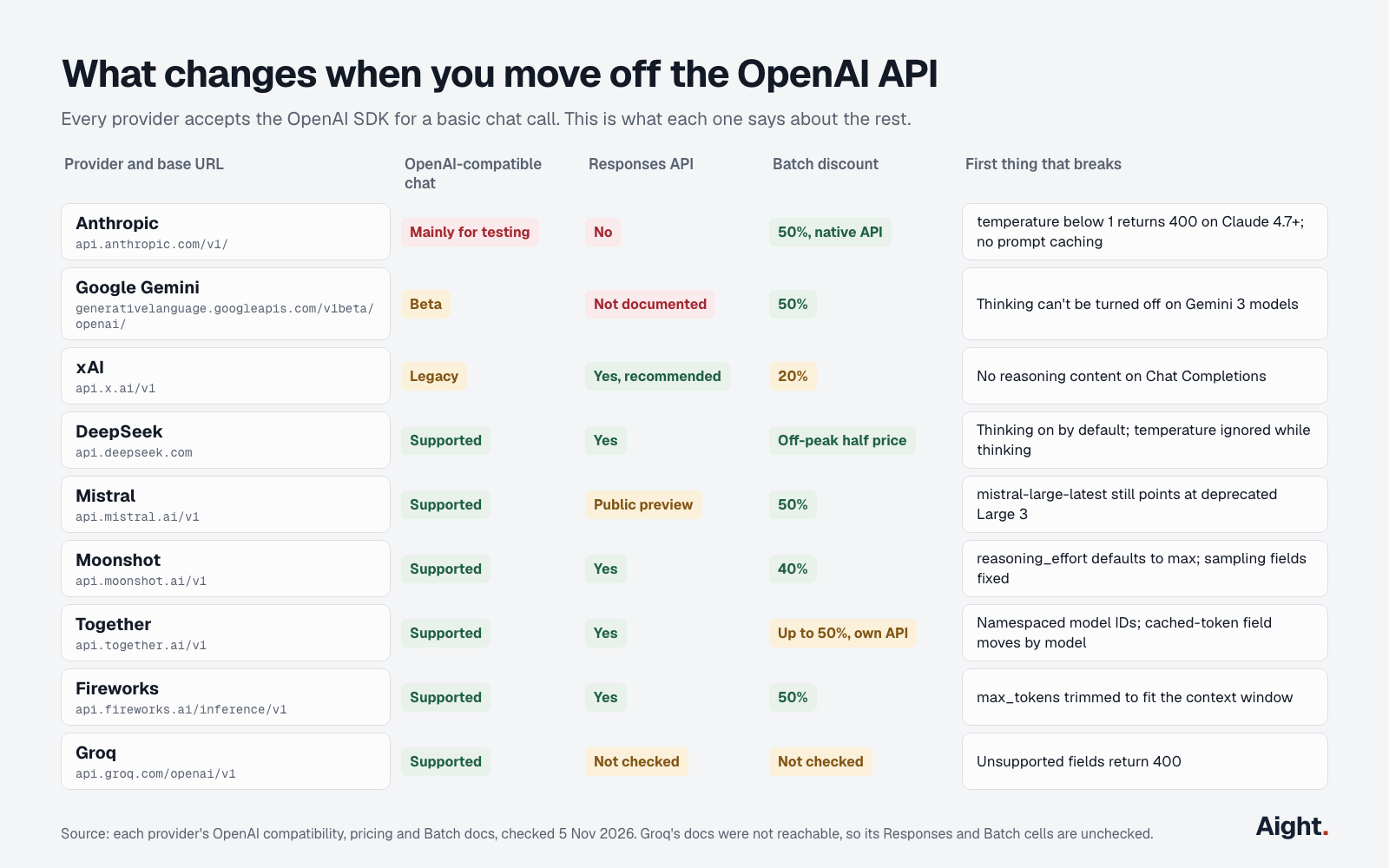
The details that cost people the most time:
- Anthropic returns 400 for
response_format: json_object, fornother than 1, and for forced tool use (tool_choice: "required") on Opus 5.5 and Sonnet 5.5. It silently ignoresreasoning_effort,seed,logprobsandstricton tools, so a schema isn't guaranteed. Through this endpoint there's no prompt caching, which on Sonnet 5.5 means paying $2.00 for input that would cost $0.10 as a cache hit. For production, Anthropic points you to its own SDK. The temperature post covers the 400 in detail. - Google maps
reasoning_effortonto Gemini's thinking levels and matches OpenAI'sservice_tierfor Flex and Priority. Batch jobs can be created through the OpenAI library, but files have to be uploaded and downloaded with Google's own SDK. Gemini's context cache goes throughextra_body. - DeepSeek switches thinking off with
extra_body={"thinking": {"type": "disabled"}}. Its old model names (deepseek-v4-flash) still work but are served by V4.1 Flash. - Moonshot fixes
temperature,top_p,nand the penalties on Kimi K3.1 Pro, so remove them. Vision input needs base64, not a public image URL. - Together accepts
service_tierandstorebut ignores them, and returns 404 for OpenAI model names such asgpt-4o.
Tool-calling schemas are the other quiet difference. A schema OpenAI accepts can fail elsewhere, so run your real tool definitions through each candidate before you switch.
Each alternative in brief
Anthropic (Claude)
Claude Opus 5.5 ($4 / $20) tops this group on the hardest work, Sonnet 5.5 ($2 / $10) is the middle option, and Haiku 5.5 ($0.10 / $0.50 up to 100,000 prompt tokens) matches GPT-6 Luna's price. Claude 4.6 and later, except Haiku 5.5, bill the whole 1M-token context at the standard rate, and US-only processing costs 1.1x. Use the native SDK for caching and structured outputs.
Google (Gemini)
Gemini 3.8 Flash and 3.5 Flash-Lite ($0.30 / $2.50) have a free tier, where Google may use your data to improve its products. Gemini 4 Argon is the reasoning model, at $2 / $10 until 30 November. Check the token volume on your own prompts before trusting the low Flash price.
xAI (Grok)
Grok 4.7 costs $2 / $6 with a 500,000-token context, and its output price is 40% below Sonnet 5.5's. Its cached input costs $0.50, five times Sonnet 5.5's cache hit, which matters for agents that resend history.
DeepSeek
V4.1 Flash (deepseek-flash) is $0.30 / $1.20 at peak and half that off-peak. Peak is 01:00 to 04:00 and 06:00 to 10:00 UTC on weekdays, so a 9-to-5 workday on Eastern, Central, Mountain or Pacific time is off-peak. DeepSeek's privacy policy says it stores personal data in the People's Republic of China. The same model runs on Together and Fireworks at $0.30 / $1.20 around the clock.
Mistral
Mistral Large 4 ($0.70 / $2.10, 1M context, open weights) has been in public preview since 6 October. Mistral Small 4 ($0.15 / $0.60) is the low-cost option. Medium 3.5 and Large 3 were deprecated on 31 October and retire on 30 April 2027.
Moonshot (Kimi)
Kimi K3.1 Pro ($2 / $10, 1M context) has open weights and scores highest of the open-weight models on Artificial Analysis. Set reasoning_effort to low or high yourself, because max is the default. K2 models closed to new users on 31 October and retire by the end of December.
Open models on Groq, Together and Fireworks
gpt-oss-120b costs $0.15 / $0.60 on all three. The spread across hosts is wide: OpenRouter lists 26 endpoints for it, from $0.024 / $0.09 to $0.35 / $0.75, at different quantizations (fp4 to fp16), so test quality on the host you pick. Together's US-only endpoint costs 1.25x, and Fireworks charges 1.5x for US-only serving on select models. Groq's documentation and pricing pages weren't reachable for this post, so its price here is the one OpenRouter lists for Groq.
Gateways
A gateway puts many providers behind one key. OpenRouter charges list price plus 5.5% when you pay (8% on its Business plan). The OpenRouter alternatives post compares gateways on fees, refunds and data terms.
Which alternative for which workload
| Workload | First choice | Why | Also test |
|---|---|---|---|
| High-volume chat, classification, extraction | Claude Haiku 5.5 | $0.65 per 1,000 requests; 30 on the index at $0.16 a task | DeepSeek V4.1 Flash off-peak ($0.90), gpt-6-luna ($0.65) |
| Hardest reasoning and long agent runs | Claude Opus 5.5 | 59 at max, the top score open to developers | Gemini 4 Argon, until its 1 December price rise |
| Mid-range quality at a mid-range price | Claude Sonnet 5.5 | 42 at $1.64 a task | Kimi K3.1 Pro (46 at $3.68) |
| Prompts over 272,000 tokens | Claude Sonnet or Opus 5.5 | 1M tokens at the standard rate, where OpenAI charges 2x input | Gemini, Kimi K3.1 Pro, Mistral Large 4 |
| Overnight jobs that can wait | Any provider's Batch | 50% off at Anthropic, Google, Mistral and Fireworks | DeepSeek off-peak, half price with no queue |
| Data that must stay in the US | Claude with US-only processing (1.1x) | Same model, one parameter in the native API | Open models on Together's US endpoint (1.25x) |
| Prototyping at no cost | Gemini 3.8 Flash free tier | Free, with your data used to improve Google's products | Paid tier once anything sensitive goes in |
| Several providers behind one key | A gateway | One integration, one bill | Direct accounts for Batch work |
Whatever you pick, measure before moving traffic: send 200 real requests to two or three candidates, read usage from each response, and compare cost per correct answer. The Claude alternatives for coding post shows that method on coding tasks.
For a side-by-side of the main LLM APIs on price, rate limits and data terms, see the best LLM API in 2026.
Where Aight fits
Aight is one OpenAI-compatible endpoint, https://api.getaight.ai/v1, for 138 models, including Claude Sonnet 5.5 and Opus 5.5, Grok 4.7, DeepSeek V4.1 Flash and gpt-oss-120b, at the makers' list prices for most. A $100 recharge costs $103 and adds $110 of balance, about $0.94 per $1 of list-price usage, so the standard job on Sonnet 5.5 comes to about $12.17 instead of $13.00.
Where another route costs less or works better:
- Aight documents Chat Completions, embeddings and the model list only. There's no Batch API, so work that can wait for 24 hours costs half as much at the provider directly, and there's no Responses API.
- DeepSeek V4.1 Flash is a flat $0.30 / $1.20 on Aight. Direct off-peak, the standard job costs $0.90 instead of $1.69.
- Kimi K3 is $3.30 / $16.50, 10% above Moonshot. Kimi K3.1 Pro and Mistral Large 4 aren't listed yet.
What one key adds is control per key: a monthly cap, an expiry date and a list of allowed models, so a test of three alternatives can't spend past its limit. Setup is in the one API key post.
What developers run into when switching
- Anthropic describes its own OpenAI layer as "not considered a long-term or production-ready solution for most use cases" (Anthropic docs, OpenAI SDK compatibility, checked 5 Nov 2026).
- An app's OpenAI-compatible provider, pointed at Anthropic's endpoint, sent
temperature: 0.7on every call, so current Claude models returned 400 and only older ones worked (mixarr GitHub issue #94, 1 Nov 2026, link). - Tool schemas that OpenAI accepted were rejected by Gemini with 400 INVALID_ARGUMENT, because Gemini enforces a strict subset of OpenAPI 3.0 (ash_ai GitHub issue #209, 27 Jun 2026, link).
- "Chat Completions is offered as a legacy endpoint." (xAI docs, checked 5 Nov 2026)
- In the thread on Kimi K3.1 Pro's open weights, a commenter said Together appeared to have "double throughput of the Moonshot AI endpoint at the same price point" (Hacker News, 4 Nov 2026, link).
- "Official Deepseek v4.1 Flash API costs are more than GPT 5.6 Luna." (Hacker News commenter, 10 Sep 2026, link). Per token it still holds against gpt-6-luna ($0.10 / $0.50), even at Flash's off-peak $0.15 / $0.60. What Flash buys is a higher score: 29 against 21 on Artificial Analysis.
FAQ
What is the best alternative to the OpenAI API?
It depends on the job. Claude Opus 5.5 scores highest among models open to developers, Claude Haiku 5.5 and DeepSeek V4.1 Flash cost least per task, and Kimi K3.1 Pro is the strongest open-weight model. On cost per task, OpenAI's GPT-6.1 Terra and Sol still compete with all of them, so compare against them too.
Is there a free alternative to the OpenAI API?
Google's Gemini API has a free tier for Gemini 3.8 Flash and the Flash-Lite models, and Google may use free-tier data to improve its products. Open-weight models such as gpt-oss-120b and Kimi K3.1 Pro are free to download and run on your own hardware, but the hardware isn't free.
Does the OpenAI Python SDK work with Claude or Gemini?
Yes. Set base_url to https://api.anthropic.com/v1/ or https://generativelanguage.googleapis.com/v1beta/openai/ and use that provider's key and model name. Anthropic positions its layer for testing and drops prompt caching, and Google labels its layer beta, so production code usually moves to the native SDK.
Which OpenAI API alternatives support the Responses API?
xAI, DeepSeek, Moonshot, Together, Fireworks and OpenRouter accept it, and Mistral has it in public preview. Anthropic's and Google's OpenAI compatibility docs cover Chat Completions only, so code built on client.responses.create needs rewriting for them.
What is the cheapest alternative to the OpenAI API?
For the standard job here, Claude Haiku 5.5 at $0.65 per 1,000 requests, the same as OpenAI's gpt-6-luna. DeepSeek V4.1 Flash off-peak and gpt-oss-120b on Groq, Together or Fireworks come to $0.90, and some smaller gpt-oss-120b hosts on OpenRouter charge a fraction of that.
Sources
- OpenAI: Pricing, Migrate to the Responses API, gpt-6.1-sol model page, openai on PyPI
- Anthropic: Pricing, OpenAI SDK compatibility
- Google: Gemini API pricing, OpenAI compatibility, Gemini 4 Carbon announcement
- xAI: Pricing, Models, Chat Completions (legacy), Comparison with Chat Completions, Generate text
- DeepSeek: Models and pricing, Your first API call, Thinking mode, Privacy policy
- Mistral: API pricing, Models overview, Mistral Large 4, Migration guides, Batch processing
- Moonshot AI: Kimi model inference pricing, Kimi K3.1 Pro quickstart
- Together AI: OpenAI compatibility, Serverless models, Batch overview, Pricing
- Fireworks AI: Pricing, OpenAI compatibility, Responses API
- Groq: OpenAI compatibility, groq-python on GitHub
- OpenRouter: Pricing, Quickstart, gpt-oss-120b endpoints
- Artificial Analysis: LLM leaderboard, Gemini 3.8 Flash model page
- GitHub: mixarr issue #94, ash_ai issue #209
- Hacker News: Kimi K3.1 Pro weights thread, DeepSeek V4.1 Flash thread
- Aight: Models and pricing, API reference, Refund policy
Checked on 5 November 2026. Updated 17 November 2026: Aight's current model list.