For most teams in November 2026, the best LLM API is OpenAI's for one product on one model (GPT-6.1 Sol and Terra give the most capability per dollar) and Anthropic's for the hardest reasoning and agent work (Claude Opus 5.5 scores highest among models you can buy self-serve). Google's Gemini API wins for prototyping because of its free tier, and DeepSeek has the lowest token price if storing data in China is acceptable.
After the demo, other terms decide: the entry rate limit, whether prepaid balance expires, how long prompts are kept, and how much notice comes before a model disappears. Below, the six main LLM APIs compared on those terms, from each provider's own pages on 5 November 2026.
What is an AI API?
An AI API, or LLM API, is a web endpoint that runs a large language model on the provider's servers: you send text (and often images or audio) in an HTTPS request with an API key, and you get the model's reply back, billed per million tokens of input and output. A token is roughly three quarters of an English word. You don't host the model, and you pay only for what you send and receive.
Most LLM APIs accept OpenAI's Chat Completions request shape, so switching can be a two-line change. What costs money sits around the request: limits, billing, data handling and model lifecycles. The alternatives to the OpenAI API post covers the code side of switching; this one covers the buying side.
The main LLM APIs and their models
Prices per million tokens, input / output, at standard (non-Batch) rates.
| Provider | Top model | Workhorse | Low-cost model | Batch discount |
|---|---|---|---|---|
| OpenAI | gpt-6-astra, $10 / $50 | gpt-6.1-sol $2 / $10, gpt-6.1-terra $1 / $5 | gpt-6-luna, $0.10 / $0.50 | 50% |
| Anthropic | Claude Fable 5.2, $8 / $40 | Claude Opus 5.5 $4 / $20, Sonnet 5.5 $2 / $10 | Claude Haiku 5.5, $0.10 / $0.50 | 50% |
| Gemini 4 Argon, $2 / $10 to 30 Nov, then $4 / $20 | Gemini 3.8 Flash, $0.75 / $3.75 to 31 Dec, then $1.50 / $7.50 | Gemini 3.5 Flash-Lite, $0.30 / $2.50 | 50% | |
| xAI | grok-4.7, $2 / $6 | grok-4.3, $1.25 / $2.50 | 20% on grok-4.7 | |
| DeepSeek | deepseek-v4-pro, $1.32 / $3.96 peak | deepseek-flash, $0.30 / $1.20 peak, half off-peak | None | |
| Mistral | Mistral Large 4, $0.70 / $2.10 (preview) | Mistral Small 4, $0.15 / $0.60 | 50% |
Sources: OpenAI pricing, Anthropic pricing, Gemini API pricing, xAI models, DeepSeek pricing, Mistral pricing.
Watch three price changes: Google's two main models double on 1 December and 1 January, Grok 4.7 bills the whole request at $4 / $12 once a prompt reaches 200,000 tokens, and Claude Haiku 5.5 moves to $0.50 / $2.50 above 100,000. DeepSeek's peak hours (01:00 to 04:00 and 06:00 to 10:00 UTC on weekdays) miss the US working day, so US daytime traffic pays half.
Price per task, not per token
Token prices hide how many tokens a model spends thinking. Artificial Analysis runs every model through the same evaluation suite and publishes the cost of one task and the measured output speed. At each model's high reasoning setting:
| Model | Intelligence Index | Cost per task | Output speed | Seconds to first answer token |
|---|---|---|---|---|
| Claude Opus 5.5 | 51.8 | $3.46 | 109 tokens/s | 32.4 |
| Gemini 4 Argon | 50.4 | $7.68 | 55 tokens/s | 37.9 |
| GPT-6.1 Sol | 50.3 | $0.59 | 57 tokens/s | 34.2 |
| Claude Fable 5.1 | 47.2 | $7.54 | 87 tokens/s | 15.7 |
| GPT-6.1 Terra | 42.4 | $0.26 | 74 tokens/s | 10.0 |
| Claude Sonnet 5.5 | 41.5 | $1.64 | 141 tokens/s | 12.5 |
| Grok 4.7 | 35.2 | $6.18 | 72 tokens/s | 32.0 |
| Gemini 3.8 Flash | 30.8 | $7.77 | 112 tokens/s | 21.5 |
| Claude Haiku 5.5 | 29.9 | $0.16 | 216 tokens/s | 22.7 |
| DeepSeek V4.1 Flash | 28.6 | $0.46 | 179 tokens/s | 22.5 |
| GPT-6 Luna | 21.4 | $0.07 | 98 tokens/s | 11.5 |
Two things stand out. OpenAI's GPT-6.1 Sol scores within 1.5 points of Opus 5.5 for a sixth of the cost per task, though it writes half as fast. Claude Fable 5.1, Anthropic's most expensive model when these figures were taken, scores below Opus 5.5 at the same setting on this index. Its successor, Fable 5.2, launched on 9 November at $8 / $40, and Artificial Analysis scores it above Opus 5.5. Artificial Analysis prices Gemini 4 Argon at its 1 December rate of $4 / $20, so through November its cost per task is about half the figure shown.
Gemini 3.8 Flash shows the opposite trap: low token prices, one of the highest costs per task. Treat this as a shortlist and run 100 to 200 of your own requests. The LLM API cost per month post turns token counts into a monthly bill, and the best LLM for coding post ranks models on coding tasks specifically.
Rate limits: what a new account can do
New accounts start below the top limits, and your launch week runs on the entry tier.
| Provider | How the tier rises | Entry tier | Top self-serve tier |
|---|---|---|---|
| OpenAI | Total purchases: $5, $100, $500 | Build: 5,000 requests a minute, 1M tokens a minute on Sol and Terra, $500 a month usage limit | Grow: 15,000 RPM, 40M TPM, $200,000 a month |
| Anthropic | Usage history and account standing | Start: 4,000 RPM, 2M input tokens a minute on Opus, Sonnet and Haiku 5.5, $500 monthly spend cap | Scale: 13,000 RPM, 10M input TPM, $200,000 cap |
| Billing linked, then $100 paid plus 3 days, then $1,000 plus 30 days | Tier 1: $250 cap, and no more than $10 of spend per 10 minutes | Tier 3: $20,000 to $100,000+ cap | |
| xAI | Spend since 1 Jan 2026: $50, $250, $1,000, $5,000 | Tier 0: 150 requests a second, 50M TPM on grok-4.7 | Tier 4: 500 RPS, 100M TPM |
| DeepSeek | Request it, no extra charge | 2,500 concurrent requests (flash), 500 (v4-pro) | Set per request |
| Mistral | Shown in the Admin Panel | Not published | Not published |
The limits that catch teams out aren't per minute. Anthropic's Start tier stops at $500 a month and returns 429 until 00:00 UTC on the 1st, and new organizations may begin in an Evaluation tier below the published numbers (rate limits). Google's Tier 1 returns 429 RESOURCE_EXHAUSTED past $10 of usage in any rolling 10 minutes, or $60 an hour (Gemini rate limits). OpenAI adds a ramp limit: above 1M tokens a minute, it advises growing traffic by no more than 50% every 15 minutes or you get slow_down errors (OpenAI rate limits).
xAI is the outlier on the generous side: its Tier 0 allows 150 requests a second on grok-4.7 from the first dollar (xAI rate limits).
Billing terms: prepaid, expiry and refunds
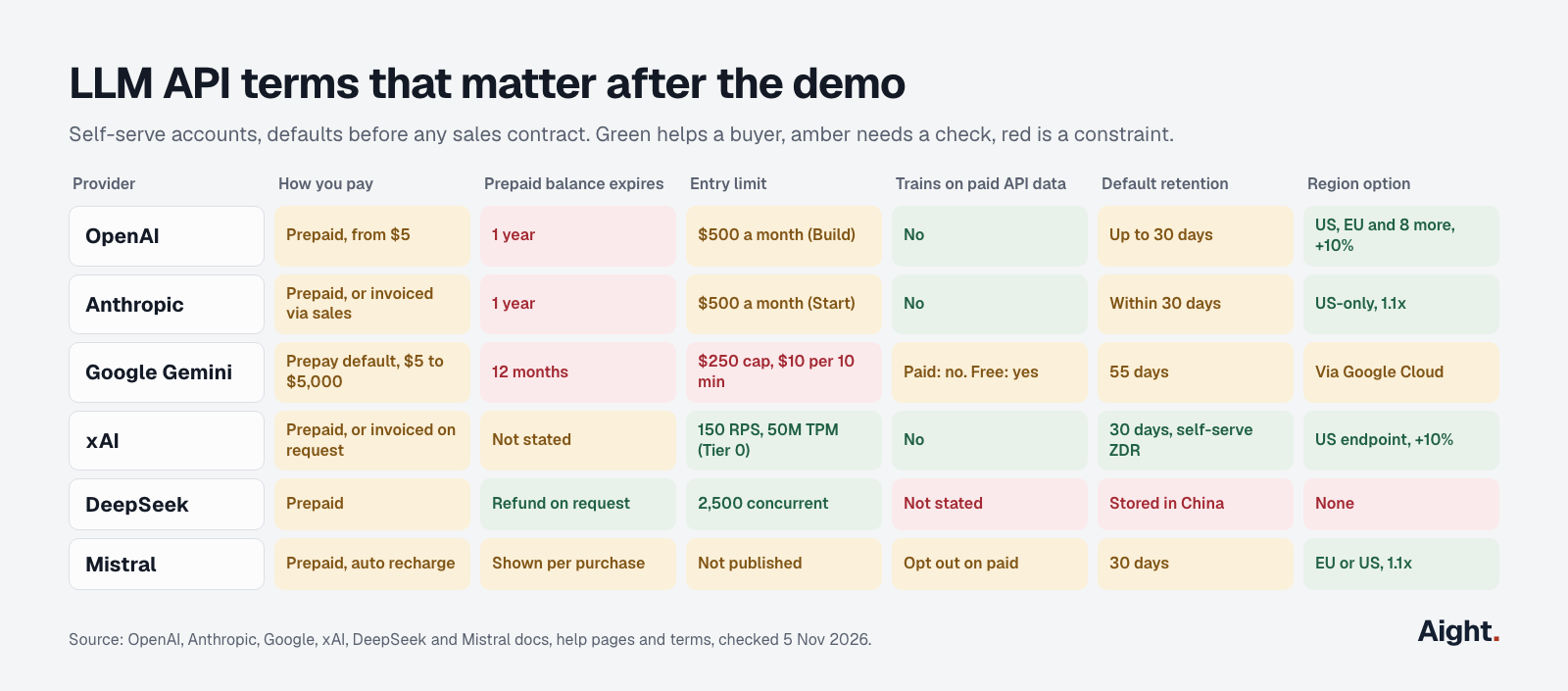
All six bill self-serve accounts in advance. What differs is what happens to unspent money.
- OpenAI: prepaid from $5. Purchased balance expires after one year, can't be extended, and is non-refundable except for billing errors, unauthorized use or a confirmed OpenAI failure (OpenAI help center).
- Anthropic: prepaid, with auto-reload. Balance expires one year from purchase and all purchases are non-refundable. Monthly invoicing is available through sales (Claude help center).
- Google: since 23 March 2026, new Gemini API accounts default to Prepay: $5 minimum, $5,000 maximum per purchase, unused balance expires after 12 months and isn't refundable unless you switch to Postpay. When the balance hits $0, every key on that billing account stops at once with a 402 (Gemini billing).
- xAI: prepaid by default, with monthly invoicing on request. Its billing docs don't state an expiry (xAI billing).
- DeepSeek: prepaid. Its terms allow a refund of the whole unspent balance after review, minus handling fees (DeepSeek terms).
- Mistral: pay-as-you-go needs a prepaid balance; at zero, requests fail with 402 (Mistral billing).
With a one-year expiry, buy one to three months ahead and let auto-reload, with a monthly limit, handle the rest. On Bedrock, Azure or Google's Gemini Enterprise Agent Platform, the same models go on your existing cloud invoice.
Data terms: training, retention and region
OpenAI, Anthropic, Google (paid tier) and xAI say they don't train on paid API traffic without permission. Mistral lets pay-as-you-go customers opt out, and DeepSeek's terms and privacy policy don't address it. The bigger differences are in how long prompts are kept and where.
| Provider | Default retention of prompts and outputs | Zero data retention | Region control |
|---|---|---|---|
| OpenAI | Abuse logs up to 30 days; Responses API state 30 days unless store is false | On approval | Data residency per project on approval, 10% extra on models from 5 Mar 2026; US and EU process in-region |
| Anthropic | Deleted within 30 days; Fable and Mythos models require 30-day retention | Via sales; not for Fable or Mythos | inference_geo: "us", 1.1x |
| Google (paid) | 55 days for abuse detection; developer logs on by default in projects created from 26 Oct 2026 | Through Google Cloud | Through Google Cloud |
| xAI | 30 days | Self-serve for team admins | us.api.x.ai, 10% extra, grok-4.7 and 4.6 only |
| DeepSeek | Not stated; personal data stored in China | Not offered | None |
| Mistral | 30 rolling days | On request for paid plans | EU or US endpoint, 1.1x |
Sources: OpenAI data controls, Anthropic data retention and privacy center, Gemini usage policies and logs policy, xAI security FAQ, DeepSeek privacy policy, Mistral privacy policy, Mistral regional inference.
For regulated work: Anthropic's Fable and Mythos models need 30-day retention and aren't available under ZDR, and eligible organizations can sign a HIPAA Business Associate Agreement in the Claude Console. xAI's self-serve ZDR turns off Batch, file storage and stateful Responses for the whole team.
Free tiers are a different deal. Google says content on its free tier is used to improve its products and may be read by human reviewers, and Mistral's free mode may train on your data unless you opt out. The free LLM API guide covers every free tier and its limits; OpenRouter's free models are covered in OpenRouter's free models and daily limits.
AWS and Microsoft say Bedrock and Azure prompts aren't shared with model makers or used to improve their models, though Bedrock keeps Claude Fable traffic up to 30 days (Bedrock abuse detection).
SDKs and API shape
| Provider | Official SDKs | Native API | OpenAI-compatible endpoint |
|---|---|---|---|
| OpenAI | Python, TypeScript/JavaScript, .NET, Ruby; Java and Go in beta | Responses (recommended), Chat Completions | Native |
| Anthropic | Python, TypeScript, C#, Go, Java, PHP, Ruby | Messages | Yes, "not considered a long-term or production-ready solution" |
| Python, JavaScript/TypeScript, Go, Java (Google GenAI SDK) | generateContent, Interactions | Yes, in beta | |
| xAI | Python SDK; OpenAI SDK works | Responses (recommended) | Chat Completions is "a legacy endpoint" |
| DeepSeek | None of its own | OpenAI and Anthropic formats | Native |
| Mistral | Python, TypeScript | Chat Completions style | Native shape |
To switch providers by changing a base URL, write against Chat Completions with basic fields. For each provider's caching, structured outputs and tools at full strength, use its native SDK. Sources: OpenAI libraries, Anthropic SDKs, Google GenAI SDK, Mistral SDK clients.
Model lifecycles and deprecation notice
The notice before a model is retired varies widely:
- OpenAI commits to at least 6 months for generally available models, 3 months for specialized variants such as Codex models, and as little as 2 weeks for anything named
preview(deprecations). - Anthropic commits to at least 60 days, and its current models carry a "not sooner than" date: Opus 5.5 22 September 2027, Sonnet 5.5 28 September 2027, Haiku 5.5 7 October 2027 (models overview).
- Google lists only earliest possible shutdown dates. On 2 November it announced that from 1 December, calls to
gemini-2.5-prowill run on Gemini 3.8 Flash and calls togemini-2.5-flashon 3.5 Flash-Lite, billed at those models' rates (Gemini changelog). - xAI retired eight models on 15 May 2026 and redirected their names to grok-4.3, at grok-4.3's prices (xAI migration guide).
Redirects keep code running but change behavior and price, so watch each deprecation page.
Best LLM API by team type and workload
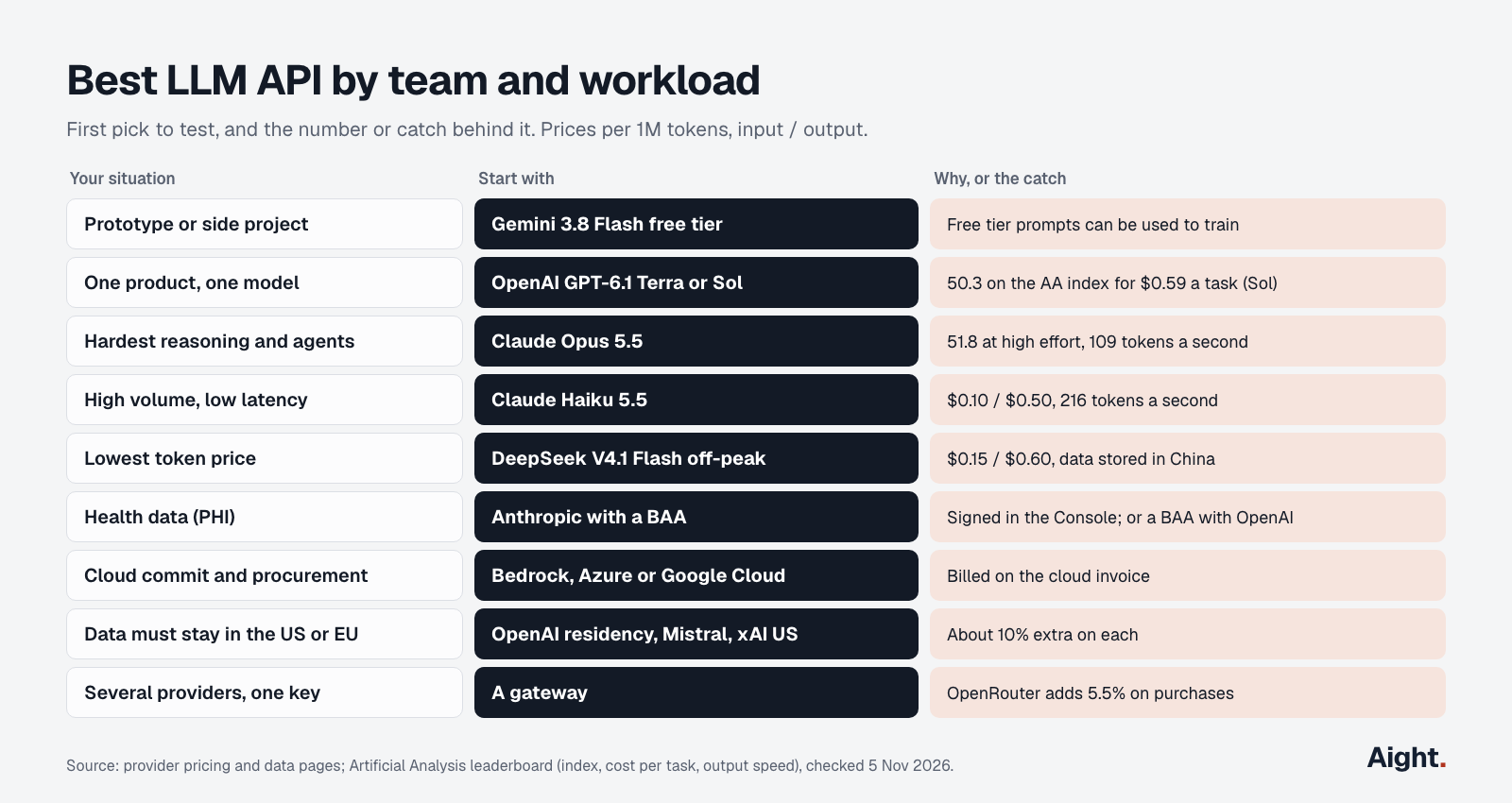
| Your situation | Start with | Why, or the catch |
|---|---|---|
| Prototype or side project | Gemini 3.8 Flash free tier | Free-tier prompts can train Google's models |
| One product, one model | OpenAI GPT-6.1 Terra or Sol | 50.3 on the index for $0.59 a task (Sol); tools need the Responses API |
| Hardest reasoning and agents | Claude Opus 5.5 | 51.8 at high effort, 109 tokens/s; $500 Start-tier cap |
| High volume, low latency | Claude Haiku 5.5 | $0.10 / $0.50, 216 tokens/s; 5x price above 100,000-token prompts |
| Lowest token price | DeepSeek V4.1 Flash off-peak | $0.15 / $0.60; data stored in China |
| Health data (PHI) | Anthropic with a BAA | Signed in the Console; OpenAI also offers a BAA |
| Cloud commitment or procurement | Bedrock, Azure or Google Cloud | Billed on the cloud invoice; the cloud sets its own prices and dates |
| Data must stay in the US or EU | OpenAI residency, Mistral, xAI US | About 10% extra on each; OpenAI needs approval |
| Several providers, one key | A gateway | OpenRouter adds 5.5% on purchases |
For a small team shipping one product, the shortest path is OpenAI plus Anthropic, each the other's fallback: the top of the index, two separate outage domains and two half-price Batch APIs. Add Gemini or DeepSeek when a measured workload costs less there. Gateways trade a fee for one bill; OpenRouter alternatives compares them on fees, refunds and data terms.
If you're choosing a chat app rather than an API, Claude vs ChatGPT vs Gemini compares the three assistants, and Perplexity vs Claude covers research that leans on web search.
Where Aight fits
Aight is one OpenAI-compatible API (https://api.getaight.ai/v1) for 138 models, including Claude Opus 5.5, Sonnet 5.5, Haiku 5.5 and Fable 5.1, gpt-6.1-sol, gpt-6-luna, grok-4.7 and DeepSeek V4.1 Flash, at the makers' list prices for most. It addresses two of the terms above: the balance never expires, and unspent paid balance is refundable. A $100 recharge costs $103 outside India and adds $110 of balance, about $0.94 per $1 of list-price usage. Each key can have its own monthly cap, expiry date and allowed-model list.
Where going direct is better:
- Aight documents Chat Completions, embeddings and the model list only, so there's no Batch API (direct Batch is half price) and no Responses API.
- Claude Fable 5.2 isn't on Aight's models page yet.
- DeepSeek V4.1 Flash is a flat $0.30 / $1.20 on Aight; direct off-peak is half that.
- For a BAA, ZDR or regional processing, sign with the provider or your cloud.
What developers report
- A Hacker News commenter noted that "Google Gemini API use also moved to prepaid-only starting this month" (3 Oct 2026, link). Google's billing page dates Prepay for new accounts from 23 March 2026.
- "ZDR is a contract clause." A Hacker News commenter added that it's subject to legal carve-outs and provider exceptions, citing Anthropic's Fable models (3 Nov 2026, link).
- A Hacker News commenter said several recent Grok models were deprecated at short notice, with Grok 4.1 Fast gone on 15 May (6 May 2026, link).
- A Hacker News commenter let unused OpenAI API balance expire and called the one-year policy ridiculous (17 Aug 2026, link).
- A Hacker News commenter described running Claude Opus 5.5 only for tasks that justify its cost, with lower-priced and open-weight models on Bedrock for the rest (3 Nov 2026, link).
FAQ
What is the best AI API for beginners?
Start with the Gemini API free tier to learn without a card, then open an OpenAI account with a $5 purchase when you need production terms. OpenAI's docs and SDKs are the most widely copied, and most other LLM APIs accept the same request shape.
Which LLM API is the cheapest?
Per token, DeepSeek V4.1 Flash off-peak at $0.15 / $0.60, then Claude Haiku 5.5 and GPT-6 Luna at $0.10 / $0.50 standard. Per task on Artificial Analysis, GPT-6 Luna ($0.07) and Claude Haiku 5.5 ($0.16) cost least. Batch halves OpenAI, Anthropic, Google and Mistral prices for work that can wait up to 24 hours.
Do LLM APIs train on your data?
Not on paid plans at OpenAI, Anthropic, Google or xAI, which say they don't train on API traffic without permission; Mistral lets pay-as-you-go customers opt out. Free tiers differ: Google uses free-tier content to improve its products, and Mistral's free mode may train unless you opt out. DeepSeek's terms don't address it.
Does prepaid API balance expire?
At OpenAI and Anthropic, one year after purchase; on the Gemini API, 12 months. None of the three refunds unused purchases in normal cases. DeepSeek reviews refund requests for the whole unspent balance.
Sources
- OpenAI: Pricing, Rate limits, Data controls, Libraries, Deprecations, Prepaid billing help
- Anthropic: Pricing, Models overview, Rate limits, API and data retention, Privacy center retention, Payment help, SDKs, Model deprecations, OpenAI SDK compatibility
- Google: Gemini API pricing, Billing, Rate limits, Usage policies, Logs policy, Terms, Libraries, Deprecations, Changelog, OpenAI compatibility, Gemini Enterprise Agent Platform zero data retention
- xAI: Models and pricing, Rate limits, Billing, Security FAQ, Chat Completions (legacy), 15 May 2026 retirement
- DeepSeek: Models and pricing, Rate limit and isolation, Open Platform terms, Privacy policy
- Mistral: Pricing, Billing, Usage and limits, Regional inference, Zero data retention, SDK clients, Privacy policy, Training help article
- AWS: Bedrock FAQs, Bedrock data retention, Bedrock abuse detection, Bedrock pricing
- Microsoft: Data, privacy and security for Foundry models sold by Azure
- OpenRouter: Pricing
- Artificial Analysis: LLM leaderboard
- Hacker News comments: 49943324, 50350587, 48038524, 49327807, 50352304
- Aight: Models and pricing, API reference, Refund policy
Checked on 5 November 2026. Updated 17 November 2026: Claude Fable 5.2, and Aight's current model list.