In the Perplexity vs Claude choice, Perplexity is a search engine that answers with numbered citations, and Claude is a general assistant built for writing, analysis and code that can also search the web. Use Perplexity when the answer lives on today's web and you want to check the sources. Use Claude when the work is yours: drafting, editing, reasoning over long files, or coding with Claude Code.
Price doesn't decide it. Both Pro plans cost $20 a month or $200 a year. What differs is what the $20 buys: Perplexity Pro gives you Claude Sonnet 5.5 as one of seven models inside its search, while Claude Pro gives you Opus 5.5, Sonnet 5.5 and Haiku 5.5, Research and Claude Code. This post compares both apps as checked on 10 November 2026, then covers the API side for builders, where Perplexity's retired Sonar API has become the Agent API, which sells Claude models at Anthropic's own token prices.
Perplexity vs Claude at a glance
| Perplexity | Claude | |
|---|---|---|
| What it is | An answer engine: every Search answer is built from live web results, with inline citations | A general assistant: chat, writing, analysis, files, code; searches the web when it helps |
| Made by | Perplexity, using its own and other companies' models | Anthropic, using only Claude models |
| Free plan | Practically unlimited basic searches, 3 Pro Searches a day, 1 Research query a month | Sonnet and Haiku, web search with citations, limits that reset every 5 hours |
| Pro | $20 a month or $200 a year | $20 a month or $200 a year |
| Top individual plan | Max, $200 a month or $2,000 a year | Max $100, Ultra $200 a month |
| Claude models | Sonnet 5.5 on Pro; Opus 5.5 and Fable 5.1 on Max | Opus, Sonnet and Haiku on Pro; Fable 5.2 on Max and Ultra, pay as you go on Pro |
| Other models | GPT-6.1 Sol, Gemini 3.8 Flash, Grok 4.7, Kimi K3, GLM 5.3, Nemotron 3.5 Super VL on Pro | None |
| Deep research | Deep Research, models chosen by Perplexity | Research (paid plans), runs on Opus 5.5 |
| Coding | Answers coding questions; Computer agent can build apps | Claude Code in the terminal, IDE and desktop, from Pro up |
| API | Agent API and Search API, billed separately from any plan | Claude API, billed separately; Max, Ultra and Team include a monthly allowance |
Sources: Perplexity's pricing page, Perplexity's model list by plan, Perplexity's plan comparison and Claude's pricing page.
Search engine with citations vs general assistant: when each wins
The two products start from opposite ends. Perplexity treats every question as a search: it queries the web, reads the results and writes an answer where each sentence points to a numbered source you can open. Claude treats every question as a conversation with a model, and calls a search tool only when current information would help. When Claude does search, Anthropic says every response includes citations, so the gap is in emphasis and depth of sourcing, not in whether sources appear at all.
Perplexity wins when:
- The answer changes week to week: prices, release dates, news, sports, store hours, regulations.
- You need to check where a claim came from before you repeat it. Perplexity Pro gives "10x as many citations per answer", according to its help center.
- You want one question answered by several companies' models. Pro lets you pick among seven, and Max adds Model Council, which runs several models on the same question and merges their answers.
- You do market or finance research. Pro and Max add premium sources such as PitchBook, Statista and S&P Capital IQ, per the pricing page.
Claude wins when:
- The output is a piece of work: an email, a report, a contract review, a refactored module.
- The input is yours. Claude's context window reaches 1M tokens on current models, and Projects, memory and connectors (Google Workspace and others) keep your material in reach.
- You write code. Claude Code comes with every paid Claude plan. Perplexity's own command-line tool,
pplx, only runs web searches. - You want one model's consistent voice. Perplexity says its third-party models run with its own search, prompts, safety systems and limits, so the same model "can behave differently" from the maker's own app (Perplexity help center).
You don't have to pick only one. Perplexity Free is enough for a few sourced lookups a day; Claude Free is enough for occasional drafting.
Perplexity vs Claude plans and prices
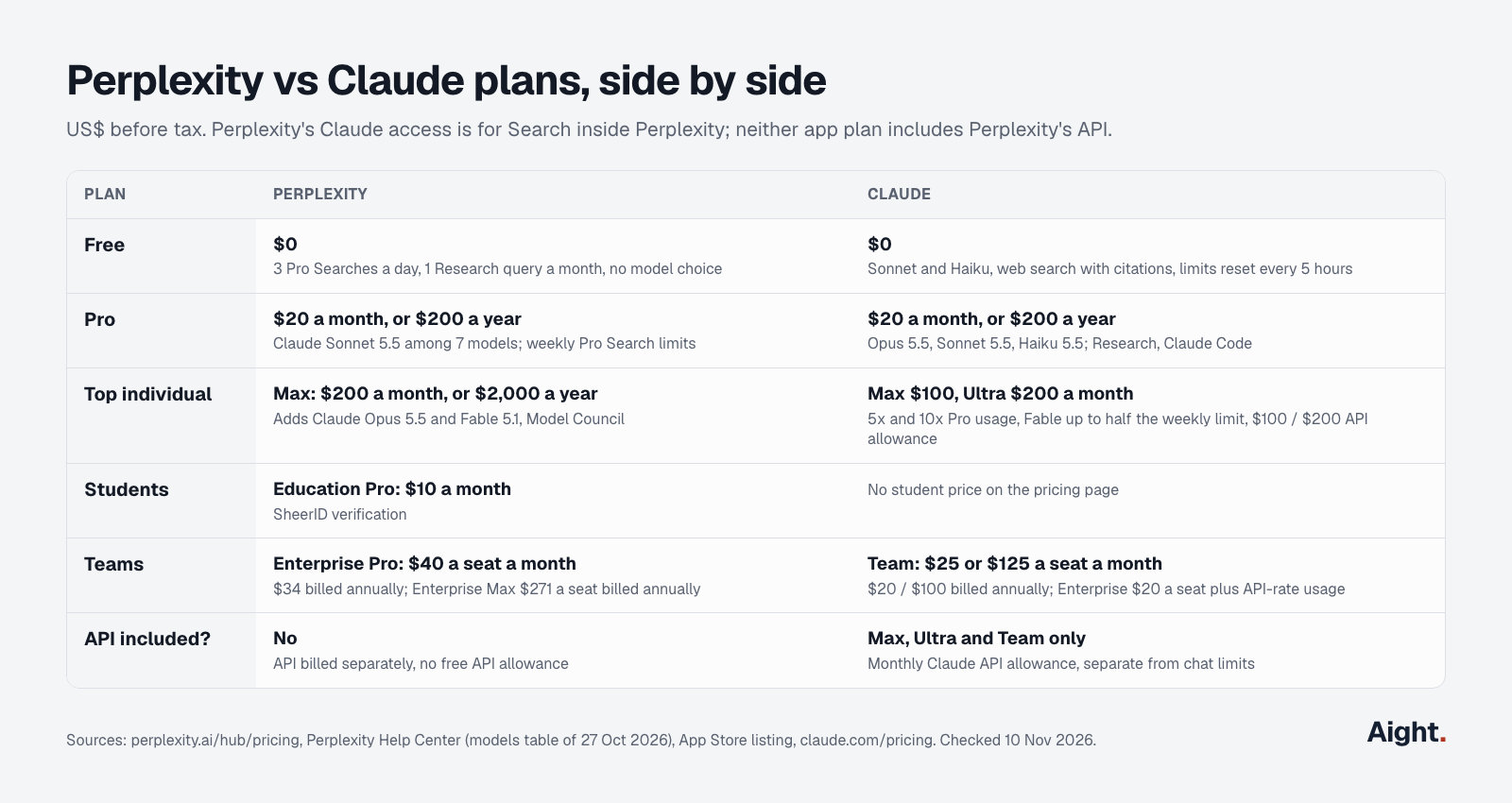
Both companies price their entry plan at $20 a month. Above that, Perplexity has one $200 tier and Claude has two.
| Plan | Perplexity | Claude |
|---|---|---|
| Free | $0 | $0 |
| Pro | $20 a month, or $17 a month billed annually | $20 a month, or $17 a month billed annually ($200 up front) |
| Max | $200 a month, or $2,000 a year (about $167 a month) | Max $100 a month; Ultra $200 a month |
| Students | Education Pro, $10 a month with SheerID verification | No student price on the pricing page |
| Teams | Enterprise Pro $40 a seat a month ($34 billed annually); Enterprise Max $271 a seat a month billed annually | Team Standard $25 a seat ($20 annually), Premium $125 ($100 annually); Enterprise $20 a seat plus usage at API rates |
Perplexity's pricing page only shows the annual rates. The month-to-month Pro price comes from its App Store listing, which sells Pro at $20.00 and $200.00 and Max at $200.00, and the Max prices from Perplexity's Max article. Annual Max billing is only offered on the web.
What the limits look like:
- Perplexity Free gets 3 Pro Searches a day and 1 Research query a month; Pro and Max get weekly and monthly limits that Perplexity describes as "average use" and "advanced use" without numbers. Only the Enterprise plans publish counts: 400 Pro Searches a week and 50 Research queries a month on Enterprise Pro, 4,000 and 500 on Enterprise Max.
- Claude's paid plans have a 5-hour limit and a weekly limit. Max is 5 times Pro, Ultra 10 times Pro weekly with no 5-hour limit once verified, and chat, Research and Claude Code share one pool. The Claude Code pricing guide covers those limits in detail.
- Perplexity's agent, Computer, is metered separately: 100 of its usage units cost $1, a quick fact uses 15 to 70 and a research report 350 to 950 (Perplexity help center). Max includes 10,000 units a month; paid Pro plans are getting a weekly included amount. Ordinary searches don't use them.
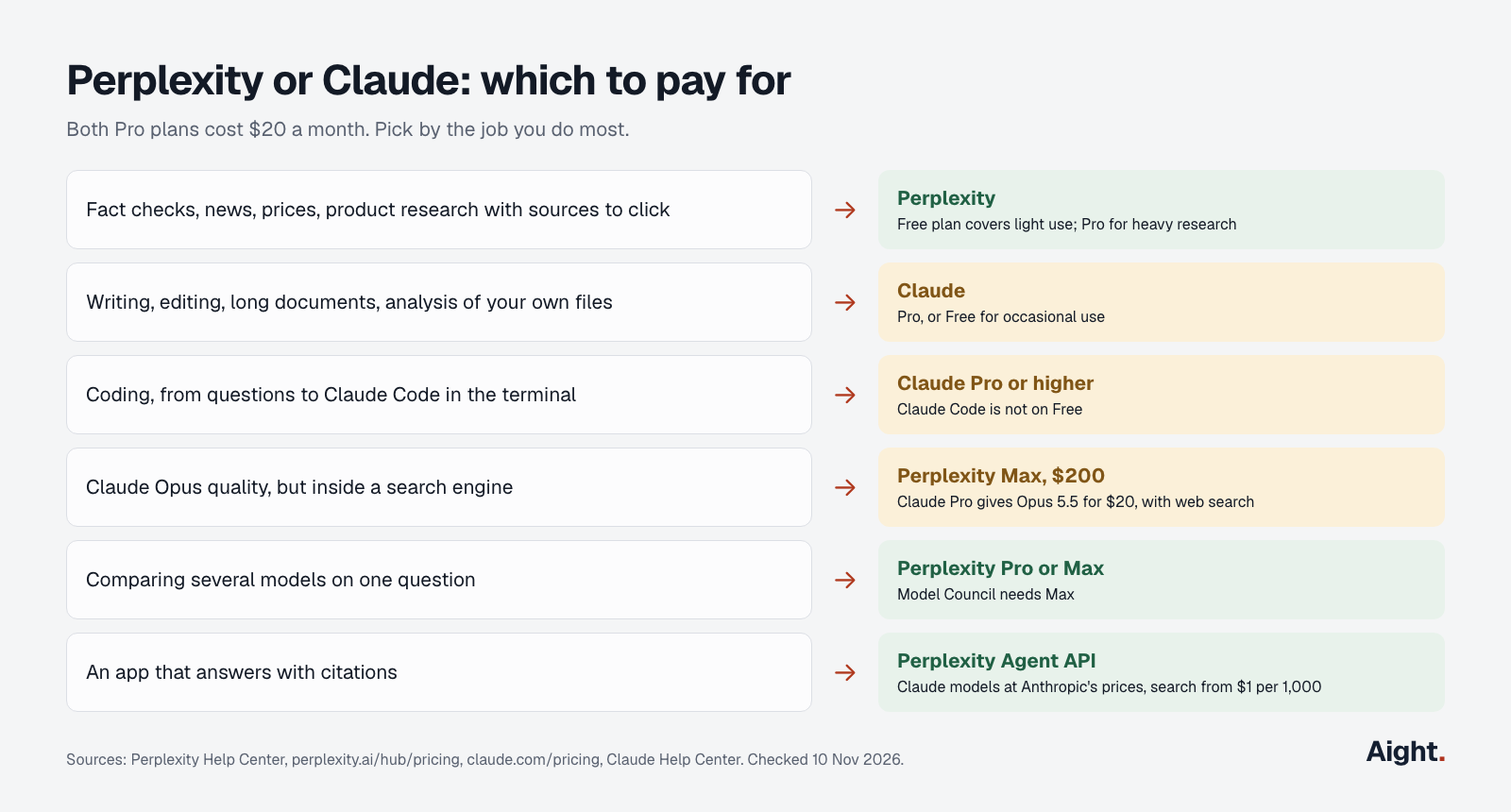
For most people the $20 decision comes down to one question: is the thing you do most often looking something up, or making something?
Which Claude models Perplexity uses
Perplexity Pro includes Claude Sonnet 5.5. Claude Opus 5.5 and Claude Fable 5.1 need Perplexity Max at $200 a month. That is Perplexity's own table of Search models as of 27 October 2026:
| Model | Maker | Perplexity Pro | Perplexity Max |
|---|---|---|---|
| Claude Sonnet 5.5 | Anthropic | Yes | Yes |
| Claude Opus 5.5 | Anthropic | No | Yes |
| Claude Fable 5.1 | Anthropic | No | Yes |
| GPT-6.1 Sol | OpenAI | Yes | Yes |
| GPT-6 Astra | OpenAI | No | Yes |
| Gemini 3.8 Flash | Yes | Yes | |
| Gemini 4 Argon | No | Yes | |
| Grok 4.7 | xAI | Yes | Yes |
| Kimi K3 | Moonshot AI | Yes | Yes |
| GLM 5.3 | Z.ai | Yes | Yes |
| Nemotron 3.5 Super VL | NVIDIA | Yes | Yes |
Three details matter if you want Claude inside Perplexity:
- On Free you can't choose a model at all. Perplexity's "Best" setting picks one per query.
- Claude Fable 5.2, which Anthropic launched on 9 November 2026, isn't in Perplexity's table yet. Claude's own apps already offer it.
- Perplexity's Deep Research and its Computer agent choose their own models, so picking Claude in the selector applies to Search only.
Sources disagree here. The FAQ on Perplexity's Pro page still lists Claude Sonnet 5 and Gemini 3.1 Pro Thinking, and the "What is Perplexity Pro?" article names Claude Sonnet 4.6. The help center's model table above is the most recent, dated 27 October 2026, and matches the model cards on the Pro and Max pages. Perplexity says the model selector in your account is the final word.
The practical result: $20 on Claude Pro gets you Opus 5.5 with web search, while Perplexity charges $200 for Opus 5.5 inside its search. If Opus is the point, Claude Pro is the lower-cost route.
Is Claude better than Perplexity for research?
On the Claude vs Perplexity research question, Perplexity is faster and cites more for quick sourced answers. For long, multi-angle research, Claude's Research mode and Perplexity's Deep Research both run many searches and write a report, and the difference is in what they can reach.
- Claude Research is on paid plans only. It runs on Opus 5.5 (falling back to Opus 4.8) whatever model you picked, and on the web and desktop apps it can search your connectors, such as Gmail, Google Calendar and Google Docs, as well as the web (Claude help center). It counts against the same usage limits as chat, and uses them faster.
- Perplexity Deep Research is on every plan, with 1 query a month on Free. Perplexity selects the models automatically, and Pro and Max add premium data sources for finance and market work.
On the public Search Arena leaderboard, which ranks models by user votes on answers with live web search (8 November 2026, 1,487,588 votes), Claude Opus 4.6 with search ranks third at 1252, while Perplexity's Sonar Reasoning Pro ranks 37th at 1139 and Sonar Pro 39th at 1130. Those Sonar entries are Perplexity's retired API models, not the current Perplexity app, which runs on the models in the table above, so read the gap as a verdict on Sonar, not on Perplexity Pro with Claude Sonnet 5.5 selected.
Perplexity vs ChatGPT vs Claude
If the shortlist is Perplexity vs ChatGPT vs Claude, the three split along the same line. Perplexity is the search-first product with citations on every answer and models from several companies. ChatGPT and Claude are general assistants from model makers, each with its own models, file handling, memory and a coding agent (Codex for ChatGPT, Claude Code for Claude). Perplexity's own FAQ draws the line the same way: an answer engine for research and source checking, a chatbot for creative and conversational work.
So the real comparison is usually ChatGPT vs Claude for the general assistant, plus Perplexity on top if you research a lot. The Claude vs ChatGPT comparison covers that first choice, and Codex vs Claude Code covers the coding agents.
API prices: Perplexity Sonar API vs Claude API
The Perplexity Sonar API no longer exists as a separate product. Perplexity ended support for Sonar Chat Completions on 27 September 2026 and now calls Sonar "retired": synchronous and streaming Sonar requests still work but are being reformulated into Agent API requests, and asynchronous Sonar requests no longer work (Perplexity migration guide). Price new work against the Agent API.
Perplexity's API now has three relevant parts:
- The Agent API (
POST https://api.perplexity.ai/v1/agent) runs a model of your choice with tools. You pay the model's token price plus each tool call:web_searchcosts $2.50 per 1,000 calls, or $1 per 1,000 with Fast Search, andfetch_url$0.50 per 1,000 (Perplexity pricing). - Effort levels (
fast,low,medium,high,xhigh,ultra) are Perplexity's preset configurations that replaced the Sonar models.fastruns on GPT-6 Luna;xhighandultrarun on Claude Opus 5.5 (effort docs). - The Search API returns ranked web results with extracted page text and no generated answer, at $5 per 1,000 requests or $1 with Fast Search.
The Claude API charges tokens plus $10 per 1,000 web searches, and search results count as input tokens (Anthropic pricing). Here are the Claude models on both, per 1M input / output tokens:
| Model | Claude API | Perplexity Agent API |
|---|---|---|
| Claude Fable 5.2 | $8.00 / $40.00 | Not listed |
| Claude Fable 5.1 | $10.00 / $50.00 | $10.00 / $50.00 |
| Claude Opus 5.5 | $4.00 / $20.00 | $4.00 / $20.00 |
| Claude Sonnet 5.5 | $2.00 / $10.00 | $2.00 / $10.00 |
| Claude Haiku 5.5, prompts up to 100,000 tokens | $0.10 / $0.50 | $0.10 / $0.50 |
| Perplexity Sonar | n/a | $0.25 / $2.50 |
| Web search, per 1,000 | $10.00 | $2.50, or $1.00 with Fast Search |
Token prices match, and cache reads match too ($0.20 on Opus 5.5, $0.10 on Sonnet 5.5). The difference is the search fee, plus what each side adds: Anthropic has Batch at half price for Claude and gets new Claude models first, while Perplexity has search, page fetching and finance data as tools, and model fallback across makers. Perplexity also notes its rates "may differ from provider list prices", so recheck its models page before you commit.
What 10,000 cited answers cost
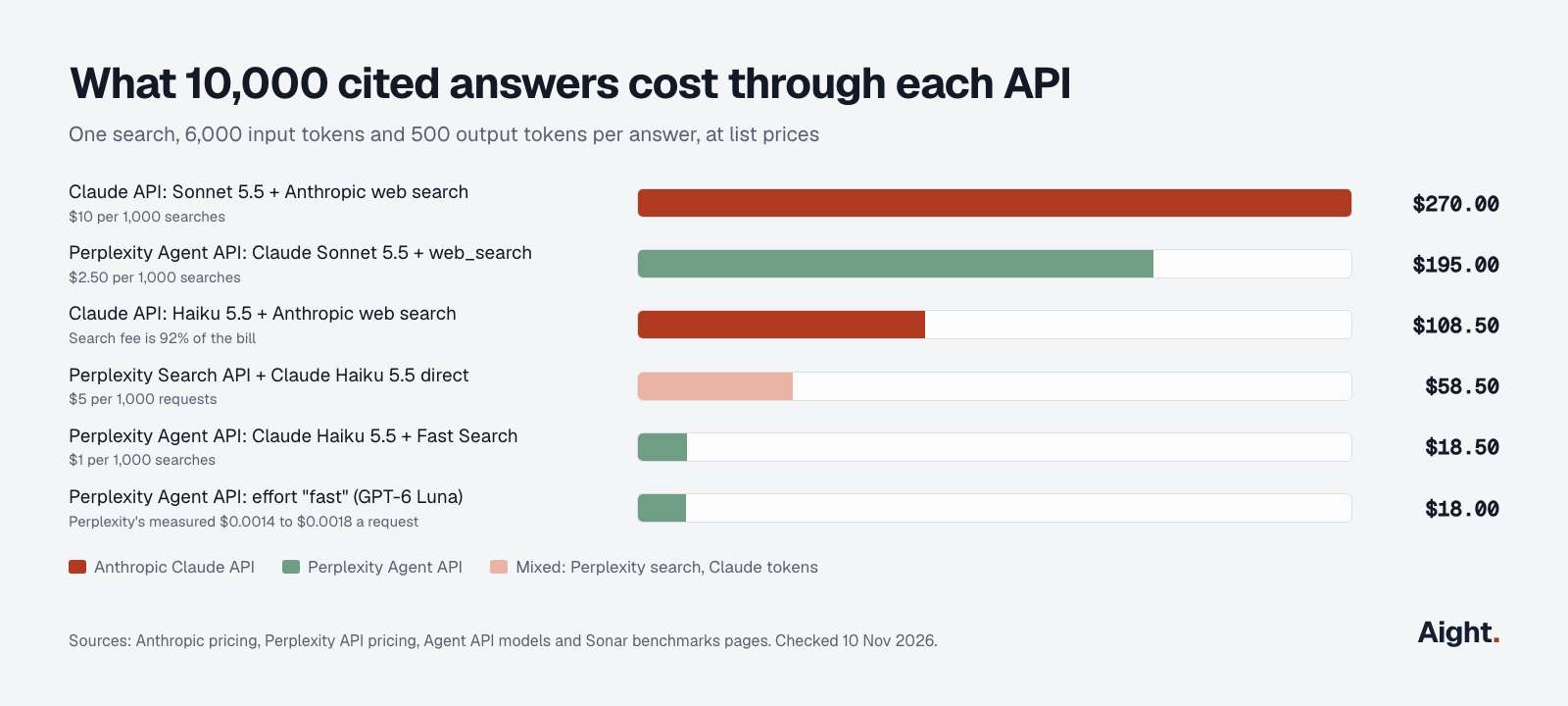
Assume each answer runs one web search and uses 6,000 input tokens (question plus search results) and 500 output tokens. The token count is an assumption; Anthropic's newer web_search_20260209 and later versions filter results with code before they reach the model, which cuts input tokens, so measure your own usage fields. The token cost calculator helps with your own numbers.
| Setup | Per answer | Per 10,000 |
|---|---|---|
| Claude API: Sonnet 5.5 + Anthropic web search | $0.0270 | $270.00 |
Perplexity Agent API: Claude Sonnet 5.5 + web_search | $0.0195 | $195.00 |
| Claude API: Haiku 5.5 + Anthropic web search | $0.0109 | $108.50 |
| Perplexity Search API + Claude Haiku 5.5 on the Claude API | $0.0059 | $58.50 |
| Perplexity Agent API: Claude Haiku 5.5 + Fast Search | $0.0019 | $18.50 |
Perplexity Agent API: effort fast (GPT-6 Luna), Perplexity's measured cost | $0.0014 to $0.0018 | $14.00 to $18.00 |
With a small model, the search fee is most of the bill: on Haiku 5.5 through the Claude API, $100 of the $108.50 is searches. That's where Perplexity's $1 to $2.50 per 1,000 makes the largest difference. With Sonnet 5.5 the tokens dominate and the gap narrows to 28%.
The deep end looks different. Perplexity's own benchmark puts xhigh (Claude Opus 5.5 with search and a code sandbox) at $0.218 to $0.78 a request, against $0.57 to $0.61 for the retired Sonar Deep Research, with much higher accuracy (Perplexity benchmarks). These are Perplexity's numbers on its own test runs.
For a full breakdown of Claude's token prices, caching and Batch, see the Claude API pricing guide.
Calling Claude through each API
Claude Sonnet 5.5 with Fast Search on Perplexity's Agent API, using perplexityai 0.46.1. Anthropic models there require max_output_tokens, or the request returns a 400.
# pip install perplexityai
from perplexity import Perplexity

client = Perplexity()  # reads PERPLEXITY_API_KEY

response = client.responses.create(
    model="anthropic/claude-sonnet-5-5",
    input="What changed in the latest stable Rust release?",
    tools=[{"type": "web_search", "search_type": "fast"}],
    max_output_tokens=1000,
)
print(response.output_text)
The same question on the Claude API with Anthropic's web search tool, using anthropic 2.7.0. max_uses caps the searches, and with them the $10 per 1,000 fee.
# pip install anthropic
import anthropic

client = anthropic.Anthropic()  # reads ANTHROPIC_API_KEY

message = client.messages.create(
    model="claude-sonnet-5-5",
    max_tokens=1000,
    messages=[{"role": "user", "content": "What changed in the latest stable Rust release?"}],
    tools=[{"type": "web_search_20260318", "name": "web_search", "max_uses": 3}],
)
print("".join(b.text for b in message.content if b.type == "text"))
Both requests were checked with fake keys against the live endpoints, which returned the expected 401 errors. No Claude subscription includes Perplexity's API, and no Perplexity plan includes it either: Perplexity's API "has its own model catalog" and its own billing. The Claude API key guide covers setting up Anthropic's side.
Claude through Aight, with Perplexity for search
Aight doesn't sell Perplexity's models or a web search tool, so for cited answers the Agent API above is the simpler route. Aight only fits if you already send Claude, GPT or Gemini traffic through one key and want to add search from Perplexity's Search API yourself.
In that setup, Aight lists Claude Opus 5.5 at $4 / $20 and Sonnet 5.5 at $2 / $10 per 1M tokens, Anthropic's list prices, behind one OpenAI-compatible endpoint (https://api.getaight.ai/v1). A $100 recharge costs $103 with the 3% processing fee and adds $110 of balance with the 10% extra, about $0.94 per $1 of list-price usage. Each key can carry a monthly cap and an allowed-model list.
One limit matters for this use case. Aight's API reference documents chat completions, embeddings and the model list only, with no search tool, so the search half always comes from Perplexity.
What users and benchmarks report
- "Claude and ChatGPT basically offer the same functionality now, but with better models and more features." (Hacker News commenter, 6 Nov 2026, link). The same commenter says Perplexity quietly switched their selected model to a lower-cost one.
- A Hacker News commenter collecting evidence of model swaps says answers dropped in quality until the selector showed "default GPT or Sonar" (21 Jul 2026, link).
- "Perplexity Pro $17/month; perfect for this complete non-techie/normie." (Hacker News commenter, 5 Nov 2026, link)
- An analysis of 1,024 subscriber posts by Okaneland reports weekly Pro Searches cut from 200 to 100 in May 2026, and notes "The pricing page publishes no numbers for Pro." (July 2026, link)
- On Search Arena's 8 November 2026 snapshot, Claude Opus 4.6 with search scores 1252, and Perplexity's retired Sonar Pro scores 1130 (Arena).
- Perplexity's own benchmark has its
loweffort level beating Sonar Deep Research on both of its tests "at 1-2% of its per-request cost" (Perplexity docs).
FAQ
Does Perplexity use Claude?
Yes. Perplexity Pro includes Claude Sonnet 5.5 in Search, and Perplexity Max adds Claude Opus 5.5 and Claude Fable 5.1. Its xhigh and ultra API effort levels also run on Claude Opus 5.5. Perplexity runs these models with its own search, prompts and limits, so answers can differ from Claude's own apps.
Is Perplexity Pro worth it if you already pay for Claude Pro?
Only if you research a lot. Claude Pro already searches the web with citations and includes Research, so Perplexity Pro adds more citations per answer, other companies' models, premium finance data and Computer. Perplexity Free, with 3 Pro Searches a day, covers occasional sourced lookups at no cost.
Is Claude better than Perplexity for coding?
Yes for most coding work. Every paid Claude plan includes Claude Code, which edits files and runs commands in your repository, while Perplexity answers coding questions in Search and builds apps through its Computer agent, metered at about $1 per 100 units. For looking up a library's latest API, Perplexity's sourced answers are still useful.
Can Perplexity replace Google Search?
For questions, often yes: Perplexity answers with sources instead of a list of links, and Free includes practically unlimited basic searches. To reach a specific site or page, a list of links is still the direct route. Claude is not designed as a search engine replacement.
Does Perplexity train on your searches?
By default Perplexity may use consumer searches to improve its AI, and Pro and Max users can opt out in Account Settings. Enterprise plans are never used for training, and the API keeps no data, according to Perplexity's Pro page and plan comparison.
Is the Perplexity Sonar API still available?
Not as a product. Sonar Chat Completions support ended on 27 September 2026; existing synchronous and streaming calls are being moved onto the Agent API, and asynchronous calls stopped working. The perplexity/sonar model is still listed on the Agent API at $0.25 / $2.50 per 1M tokens, and Perplexity maps old Sonar models to effort levels: Sonar and Sonar Pro to fast, Sonar Reasoning Pro to low, Sonar Deep Research to high.
Sources
Perplexity
- Pricing (Free, Pro, Max, Enterprise)
- Perplexity Pro page and FAQ
- Perplexity Max page
- Help center: which plan is right for you
- Help center: advanced AI models by plan
- Help center: What is Perplexity Pro?
- Help center: Perplexity Max
- Help center: How Computer usage is billed
- Help center: default model
- API pricing
- Agent API models
- Agent API effort levels
- Migrate from Sonar to the Agent API
- Agent API vs Sonar benchmarks
- API changelog
- Perplexity on the App Store
Anthropic
- Claude plans and pricing
- Claude API pricing
- Claude Platform release notes
- Web search tool docs
- Help center: enable and use web search
- Help center: use Research on Claude
Independent
- Arena Search leaderboard, 8 Nov 2026
- Okaneland: Perplexity Pro limits study
- Hacker News comment, 6 Nov 2026
- Hacker News comment, 21 Jul 2026
- Hacker News comment, 5 Nov 2026
- CloudZero: Perplexity pricing, 21 Sep 2026
- PyPI: perplexityai and anthropic
Aight
Checked on 10 November 2026. Updated 17 November 2026: Aight's current model list.