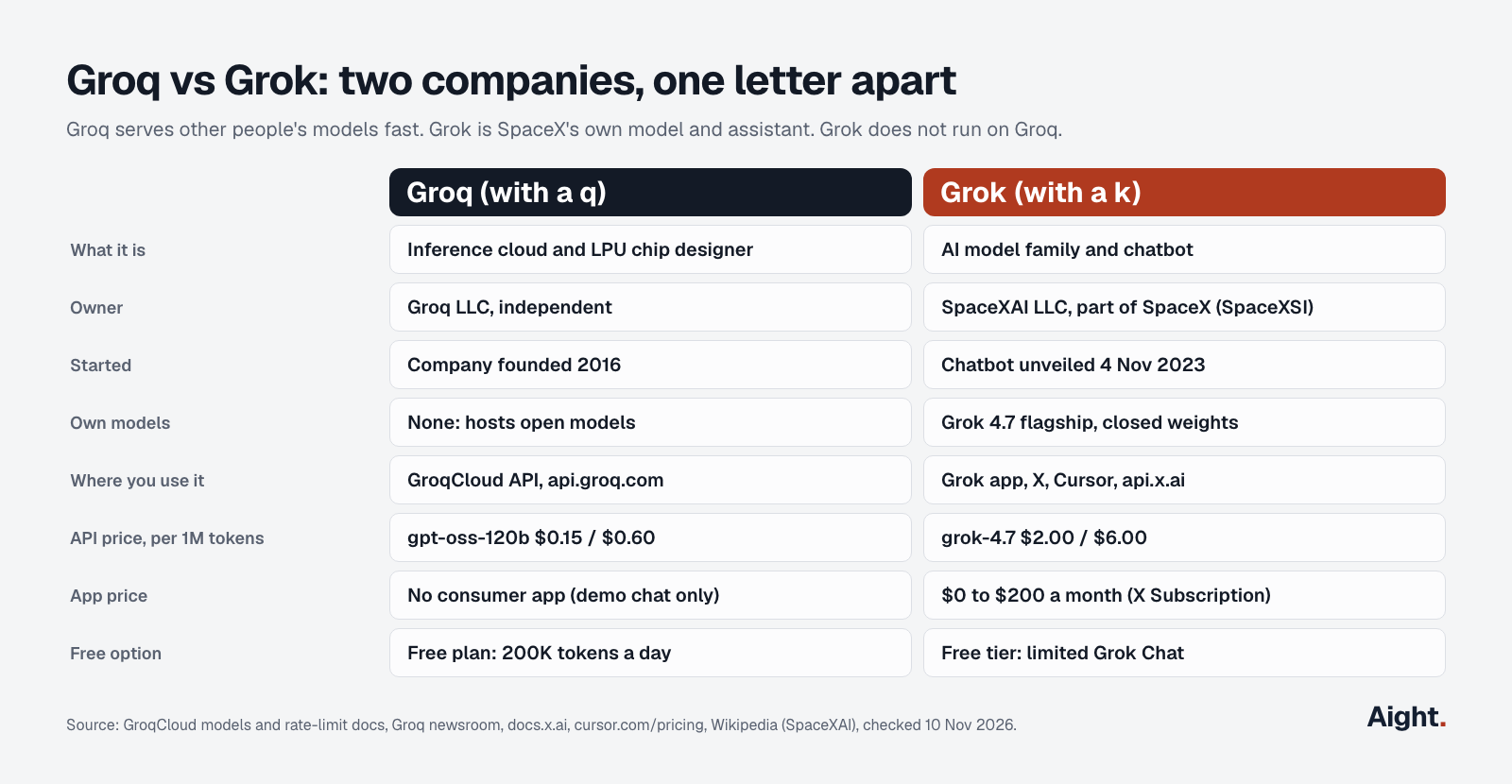
Groq vs Grok comes down to two unrelated companies with names one letter apart. Groq (with a q) is an inference company: it designed the LPU chip and runs GroqCloud, an API that serves other people's open models such as OpenAI's gpt-oss-120b very fast. Grok (with a k) is a family of AI models and a chatbot built by xAI, the Elon Musk company that SpaceX bought in February 2026 and now brands SpaceXSI.
Groq does not make a chatbot you would use instead of ChatGPT, and Grok does not run on Groq. Groq is something a developer calls from code. Grok is something you chat with on grok.com, in X or in Cursor, or call through the xAI API. The rest of this post covers what each sells, what each costs on 10 November 2026, and the 2023 trademark fight over the name.
Groq vs Grok at a glance
| Groq | Grok | |
|---|---|---|
| What it is | Inference cloud and chip designer | AI model family and chatbot |
| Owner | Groq LLC, independent, US-based | SpaceXAI LLC, a SpaceX subsidiary (brand: SpaceXSI) |
| Founded or launched | Company founded 2016 | Chatbot unveiled 4 November 2023 |
| Makes its own models | No, it hosts open models | Yes, Grok 4.7 is the current flagship |
| Main product | GroqCloud API at api.groq.com | Grok app, X, Cursor, and the API at api.x.ai |
| Who uses it | Developers who need fast, low-cost tokens | Consumers, X users, Cursor users, developers |
| Typical price | gpt-oss-120b at $0.15 / $0.60 per 1M tokens | Grok 4.7 at $2.00 / $6.00 per 1M tokens; apps from $0 to $200 a month |
What Groq is: LPU chips and GroqCloud
Groq was founded in 2016 by former Google engineers led by Jonathan Ross, one of the designers of Google's TPU (Wikipedia). Its chip, first called the Tensor Streaming Processor and later renamed the Language Processing Unit (LPU), keeps model weights in on-chip SRAM instead of separate high-bandwidth memory. Groq's own LPU explainer puts that SRAM bandwidth above 80 TB/s against about 8 TB/s for GPU memory, and describes a compiler that schedules every step ahead of time, so a request runs the same way every time.
The trade-off is capacity. SRAM is fast but small, so a big model has to be spread across many chips. That is why Groq sells tokens, not chips, to most customers.
2026 changed the company more than any year before it:
- On 24 December 2025 Groq signed a non-exclusive licensing agreement with Nvidia. Ross, president Sunny Madra and other staff moved to Nvidia, and Groq said GroqCloud would keep running. The reported price was about $20 billion (TechCrunch); neither company published a figure.
- At GTC on 16 March 2026 Nvidia announced Groq 3 LPX racks, 256 LPUs each, paired with Vera Rubin GPU racks so the GPUs read the prompt and the LPUs generate tokens (The Register).
- Groq raised $650 million in June under a new CEO, Adam Winter, became an Nvidia Cloud Partner on 12 August, and closed a $350 million Series A at a $3.5 billion valuation on 17 August. It reports 13 data centers and more than six million developers.
So in November 2026 Groq is best described the way its homepage now does: an inference cloud ("neocloud") that runs its own LPUs and is adding Nvidia hardware. It does not train frontier models.
What GroqCloud serves and charges
GroqCloud's models page lists these on 10 November 2026:
| Model on Groq | Price per 1M tokens (input / output) | Speed Groq quotes | Status |
|---|---|---|---|
| openai/gpt-oss-120b | $0.15 / $0.60 | about 500 tokens/s | Production |
| openai/gpt-oss-20b | $0.075 / $0.30 | about 1,000 tokens/s | Production |
| qwen/qwen3.8-27b | $0.80 / $4.00 | about 450 tokens/s | Preview |
| llama-3.3-70b-versatile | Contact sales | about 280 tokens/s | Enterprise |
| whisper-large-v3-turbo | $0.04 per audio hour | n/a | Production |
Two things stand out. The Llama models that made Groq famous in 2024 now sit behind an enterprise contract, and there is no Grok model anywhere in the list.
The free plan needs no card and allows 30 requests a minute, 1,000 a day and 200,000 tokens a day on gpt-oss-120b. The Developer plan raises that to 1,000 requests and 250,000 tokens a minute, adds Batch and Flex processing, and bills monthly in arrears, with early charges at $1, $10, $100, $500 and $1,000 of lifetime use (billing FAQ). Groq also runs a demo chatbot at chat.groq.com, but it exists to show speed, not to compete with Grok or ChatGPT.
What Grok is: SpaceX's model and chatbot
Grok is the model family and assistant from the company Musk founded as xAI on 9 March 2023. Grok was unveiled on 4 November 2023. SpaceX acquired xAI in an all-stock deal on 2 February 2026, renamed it SpaceXAI in July, and since mid-October has branded it SpaceX Super Intelligence, or SpaceXSI; the legal entity is still SpaceXAI LLC (Wikipedia). The developer docs now carry the title "SpaceXSI Docs", while the product is still called Grok.
The name comes from Robert A. Heinlein's 1961 novel Stranger in a Strange Land, where to grok means to understand something intuitively or by empathy (Wikipedia).
Grok for app users
Since 12 October, Grok is sold inside The X Subscription, one bundle of Grok, X Premium and Cursor (Cursor pricing, Yahoo Finance):
| Plan | Price a month | What it gives you in Grok |
|---|---|---|
| Free | $0 | Limited Grok Chat and image generation |
| Plus | $8 | Shared usage pool across Grok Chat, Voice, Imagine, Build and Grok API access, plus Cursor; Grok models only |
| Premium | $30 | 4x Plus usage, latest Grok models, Grok Bot, faster responses |
| Super | $100 | 15x Plus usage, priority access at peak times |
| Ultra | $200 | 50x Plus usage, earliest access to new models |
Grok's live-information edge comes from search. The models page states that Grok 4.7 has a May 2026 knowledge cutoff and knows nothing newer unless Web Search or X Search is turned on. For how the app compares with ChatGPT for everyday use, see Grok vs ChatGPT.
Grok for developers
The xAI API's flagship is grok-4.7 (model page): a 500,000-token context window, $2.00 input, $0.50 cached input and $6.00 output per million tokens. Once a prompt reaches 200,000 tokens, the whole request bills at $4.00 / $1.00 / $12.00. Batch requests get 20% off, and new accounts start at 150 requests a second. The older grok-4.3 costs $1.25 / $2.50.
Grok 4.7 also runs outside xAI: on Amazon Bedrock since 28 September and Microsoft Foundry since 6 October. Rate limits, data retention and billing terms for xAI next to other providers are in the best LLM API comparison.
Can you run Grok on Groq?
No. GroqCloud's catalog has no Grok model, OpenRouter lists only xAI and Amazon Bedrock as hosts for Grok 4.7 (endpoints), and neither company has announced a deal to change that. Current Grok models are closed weights, so only SpaceXSI and the clouds it licenses can serve them.
Two older Grok models do have public weights:
| Model | Released | Size | License |
|---|---|---|---|
| Grok-1 | 17 March 2024 | 314B parameters, mixture of 8 experts, 8,192-token context | Apache 2.0 |
| Grok 2 | 22 August 2025 | About 500 GB checkpoint, needs 8 GPUs with over 40 GB each | Grok 2 Community License: commercial use only under xAI's acceptable use policy, no training other models |
In theory any host could serve these. In practice no public Groq endpoint does, and both are well behind current models. Size also works against it on LPUs: The Register calculated that a 256-chip LPX rack holds 128 GB of SRAM, a fraction of what a model of Grok 2's size needs.
If what you want is Groq's speed with a capable model, the realistic choice is an open model Groq already hosts, such as gpt-oss-120b. If you want Grok, call xAI, Bedrock or Foundry.
How fast Groq really is
Groq's speed claim holds up in independent tests, though it is no longer alone. Artificial Analysis runs the same gpt-oss-120b workload against every host:
| Host of gpt-oss-120b | Minutes per task | Seconds to first answer token | Cost per task |
|---|---|---|---|
| Cerebras | 0.9 | 1.90 | $0.76 |
| SambaNova | 3.1 | 5.86 | $0.49 |
| Groq | 3.4 | 4.51 | $0.32 |
| Microsoft Azure | 5.2 | 9.83 | $0.35 |
| Amazon Bedrock | 13.9 | 19.64 | $0.35 |
| Together AI | 17.2 | 19.35 | $0.35 |
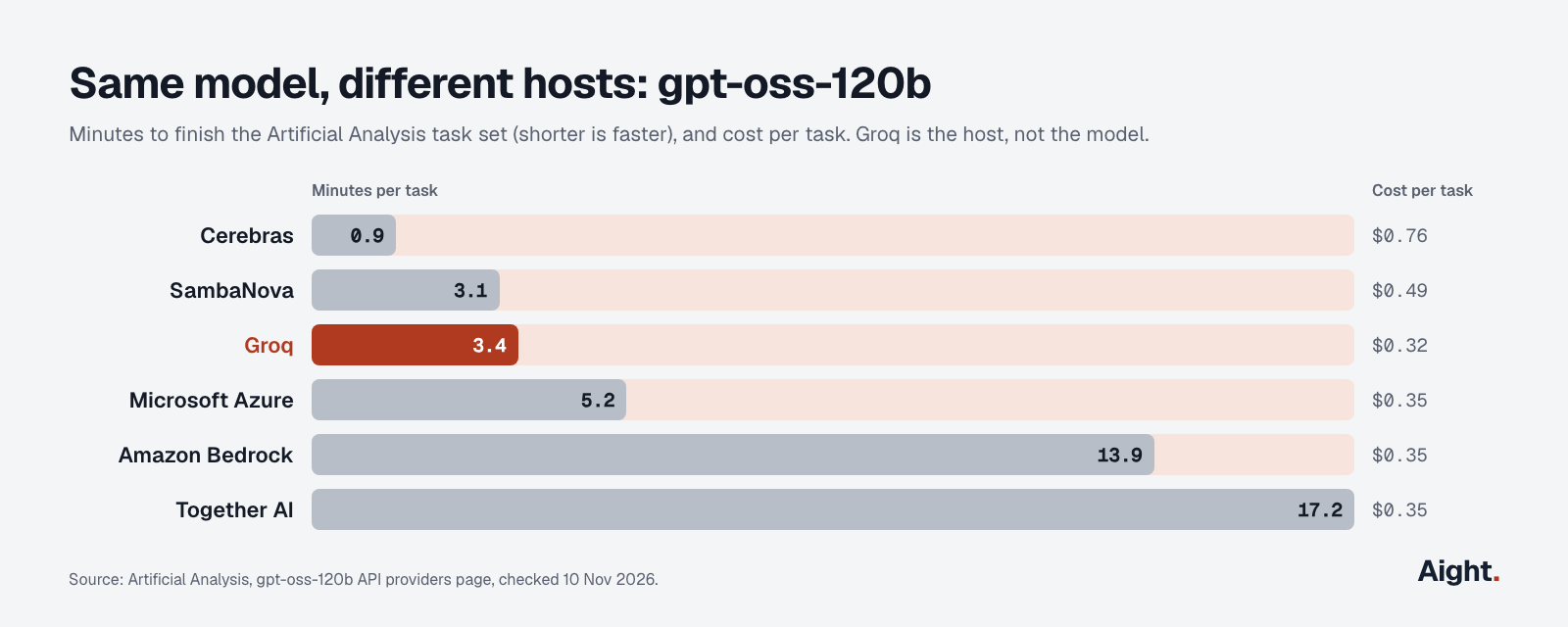
Groq is about four times faster than Bedrock on the same model at a slightly lower price per task. Cerebras is faster still but costs more than twice as much per task. This is the comparison that matters for Groq. Comparing Groq with Grok on speed is comparing a host with a model.
The Groq vs Grok name dispute
Groq had the name first, and said so publicly within days of Grok's launch. The sequence, from the original posts and filings:
- 9 November 2023: Ross published "Welcome to Groq's Galaxy, Elon", calling the chatbot's name phonetically identical to Groq's name and trademark and suggesting "Slartibartfast the Chatbot" instead (archived post).
- 29 November 2023: a mock cease-and-desist, "Hey Elon, it's time to cease de-grok", asked Musk to pick another name and noted that "the difference of one consonant (q, k) only matters to scrabblers and spell checkers" (archived post). Techdirt called it a funny one.
- 2024: the US Patent and Trademark Office refused xAI's original GROK applications, citing registered marks for GROQ, GROK HEALTH and GROCK STREAM plus 16 pending applications, and suspended them (Gerben IP, Trademarkia).
- 17 June 2025: new refusals for XAI GROK and a GROK logo mark, citing 28 earlier marks (Gerben IP). A separate startup, Bizly, also claims earlier use of Grok (CO/AI).
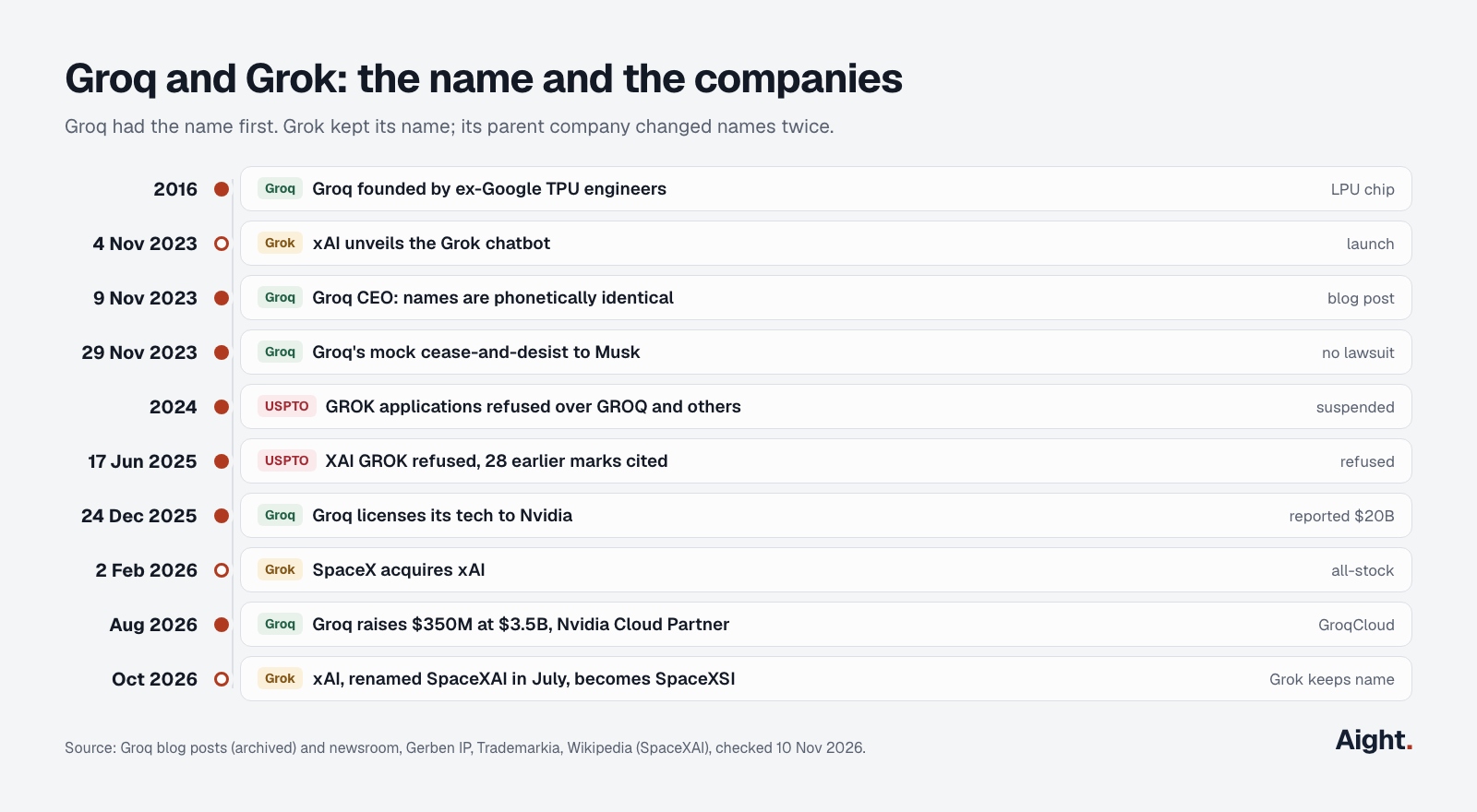
No lawsuit between Groq and xAI has been reported, and Grok was never renamed. Using an unregistered name is legal in the US; the refusals only stop xAI from owning "Grok" as a federal trademark. No public update on those applications after June 2025 could be found for this post, so check the USPTO record if the current status matters to you. The irony of 2026 is that the parent company did change its name, twice, while the chatbot kept the one Groq objected to.
Using both from the same code
Both APIs accept the OpenAI SDK, so the same client code talks to either one. Only the base URL, key and model name change (Groq OpenAI compatibility, xAI quickstart). Tested with openai 3.48.0 for Python:
import os
from openai import OpenAI

groq = OpenAI(base_url="https://api.groq.com/openai/v1", api_key=os.environ["GROQ_API_KEY"])
grok = OpenAI(base_url="https://api.x.ai/v1", api_key=os.environ["XAI_API_KEY"])

for name, client, model in [("Groq", groq, "openai/gpt-oss-120b"), ("xAI", grok, "grok-4.7")]:
    r = client.chat.completions.create(
        model=model,
        messages=[{"role": "user", "content": "In one sentence, what is an LPU?"}],
    )
    print(name, model, r.choices[0].message.content)
A wrong key fails differently on each, which helps when a log only says "Grok" or "Groq". Groq returns HTTP 401 with "code":"invalid_api_key". xAI returns HTTP 400 with "code":"invalid-argument" and the message "Incorrect API key provided". If you see a 400 on what should be an auth problem, you are talking to xAI. If keys are new to you, see what an API key is.
To price the same workload on both, paste the token counts into the token cost calculator. At list prices, 10 million input and 2 million output tokens cost $2.70 on gpt-oss-120b at Groq and $32.00 on Grok 4.7 at xAI, before caching or Batch. That gap is the price of a frontier model against an open one, not of one company against the other.
Which one you need
- You want a chatbot or assistant to talk to: Grok, through grok.com, X or the Grok apps. Groq has nothing comparable.
- You write code with Cursor and want Grok included: The X Subscription, from $8 a month. See Cursor vs Claude Code for what changed in Cursor.
- You need Grok 4.7 in your own product: the xAI API, or Bedrock or Foundry if your company already buys through AWS or Azure.
- You need the lowest latency per token on an open model, for voice agents, autocomplete or chained agent steps: GroqCloud, starting on the free plan. Free LLM APIs compares Groq's free limits with others.
- You need open models at the lowest price and speed matters less: compare hosts first, as in alternatives to the OpenAI API.
What developers say about the mix-up
- "They're unrelated. Groq = chip company, Grok = model by x.ai." (Hacker News commenter, 8 Dec 2025, link)
- "Groq and Grok are distinct entities. They just have similar names." (Hacker News commenter, 27 Dec 2025, link)
- A developer reported signing up for Groq to get fast code suggestions from qwen3-32b and gpt-oss-20b in JetBrains, while keeping Claude Code as the main agent (Hacker News commenter, 29 Aug 2025, link).
- A commenter criticized a product launch for listing Grok and Groq in one block as if they were related (Hacker News commenter, 11 Apr 2025, link).
- "Mistral vs mistral.rs, Llama and llama.cpp and ollama, groq and grok." (Hacker News commenter on confusing AI names, 5 Feb 2025, link)
For how Grok compares with Google's models, see Grok vs Gemini.
FAQ
Is Groq owned by Elon Musk?
No. Groq is an independent US company chaired by Alex Davis of Disruptive and run by CEO Adam Winter. Musk's AI company is xAI, now SpaceXAI under SpaceX, which makes Grok. No ownership link between the two has been reported.
Did Nvidia buy Groq?
Not the company. In December 2025 Nvidia licensed Groq's inference technology on a non-exclusive basis and hired its founder and many engineers, in a deal reported at about $20 billion. Groq LLC kept GroqCloud and has since raised $1 billion in 2026, with Nvidia planning to join the August round.
Is Groq free?
GroqCloud has a free plan with no card required, limited to 30 requests a minute and 200,000 tokens a day on gpt-oss-120b. Beyond that you move to the pay-as-you-go Developer plan, where gpt-oss-120b costs $0.15 / $0.60 per million tokens.
Is Grok free?
Yes, with limits. The free tier of The X Subscription includes limited Grok Chat and image generation. Paid tiers run from $8 to $200 a month, and the xAI API is billed per token.
Is Groq faster than Grok?
They measure different things. Groq is a host, and on gpt-oss-120b it finishes a benchmark task in 3.4 minutes against 13.9 on Amazon Bedrock. Grok is a model, served by xAI and the clouds it licenses, and Groq does not offer it.
How do you pronounce Groq and Grok?
The same way, like "grock". Groq's founder made exactly that point in 2023: the names are phonetically identical, and only the last letter differs in writing.
Sources
- Groq: homepage, LPU explained, Nvidia licensing agreement, 24 Dec 2025, $650M raise, 22 Jun 2026, Nvidia Cloud Partner, 12 Aug 2026, $350M Series A, 17 Aug 2026, Groq 3 LPX deployment, 24 Aug 2026, Groq Chat
- GroqCloud docs: models, rate limits, billing FAQ, OpenAI compatibility
- Groq on the name (archived): Welcome to Groq's Galaxy, Elon, 9 Nov 2023, Hey Elon, it's time to cease de-grok, 29 Nov 2023
- xAI / SpaceXSI docs: models and pricing, grok-4.7, grok-4.3, rate limits, quickstart
- xAI open weights: grok-1 on GitHub, grok-2 on Hugging Face
- Cloud hosts: AWS, Grok 4.7 on Amazon Bedrock, Microsoft, Grok 4.7 on Microsoft Foundry, OpenRouter endpoints for Grok 4.7
- Plans: Cursor pricing (The X Subscription), Yahoo Finance, SpaceX bundles Grok, X and Cursor
- Benchmarks: Artificial Analysis, gpt-oss-120b providers
- News and reference: TechCrunch on the $20B report, The Register on Groq 3 LPX, Techdirt on the letter, Wikipedia: Groq, Wikipedia: SpaceXAI, Wikipedia: Grok (word)
- Trademarks: Gerben IP on the USPTO refusals, Trademarkia, CO/AI on the Bizly claim
- Hacker News: 46197744, 46404672, 45068258, 43657677, 42953133
Checked on 10 November 2026.