Grok vs ChatGPT comes down to this: ChatGPT is the stronger assistant for reasoning, research, coding and images, and Grok is the better pick if you live on X, want video generation, or want an AI plan bundled with X Premium and Cursor. On Artificial Analysis's independent index, OpenAI's GPT-6.1 Sol scores 55 against 35 for Grok 4.7, and finishes a task for $1.27 against $7.77.
The prices line up closely. Both have a free tier and an $8 plan, ChatGPT Plus costs $20 and Grok's Premium $30, and both offer $100 and $200 tiers; ChatGPT adds a $500 Pro plan. What follows covers the Grok vs ChatGPT differences 2026 has brought: the models inside each app, live X data against ChatGPT search, images and video, every plan, the benchmarks, and, for builders, Grok 4.7 vs GPT-6 API prices. Everything was checked on 10 November 2026.
The short answer
- Pick ChatGPT for the best answers on hard questions, research with sources, coding, documents and images. GPT-6.1 Sol leads Grok 4.7 on seven of the nine benchmarks in the Artificial Analysis index, and OpenAI's newest image model ranks first on Artificial Analysis's text-to-image leaderboard.
- Pick Grok if you want to know what people on X are saying right now, if you want video (ChatGPT has made none since OpenAI closed the Sora app on 26 April 2026), or if you already pay for X Premium or Cursor, since one X Subscription now covers all three.
- The free tiers differ in kind. ChatGPT Free gives unlimited text chats on GPT-6 Luna; Grok Free gives limited chat and no video.
- On price per month, the plans match at $0, $8, $100 and $200. In the middle, ChatGPT Plus costs $20 and Grok Premium $30.
- In the API, Grok 4.7 costs less per token than GPT-6.1 Sol ($2 / $6 against $2 / $10 per 1M tokens), but its cache reads cost five times as much and it writes more tokens per task, so agent workloads usually cost more on Grok.
Grok vs ChatGPT comparison 2026, side by side
| Grok | ChatGPT | |
|---|---|---|
| Company | xAI, now SpaceX Super Intelligence (SpaceXSI) | OpenAI |
| Top model in the app | Grok 4.7 (Expert and Heavy modes) | GPT-6 Sol in chat on paid plans; GPT-6 Astra for Pro reasoning; GPT-6.1 Sol in Work and Codex |
| Free model | Fast mode | GPT-6 Luna, unlimited text chats |
| Live data | X Search over posts, profiles and threads, plus web search | Web search with sources; no X search tool |
| Images | Grok Imagine Image 2.0, limited on Free | ChatGPT Images 2.6 (4 Nov 2026), GIFs, saved reference images |
| Video | Grok Imagine Video 1.5 from Premium ($30); 1080p, 15-second clips on Super | None since 26 April 2026 |
| Voice | Grok Voice 3.0 (14 Oct 2026) | GPT-Live-1.1 (15 Oct 2026) |
| Agents and coding | Grok Bot, Grok Build, Cursor included | ChatGPT Work, Codex, Dot (Pro) |
| Paid plans | $8, $30, $100, $200 | $8, $20, $100, $200, $500 |
| Also included | X Premium features, Cursor | Monthly API usage on Pro |
| API flagship price | grok-4.7: $2 / $6 per 1M tokens | gpt-6.1-sol: $2 / $10 per 1M tokens |
Models inside each app
Grok's model picker on grok.com has four modes. Fast gives quick replies, Auto chooses between Fast and Expert, Expert "thinks hard" on Grok 4.7, and Heavy runs a "Team of Experts" on Grok 4.7. Auto, Expert and Heavy require you to sign in. xAI released Grok 4.7 on 21 September 2026, first in Cursor, Grok Build and the API, and calls it its most capable model for coding and knowledge work. xAI's pricing page lists "Latest Grok models" from the $30 Premium plan up.
ChatGPT switched to GPT-6 on 7 October 2026. Per OpenAI's release notes, Plus, Pro, Business and Enterprise use GPT-6 Sol in chat, Free and Go use GPT-6 Luna, and the Pro reasoning option uses GPT-6 Astra. The same release added Intelligent UI, where answers can include comparisons, diagrams and small tools such as calculators. The plans page also lists GPT-6.1 Sol and GPT-6 Astra for Plus, and GPT-6.1 Sol is the main model in ChatGPT Work and Codex.
Context windows in ChatGPT depend on the plan: 27K tokens for GPT Instant on Free, 54K on Go and Plus, 128K on Pro, and 256K for reasoning models on Plus (400K on Pro). xAI doesn't publish a context limit for the Grok apps; in the API, Grok 4.7 takes 500K tokens and GPT-6.1 Sol 1,050,000.
Real-time X data vs ChatGPT search
This is the clearest difference between Grok and ChatGPT. Grok can search X itself: keyword and semantic search over posts, user search and whole threads, with filters by handle and date, and it can look at images and videos inside posts. That is xAI's X Search tool, which xAI describes as giving the model "real-time social media content". It sits alongside ordinary web search. Paid plans also include the Grok tab on X.
ChatGPT searches the web and cites its sources, and its paid plans add deep research. OpenAI's tools have no X search: the API pricing page lists web search, file search and containers, nothing that reads X directly. So ChatGPT sees X posts only when they surface through the web.
What that means in practice:
- For "what are people saying about this launch, game or outage right now", Grok has the better source, because posts reach it as they're published.
- For a question that needs checked facts, ChatGPT's cited web pages are the safer source. Fresh X posts are fast but often unverified, and Grok can repeat a claim that's trending before anyone has checked it.
- Neither model knows recent events without search. xAI's models page says Grok has no knowledge of current events beyond its training data unless search tools are on; Grok 4.7's training data runs to May 2026, and GPT-6.1 Sol's to 30 April 2026.
Images, video and voice
Images favor ChatGPT. OpenAI released ChatGPT Images 2.6 on 4 November 2026, with animated GIF creation and saved reference images you can reuse in later chats (save a photo of your dog once, then ask for "@Pepper" in watercolor). On Artificial Analysis's text-to-image leaderboard, built from blind votes, GPT Image 2.6 Sunburst ranks first with an Elo of 1,259. Grok Imagine Image 2.0 ranks eighth at 1,166. Free plans on both include limited image creation.
Video favors Grok, because ChatGPT has none. OpenAI announced on 24 March 2026 that it would discontinue Sora; the app and web version closed on 26 April and the API on 24 September, and ChatGPT's plans page lists no video feature. Grok includes video from Premium ($30), and Super ($100) adds 1080p, 15-second clips. Grok Imagine Video 1.5 takes text, image and voice references. It isn't a top video model: Artificial Analysis's text-to-video leaderboard puts it 15th, behind Wan 3.0, MiniMax H3 and Seedance 2.5.
Grok Imagine also carries a record. In January 2026 it produced a wave of sexualized deepfakes of real people, and in April NBC News reported that eight regulators and law enforcement bodies, including California's attorney general, the European Commission and Ofcom, were still investigating. xAI says it prohibits non-consensual explicit images.
Voice is close. xAI shipped Grok Voice 3.0 on 14 October and OpenAI shipped GPT-Live-1.1 on 15 October, with new accents and voices. Some users rate Grok's voice mode higher (see the reports below).
Plans and prices
Since 12 October 2026, Grok is sold as The X Subscription, one plan covering Grok, Grok Bot, Cursor and X Premium features. The older SuperGrok plans are closed to new buyers. ChatGPT's plans are on its pricing page, with US prices from OpenAI's Go announcement and the Pro tiers article.
| Price a month | Grok (The X Subscription) | ChatGPT |
|---|---|---|
| $0 | Free: limited chat and agent requests, limited images, no video | Free: unlimited text chats on GPT-6 Luna, limited images, deep research and Codex |
| $8 | Plus: chat, voice, images and Grok Build from a shared pool; Grok API access; X Premium checkmark and fewer ads | Go: GPT-6 Luna with more messages, uploads and images; may show ads |
| $20 | None | Plus: GPT-6 Sol and GPT-6.1 Sol, image generation with Thinking, expanded deep research and Codex |
| $30 | Premium: 4x Plus usage, latest Grok models, video, Grok Bot, Cursor cloud agents, ad-free X on most surfaces | None |
| $100 | Super: 15x Plus usage, 1080p 15-second videos, priority at peak times | Pro 100: Pro reasoning on GPT-6 Astra, unlimited images, longer Work and Codex sessions |
| $200 | Ultra: 50x Plus usage, earliest access to new models | Pro 200: more Work and Codex usage |
| $500 | None | Pro 500: the most usage, Astra Ultrafast |
| Teams | From $30 a user | Business: $25 a user monthly, $20 annually, 2 users minimum |
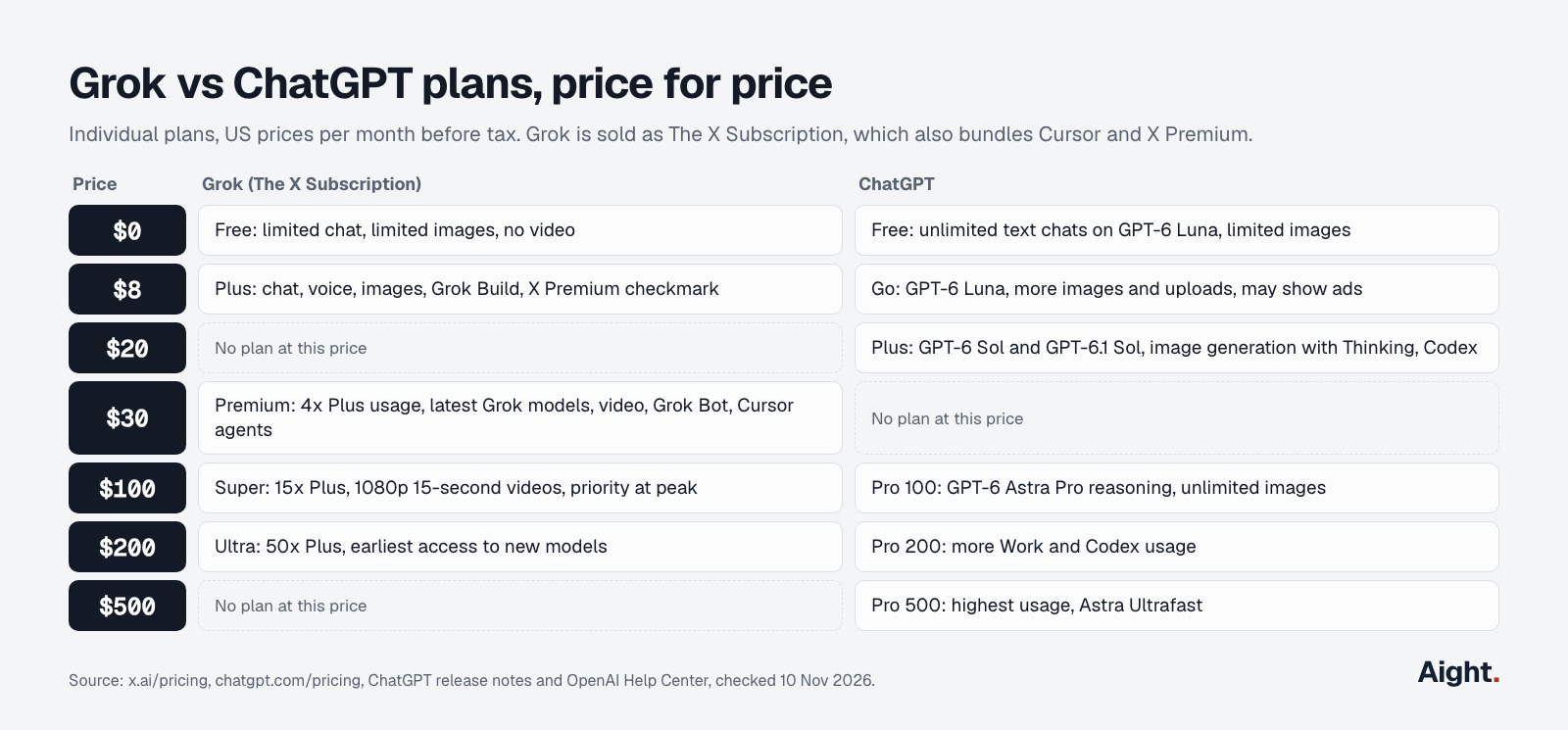
How the limits work differs. Grok's paid plans draw on one weekly pool shared by Chat, Imagine, Voice, Grok Bot and Cursor; xAI says the allowance "refreshes weekly", and past it you wait or pay for more usage. ChatGPT says text chats are unlimited on every plan, subject to abuse guardrails, with separate limits for images, uploads, deep research and Codex. From December, Plus, Pro and Business move to one token-based allowance shared across ChatGPT and Codex, though Instant chat won't draw from it.
Which plan costs less depends on what you'd use:
- For chat only, ChatGPT Free is the stronger free tier, and at $8 Go and Grok Plus are both entry plans; Grok Plus adds X Premium features.
- For the best model in each app, ChatGPT Plus at $20 gets GPT-6 Sol and GPT-6.1 Sol; Grok needs Premium at $30 for its latest models.
- For video, only Grok sells it, from $30.
- If you'd pay for X Premium or Cursor anyway, Grok Premium bundles them with Grok in one $30 plan. The Cursor vs Claude Code comparison covers what the Cursor part includes.
Privacy defaults are similar. ChatGPT's plans page says your content is used to train models on Free, Go, Plus and Pro, with an opt-out. xAI's privacy policy (updated 27 October 2026) lists training its models among the uses of your data, and its Private Chat mode keeps chats out of your history and deletes them within 30 days. Business and team plans on both sides offer stricter controls.
Grok vs ChatGPT benchmarks
Independent benchmarks put ChatGPT's models well ahead of Grok 4.7 on reasoning and coding, with Grok close or ahead on some office-work tests.
Artificial Analysis runs both through the same nine evaluations in its Intelligence Index v5.0.1, each at its highest effort setting:
| Benchmark | GPT-6.1 Sol (max) | Grok 4.7 (xhigh) |
|---|---|---|
| Intelligence Index v5.0.1 | 55 | 35 |
| Terminal-Bench 4.0 (agentic coding) | 56.1% | 25.8% |
| FrontierCode 2.0 (software engineering) | 40.6% | 28.7% |
| HLE-Diamond (reasoning and knowledge) | 58.8% | 23.2% |
| CritPt v2, hard subset (physics) | 69.5% | 33.5% |
| GDP.pdf (professional documents) | 31.0% | 20.0% |
| AA-Omniscience v1.1 (knowledge minus hallucination) | 42 | 31 |
| AutomationBench-AA (SaaS workflows) | 64.9% | 65.6% |
| AA-Briefcase v1.1 (office work, Elo) | 1,555 | 1,636 |
| Cost per task | $1.27 | $7.77 |
| Output tokens per task | 67.8K | 105K |
| Time to first answer token | 138 s | 56 s |
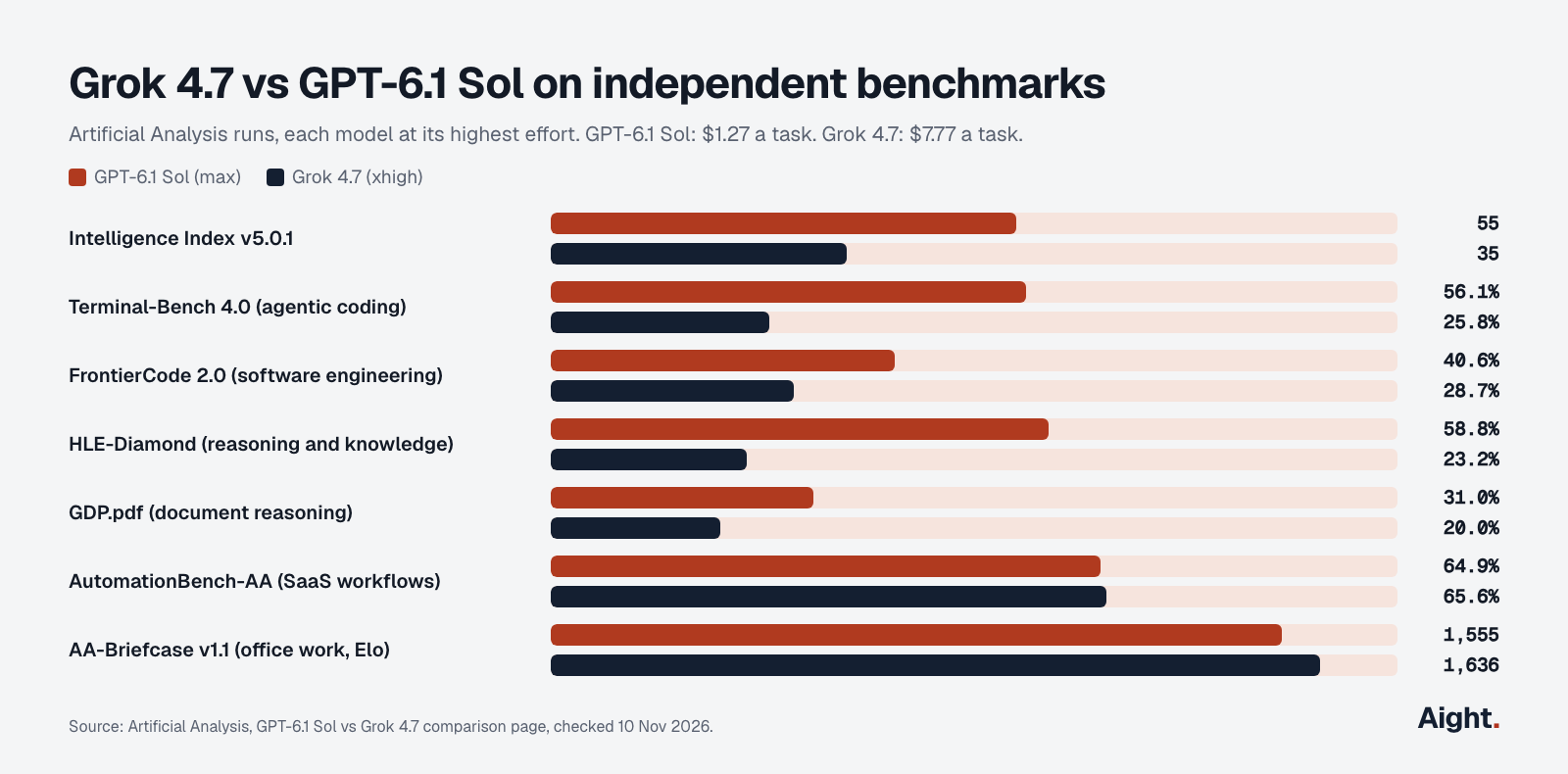
Four things to read from it:
- Grok wins office work. It beats GPT-6.1 Sol on AA-Briefcase, which grades multi-hour tasks such as building documents and analyses, and ties on SaaS automation. xAI's own launch post reports a GDPval Elo of 1,695 for Grok 4.7 against 1,542 for GPT-6 Astra.
- Grok loses badly on hard reasoning, science and agentic coding, where the gaps run from about 12 to 47 points.
- Grok answers sooner (56 seconds to the first answer token at max effort, against 138) but writes more, about 55% more output tokens per task.
- The index changed. At launch on 21 September, Grok 4.7 scored 46 against 53 for GPT-6 on the previous index (v4.3.2), The Decoder reported. The late-October v5 rescoring cost Grok 11 points, more than any other proprietary model, and some developers dispute it. The gap was large on both versions.
Human preference tells a milder ChatGPT vs Grok story. On Arena's text leaderboard, where people vote between two anonymous answers, GPT-6.1 Sol (max) scores 1,482 and ranks 27th, GPT-6 Sol (max), the model behind ChatGPT's chat, scores 1,457, and Grok 4.7 (xhigh) scores 1,442. For everyday chat, the three are within 40 points of each other, and xAI's older Grok 4.20 Beta (1,475) scores higher than Grok 4.7.
For coding agents specifically, the best LLM for coding ranking has Terminal-Bench and other runs for both families.
Which is better for what
Grok AI vs ChatGPT, task by task:
- Research and fact-checking: ChatGPT. Cited web search, deep research, and a 42 against 31 lead on Artificial Analysis's knowledge-and-hallucination test.
- Following live news, markets or reactions on X: Grok, with X Search.
- Coding: ChatGPT with Codex, or either model inside an agent. GPT-6.1 Sol scores more than twice Grok 4.7 on Terminal-Bench 4.0. If you already use Cursor, Grok 4.7 is included in its pool.
- Documents, spreadsheets and office tasks: close. Grok leads AA-Briefcase; ChatGPT leads on professional document reasoning (GDP.pdf).
- Images: ChatGPT, with the top-ranked image model.
- Video: Grok, since ChatGPT has no video.
- Writing with personality: Grok. On Artificial Analysis's PersonalityBench, judges found Grok 4.7's answers more eloquent than GPT-6.1 Sol's 86% of the time.
- Lowest cost for a capable assistant: ChatGPT Plus ($20) against Grok Premium ($30), unless you value the X Premium and Cursor parts of the bundle.
API prices: Grok 4.7 vs GPT-6
For builders, Grok vs GPT starts with the list prices per 1M tokens from xAI's pricing page and OpenAI's pricing page:
| Model | Input | Cached input | Output | Context | Long prompts |
|---|---|---|---|---|---|
| grok-4.7 | $2.00 | $0.50 | $6.00 | 500K | $4 / $1 / $12 from 200K prompt tokens |
| grok-4.3 | $1.25 | $0.20 | $2.50 | 1M | $2.50 / $0.40 / $5 from 200K |
| gpt-6-astra | $10.00 | $1.00 | $50.00 | 1.05M | $20 / $2 / $75 above 272K |
| gpt-6.1-sol | $2.00 | $0.10 | $10.00 | 1.05M | $4 / $0.20 / $15 above 272K |
| gpt-6-sol | $2.00 | $0.20 | $10.00 | 1.05M | $4 / $0.40 / $15 above 272K |
| gpt-6.1-terra | $1.00 | $0.05 | $5.00 | $2 / $0.10 / $7.50 above 272K | |
| gpt-6-luna | $0.10 | $0.01 | $0.50 | $0.20 / $0.02 / $0.75 above 272K |
The discounts differ too. xAI's Batch API takes 20% off grok-4.7; OpenAI's Batch and Flex take 50% off. Priority on xAI and Fast mode on OpenAI both cost 2x. OpenAI charges $2.50 per 1M for cache writes on gpt-6.1-sol (30-minute writes); xAI lists no write charge. xAI's US endpoint (us.api.x.ai) adds 10%. Live search costs extra on both: xAI's X Search bills $5 per 1,000 posts fetched and its web search $5 per 1,000 calls, against $10 per 1,000 calls for OpenAI's web search, plus tokens on both.
Grok 4.7's per-token price looks lower, but the bill depends on the workload. Two monthly examples at list price, with no Batch:
| Workload | grok-4.7 | gpt-6.1-sol | gpt-6-luna |
|---|---|---|---|
| Chat app: 100,000 requests, 3,000 tokens in (50% cached), 600 out | $735.00 | $990.00 | $50.25 |
| Agent: 50,000 calls, 50,000 tokens in (90% cached), 1,500 out | $2,075.00 | $1,600.00 | $91.25 |
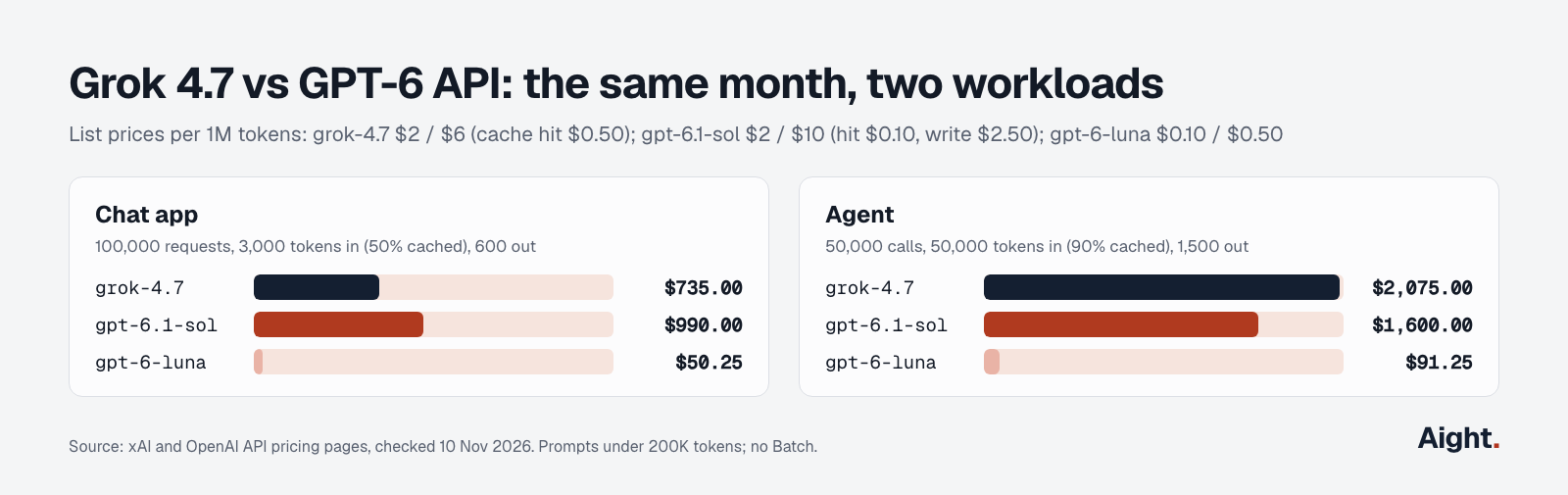
Grok costs 26% less for the chat app, where output dominates. The agent flips it: 2,250M cached tokens at $0.50 against $0.10 cost $1,125 on Grok and $225 on GPT-6.1 Sol. And if Grok writes 55% more output, as it did on Artificial Analysis's tasks, the chat app comes to $933 on Grok, close to GPT-6.1 Sol's $990. That's how Grok 4.7 ends up at $7.77 a task on the index against $1.27. GPT-6 Luna is in another price class entirely, if a small model is enough. The token cost calculator redoes this with your own numbers, and OpenAI token pricing covers OpenAI's cache, Batch, Flex and Fast rates.
Calling Grok with X Search takes a few lines. xAI's API works with the OpenAI SDK, and X Search runs through the Responses API:
import os
from openai import OpenAI

client = OpenAI(api_key=os.environ["XAI_API_KEY"], base_url="https://api.x.ai/v1")

response = client.responses.create(
    model="grok-4.7",
    input=[{"role": "user", "content": "What are developers saying about GPT-6.1 Terra on X?"}],
    tools=[{"type": "x_search", "from_date": "2026-10-26"}],  # $5 per 1,000 posts fetched
)
print(response.output_text)
xAI calls Chat Completions a legacy endpoint, and OpenAI's GPT-6 model pages point to the Responses API for built-in tools and function calling, so new code for either should use Responses. For rate limits, data terms and other providers, see the best LLM API comparison.
Grok and GPT through one key
If your app uses both families, Aight serves grok-4.7, gpt-6.1-sol, gpt-6-sol, gpt-6-astra and gpt-6-luna through one OpenAI-compatible Chat Completions endpoint (https://api.getaight.ai/v1) at list price, from one prepaid balance. A $100 recharge costs $103 outside India and adds $110 of balance, about $0.94 per $1 of list-price usage, and each key can have its own monthly cap and list of allowed models. The one API key guide shows the setup.
Going direct is better in several cases, and the catalog shows why:
- X Search and web search are xAI Responses API tools. Aight documents only Chat Completions, so live X data needs xAI directly.
- Aight's models page charges grok-4.7's higher price from 128K tokens, against 200K at xAI, so prompts between the two cost less direct.
- Batch discounts (20% on xAI, 50% on OpenAI) aren't available through Aight.
What users report
- "in voice mode Sol is much dumber, and Grok edges ahead" (a Hacker News commenter who rates GPT-6.1 Sol above Grok 4.7 for normal chat, 15 Oct 2026, link)
- "The problem with Grok 4.7 is that it's not amazing at anything" (a Hacker News commenter who still finds it a strong code reviewer, 24 Oct 2026, link)
- "Grok is okay but it's image generating has become the worst." (a Hacker News commenter who recommends ChatGPT for images, 24 Oct 2026, link)
- "Grok is even more restricted than even OpenAI's models" (a Hacker News commenter on refusals for role-play and security work, 8 Nov 2026, link)
- On one developer's PacBench game test, GPT-6.1 Terra scored 84 against Grok 4.7's 83, in 5.4 minutes for $0.19 against 36.5 minutes and $1.69 (Hacker News, 27 Oct 2026, link)
- A Hacker News commenter said Grok Bot's limits are now too low and moved to ChatGPT's Dot agent (6 Nov 2026, link)
The reports split along the benchmarks: GPT models win on capability and cost per result, while users praise Grok for voice, personality and some review work.
For Grok against Google's models, see Grok vs Gemini. If you were looking for Groq, the inference company, Groq vs Grok explains how the two differ.
FAQ
Is Grok better than ChatGPT?
For most tasks, no. GPT-6.1 Sol leads Grok 4.7 by 55 to 35 on the Artificial Analysis Intelligence Index and wins most of its benchmarks. Grok is better for live X data and video, slightly ahead on AA-Briefcase office tasks, and many users like its voice mode and writing style.
Is Grok free?
Yes, with limits. Grok Free has limited chat and agent requests and limited image generation, and no video. Logged out, you can use Fast mode on grok.com; Expert and Heavy, which run Grok 4.7, need sign-in, and xAI lists its latest models from the $30 Premium plan. ChatGPT Free offers unlimited text chats on GPT-6 Luna.
Can ChatGPT read X posts?
Not directly. ChatGPT searches the web and sees X posts only where they appear in its results, and OpenAI offers no X search tool. Grok can search X posts, profiles and threads as they're published, including images and videos in posts.
Does Grok or ChatGPT use your chats for training?
Both can on personal plans. ChatGPT says content on Free, Go, Plus and Pro is used to train its models unless you opt out. xAI's privacy policy lists training among the uses of your data, and Grok's Private Chat mode deletes conversations within 30 days.
Chat GPT vs Grok: which is better for coding?
ChatGPT. GPT-6.1 Sol scores 56.1% on Terminal-Bench 4.0 against 25.8% for Grok 4.7 on Artificial Analysis's runs, at about a sixth of the cost per task. Grok 4.7 is included in Cursor's plans, which some developers use for reviews and routine work.
Does the Grok API cost less than the OpenAI API?
Per token, Grok 4.7 costs less than GPT-6.1 Sol on output ($6 against $10) and the same on input ($2). Per task it usually costs more, because cache hits cost $0.50 against $0.10 and Grok writes more tokens. GPT-6 Luna, at $0.10 / $0.50, costs far less than either.
Sources
- xAI: Pricing and plans, Introducing Grok 4.7, News, Privacy policy, grok.com (model picker)
- xAI docs: API pricing, Models, X Search
- OpenAI: ChatGPT pricing, ChatGPT release notes, About ChatGPT Pro tiers, Introducing ChatGPT Go, Images 2.6 announcement
- OpenAI API: Pricing, GPT-6.1 Sol, GPT-6 Sol
- Artificial Analysis: GPT-6.1 Sol vs Grok 4.7, LLM leaderboard, Text-to-image leaderboard, Text-to-video leaderboard
- Arena: Text leaderboard
- The Decoder: Grok 4.7 launch and benchmarks, Sora shutdown dates
- NBC News: Grok is still making sexual deepfakes (14 Apr 2026)
- Hacker News comments: 50105143, 50219959, 50221584, 50414513, 50254188, 50398817, 50270428 (index v5 changes)
- Aight: Models and pricing, API reference, Token cost calculator
Checked on 10 November 2026. Updated 17 November 2026: Aight's current model list.