Cursor vs Claude Code is a choice between an editor and an agent. Cursor is a code editor built on VS Code, with its own autocomplete, agents and a menu of models; Claude Code is Anthropic's coding agent, which runs in your terminal, your IDE or a desktop app and uses only Claude. Since 12 October 2026, new Cursor plans include only Cursor's own models (Grok and Composer), and Claude in Cursor bills at API list price, while a $100 Claude Max plan covers Claude Code at a flat price inside its usage limits.
For heavy Claude use, that makes Claude Code the lower-cost route. Ten agent tasks a working day come to about $211 a month on Claude Sonnet 5.5 at list price, or $422 on Opus 5.5, and Cursor adds its $30 plan fee on top. You can also run Claude Code inside Cursor and keep both. Versions checked on 5 November 2026: Cursor 3.28.7 and Claude Code 2.1.318.
Cursor vs Claude Code at a glance
| Cursor | Claude Code | |
|---|---|---|
| What it is | Editor (a VS Code fork) with built-in agents | Anthropic's coding agent |
| Where you use it | Editor, Agents Window, agent CLI, cloud agents | Terminal, IDE extensions, desktop app, web |
| Included models | Grok 4.7, 4.6, 4.5 and Composer 2.5 | Claude: Opus 5.5 (default), Sonnet 5.5, Haiku 5.5 |
| Claude | Premium and up, at API list price from a prepaid balance | Included in Pro, Max and Ultra |
| Individual plans | Plus $8, Premium $30, Super $100, Ultra $200 | Pro $20, Max $100, Ultra $200 |
| Included usage | One weekly pool, shared with the Grok apps | A 5-hour and a weekly limit (Ultra: weekly only), shared with the Claude apps |
| Inline autocomplete | Tab | Not part of Claude Code |
| Team seat | $30, $100 or $200, plus a Token Rate on most third-party models | $25 standard, $125 premium (monthly billing) |
Editor vs terminal: how the workflows differ
In Cursor you stay in the editor. Tab predicts your next edit, across lines and files. The agent works in Agent, Plan or Ask mode and shows its edits as diffs in the files you have open. The Agents Window, added with Cursor 3 on 2 April 2026, runs parallel agents in separate Git worktrees and moves a task between your machine and the cloud. Cloud Agents and Bugbot code review need Premium or higher.
Claude Code starts from a task, not a file. You describe what you want; Claude reads the repository, edits files, runs commands and tests, and asks before risky steps, depending on your permission mode. The same agent runs in the terminal, the VS Code extension, JetBrains IDEs, a desktop app and the browser. Project instructions live in CLAUDE.md or AGENTS.md, with hooks, subagents, MCP servers and claude -p for CI. Its docs describe an agent, not an inline autocomplete like Tab.
The overlap is large: Cursor has a terminal agent, and Claude Code's extension shows edits as diffs you accept or reject. In Cursor you steer while you type; in Claude Code you hand over a task and review the result. The Claude Code vs Cursor decision used to rest on that alone. Since October it also rests on who pays for Claude.
Both install in one line on macOS, Linux and WSL:
# Claude Code (native installer, updates itself)
curl -fsSL https://claude.ai/install.sh | bash
claude

# Cursor's terminal agent
curl https://cursor.com/install -fsS | bash
agent
The Claude Code install guide covers Windows and login problems.
Pricing and usage limits
SpaceX completed its acquisition of Cursor on 14 August 2026, and since 12 October Cursor is sold as part of The X Subscription, a bundle with Grok and X Premium. The current plans:
| Cursor plan | Monthly | Billed annually | Included usage | Claude and other third-party models |
|---|---|---|---|---|
| Free | $0 | Limited agent and Chat requests | No | |
| Plus | $8 | $80 a year | Base weekly pool, Cursor models at fixed settings | No, and no own API keys |
| Premium | $30 | $300 a year | 4x Plus | API list price, from a prepaid balance |
| Super | $100 | $1,000 a year | 15x Plus, priority at peak times | API list price |
| Ultra | $200 | $2,000 a year | 50x Plus | API list price |
| Teams | $30, $100 or $200 a seat | Matches the seat | API list price plus $0.25 per 1M tokens on most |
The pool covers Grok 4.7, 4.6, 4.5 and Composer 2.5, refreshes weekly, and is shared with Grok Bot and the Grok apps. Cursor doesn't publish its size in tokens or dollars. Past the pool, Cursor models bill at their own rates: Composer 2.5 at $0.50 / $2.50 per million tokens ($3 / $15 for the Fast version, the default) and Grok 4.7 at $2 / $6. Prepaid usage expires 365 days after purchase, and a monthly additional usage limit caps what you spend.
If you're on a legacy Cursor plan (Pro $20, Pro+ $60, Ultra $200, Teams $40 or $120 a seat), it still includes a monthly Other Models pool that covers Claude. Switching to The X Subscription is optional, permanent, and drops that pool.
Claude Code comes with Anthropic's Claude plans:
| Claude plan | Monthly | Claude Code | Usage limits |
|---|---|---|---|
| Free | $0 | No | |
| Pro | $20, or $17 billed annually | Yes | 1x, every 5 hours and every week |
| Max | $100 | Yes | 5x Pro, every 5 hours and every week |
| Ultra (formerly Max 20x) | $200 | Yes | 10x Pro every week, no 5-hour limit on verified accounts |
| Team, standard seat | $25, or $20 billed annually | Yes | More than Pro |
| Team, premium seat | $125, or $100 billed annually | Yes | 5x a standard seat |
| Enterprise | $20 a seat, annual, 20 seats minimum | Yes | Usage billed at API rates |
The limits are shared between the Claude apps and Claude Code, IDE extensions included. Past a limit you can switch on extra usage at standard API rates with a monthly spend cap. Max and Ultra include Fable 5.2 up to half the weekly limit, plus $100 or $200 a month of Claude Platform API usage that can't be spent in Claude Code. If ANTHROPIC_API_KEY is set in your shell, Claude Code bills the API instead of your plan. The Claude Code pricing guide goes plan by plan.
What heavy use costs each month
Neither company publishes plan limits in tokens, so compare what the same work costs at API rates. The profile is the coding agent from the LLM API cost post: 30 model calls per task, 50,000 input tokens per call (90% read from the cache, the rest written to it) and 1,500 output tokens per call. At list prices that's $0.96 a task on Claude Sonnet 5.5 and $1.92 on Opus 5.5, in either tool.
| Usage | Tasks a month | Sonnet 5.5 at API rates | Opus 5.5 at API rates |
|---|---|---|---|
| Light, 3 a working day | 66 | $63.36 | $126.72 |
| Daily, 10 a working day | 220 | $211.20 | $422.40 |
| Heavy, 25 a working day | 550 | $528.00 | $1,056.00 |
Anthropic's own average for Claude Code at API rates is close to the daily Sonnet row: about $13 per developer per active day, $150 to $250 a month, and under $30 a day for 90% of users.
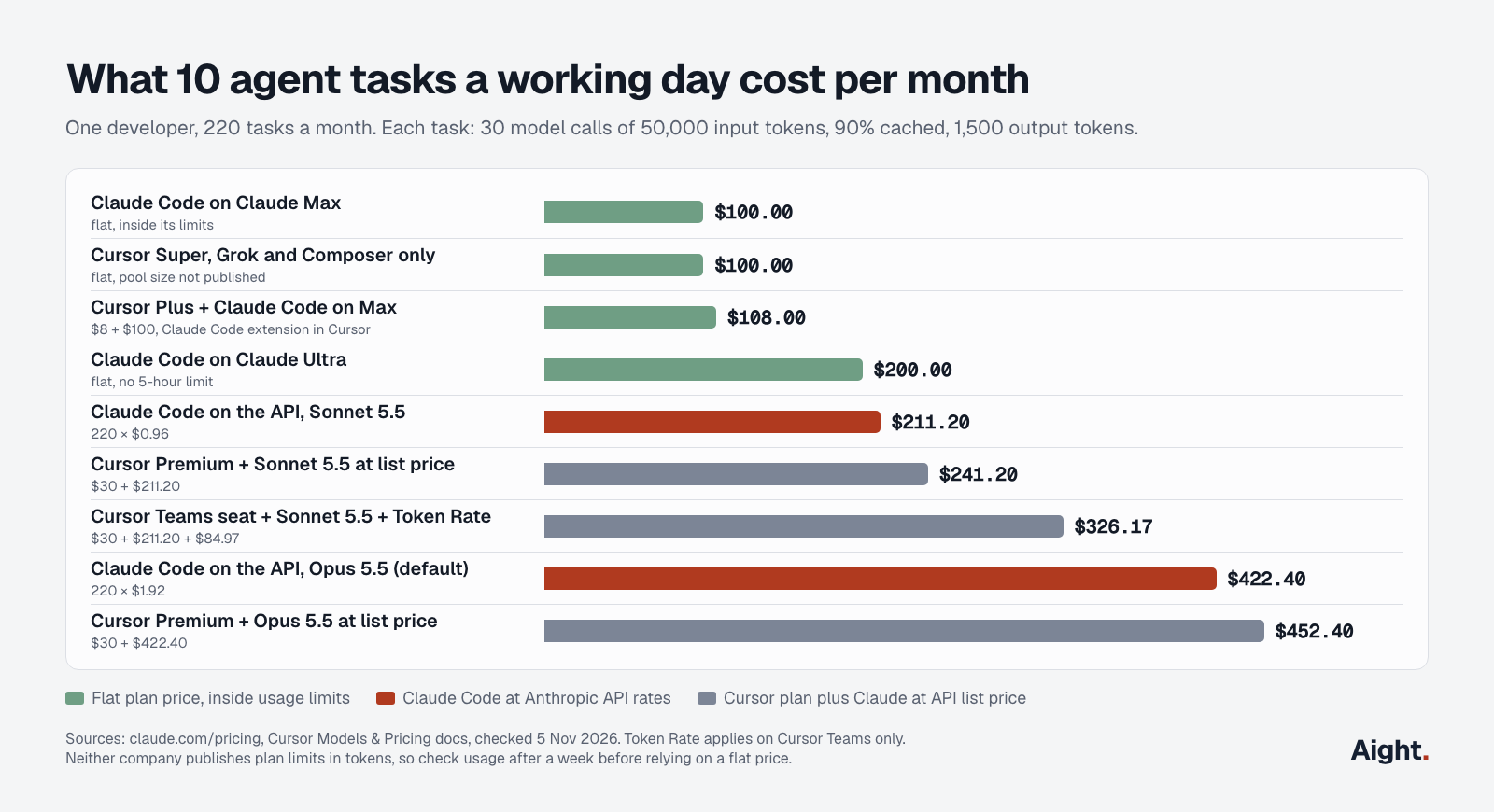
| Route, 10 tasks a working day | Per month |
|---|---|
| Claude Code on Claude Max, inside its limits | $100.00 |
| Cursor Super, Grok and Composer only, inside the pool | $100.00 |
| Cursor Plus with the Claude Code extension on Max | $108.00 |
| Claude Code on Claude Ultra, inside its limits | $200.00 |
| Claude Code on the API, Sonnet 5.5 | $211.20 |
| Cursor Premium plus Sonnet 5.5 at list price | $241.20 |
| Cursor Teams seat plus Sonnet 5.5 and the Token Rate | $326.17 |
| Claude Code on the API, Opus 5.5 | $422.40 |
| Cursor Premium plus Opus 5.5 at list price | $452.40 |
Three things drive these numbers:
- Max costs less than API rates past 104 Sonnet tasks or 52 Opus tasks a month, about 5 or 2.4 a working day, if you stay inside its limits. Claude Code defaults to Opus 5.5, so 52 is the number that applies unless you switch.
- On Cursor Teams, the Cursor Token Rate adds $0.25 per million input, output and cached tokens on third-party models whose cache-read price is $0.10 or more, including Sonnet 5.5 and Opus 5.5, and on own-key requests too. An agent loop is mostly cached tokens, so that's about $0.39 a task: 40% on Sonnet 5.5, 20% on Opus 5.5. Individual plans don't pay it.
- Cursor's own models cost nothing extra until the weekly pool runs out. Past it, the same task costs $0.46 on Composer 2.5, $1.80 on Composer 2.5 Fast and $1.25 on Grok 4.7, whose cache reads cost five times Sonnet 5.5's.
For a team, Cursor vs Claude on ten developers at this pace is $1,250 a month on Claude Team premium seats (if the limits hold) against about $3,262 on Cursor Teams seats with Sonnet 5.5.
Model access: Cursor's models, Claude, and the rest
Cursor's pool covers its own models: Grok 4.7, 4.6 and 4.5, which Cursor builds with SpaceXAI, and Composer 2.5. Premium and up add Claude Fable 5.2, Opus 5.5, Sonnet 5.5 and Haiku 5.5, Gemini 4 Carbon, 4 Hydrogen, 4 Argon, 3.1 Pro and 3.8 Flash, GPT-5.6 Sol, Terra and Luna, and Muse Wonder, at API list price (Cursor's model list, 17 November). Cursor runs Sonnet 5.5 with a 200K context window by default (up to 1M) and Opus 5.5 at 300K (up to 1M).
On Premium and up you can add your own OpenAI, Anthropic, Google, Azure or Bedrock key, and on individual plans the provider bills you directly. Cursor's zero data retention policy doesn't cover own-key requests, and a Claude Pro or Max subscription can't be used for Cursor's own agent.
OpenAI is the open question. On 29 August it said it would end Cursor's access to its models, with 12 November 2026 as the proposed date, and that it won't supply future models. The date has passed without a confirmed end: OpenAI's help article still calls 12 November a proposal and says it will share the date once both companies confirm it, and on 17 November Cursor's docs still listed GPT-5.6 Sol, Terra and Luna, with no GPT-6 or 6.1. The same article lists three ways to keep GPT in Cursor: your own OpenAI key in local Chat and Agent, the Codex extension, or an OpenAI-compatible gateway. Cursor staff said Anthropic, Google, Meta and Grok models continue through direct partnerships.
Claude Code uses Claude only. Opus 5.5 has been the default on every plan and the API since version 2.1.280; /model sonnet, /model haiku and /model fable switch to Sonnet 5.5, Haiku 5.5 and Fable 5.2 (the fable alias since 2.1.321), and Sonnet 5.5 and Opus 5.5 get their full 1M context window. On Amazon Bedrock, Google Cloud and Microsoft Foundry the aliases may point to older models.
On model quality, the Claude vs Cursor question has a clear answer on Cursor's own benchmark: Claude scores higher. CursorBench 4.0 runs ambiguous, multi-file tasks from real Cursor sessions inside Cursor:
| Model in Cursor | Effort | CursorBench 4.0 | Cost per task at list price |
|---|---|---|---|
| Claude Opus 5.5 | High | 56.0% | $3.97 |
| Claude Sonnet 5.5 | High | 47.8% | $1.20 |
| Grok 4.7 | Extra high | 46.3% | $6.01 |
| Grok 4.7 | High | 43.9% | $4.69 |
| Composer 2.5 | Default | 27.7% | $0.68 |
Grok and Composer costs come out of the weekly pool first. On the official Terminal-Bench 4.0 leaderboard, Claude Code with Opus 5.5 passed 64.8% of tasks at $14.30 per attempt, and Grok 4.7 in xAI's Grok Build agent 37.6% at $11.16. Cursor has no entry there.
Can you run Claude Code inside Cursor?
Yes. Claude Code's VS Code extension installs in Cursor and the CLI runs in Cursor's terminal. Both sign in with your Claude account and bill to your Claude plan, not Cursor's pool or prepaid balance, so pairing Cursor Free or Plus with a Claude plan costs $20 to $208 a month.
- Install the Claude Code CLI with Anthropic's native installer (below), which skips extension marketplaces.
- In Cursor, open Extensions (Cmd+Shift+X on a Mac, Ctrl+Shift+X elsewhere), search for "Claude Code", check that the publisher is Anthropic and the version is 2.1.314 or later, and install it.
- Sign in with your Pro, Max, Ultra, Team or Enterprise account.
- Run
claudein Cursor's integrated terminal. With the extension installed it connects automatically and shows diffs and diagnostics in the editor; from an outside terminal, run/ide.
curl -fsSL https://claude.ai/install.sh | bash
claude --version              # 2.1.326 was the latest release on 17 November 2026
env | grep ANTHROPIC_API_KEY  # prints nothing if Claude Code will bill your plan
The extension bundles its own copy of Claude Code, with the same version number. It offers a subset of the CLI's slash commands and no ! shell shortcut, and claude --resume picks up its sessions.
On 29 October 2026, Cursor found tampered copies of the extension, labeled 2.1.312 and 2.1.313, in its own marketplace for macOS and Windows between 2:27 am and 1:35 pm PT. They tried to add an attacker's SSH key, open a reverse SSH tunnel and install persistence. The Visual Studio Marketplace, Open VSX and npm weren't affected, SecurityWeek quotes an estimate that roughly 5,000 systems might have downloaded them, and Anthropic published 2.1.314 to avoid confusion. If you installed or updated it that day, run Cursor's check for macOS:
grep -qs svc-telemetry ~/.ssh/authorized_keys && echo "svc-telemetry key found" || echo "No key found; machine not impacted"If the key is there, follow Cursor's remediation steps and rotate credentials. Uninstalling the extension alone may not remove the persistence scripts.
Who should pick which
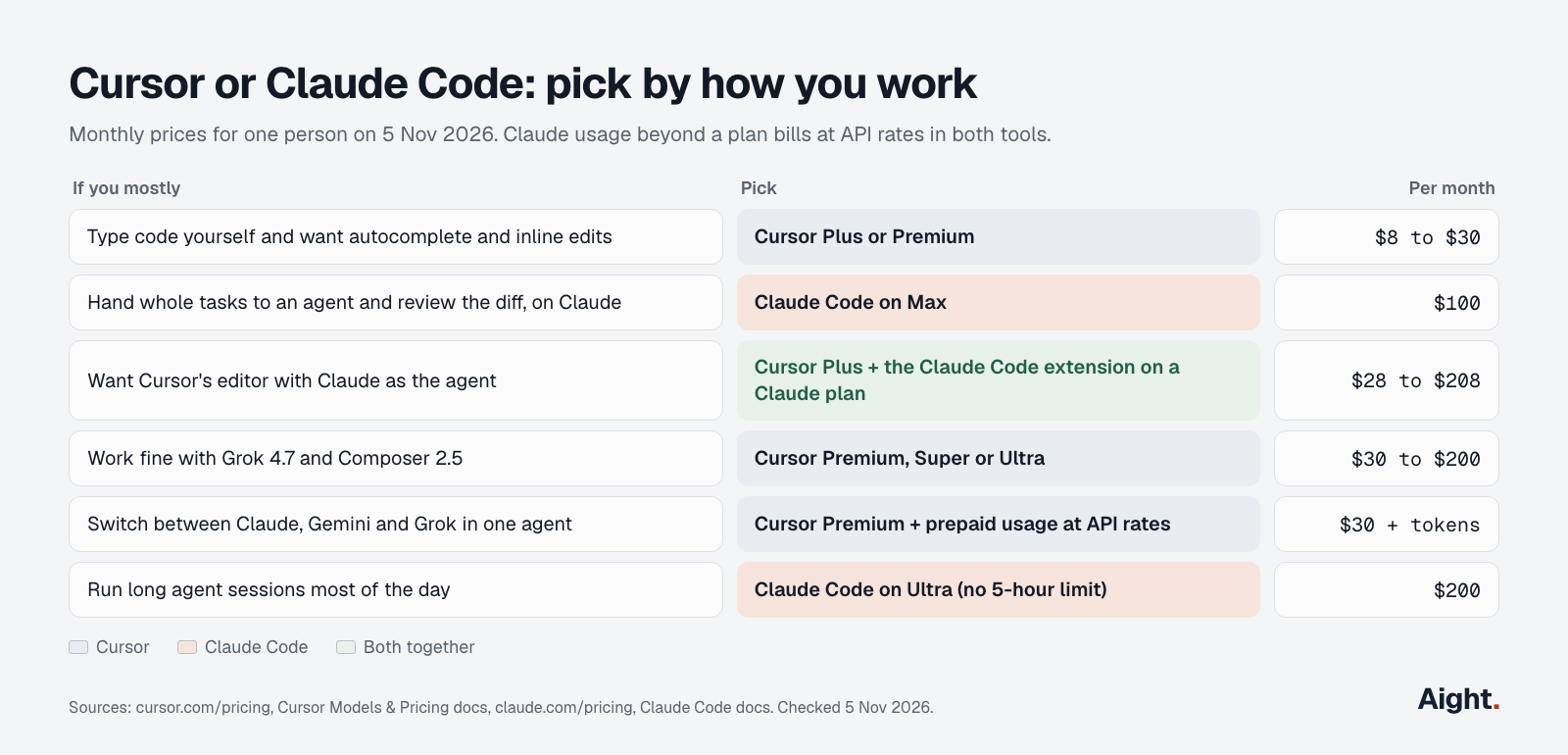
| If you mostly | Pick | Per month |
|---|---|---|
| Type code yourself and want autocomplete and inline edits | Cursor Plus or Premium | $8 to $30 |
| Hand whole tasks to an agent and review the diff, on Claude | Claude Code on Max | $100 |
| Want Cursor's editor with Claude as the agent | Cursor Plus and the Claude Code extension on a Claude plan | $28 to $208 |
| Work fine with Grok 4.7 and Composer 2.5 | Cursor Premium, Super or Ultra | $30 to $200 |
| Switch between Claude, Gemini and Grok in one agent | Cursor Premium plus prepaid usage at API rates | $30 plus tokens |
| Run long agent sessions most of the day | Claude Code on Ultra | $200 |
One exception: keep a legacy Cursor Pro, Pro+ or Ultra plan if Claude inside Cursor's own agent is your daily driver, since its Other Models pool still covers Claude and the switch can't be undone. Weighing other agents too? See Codex vs Claude Code and the Claude Code alternatives.
If GitHub Copilot is the other option on your list, see Claude Code vs GitHub Copilot.
Where Aight fits
Neither tool connects to Aight directly. Claude Code speaks Anthropic's Messages API, Aight documents OpenAI-style Chat Completions, and Cursor's own-key settings don't document a custom base URL. For daily Claude use, Max at $100 costs less than any per-token route, Aight included, as long as you stay inside its limits.
Aight fits when you want Claude by the token outside those plans: scripts, CI, or an agent that accepts an OpenAI-compatible provider. Cline 4.1.26, which also installs in Cursor, is one.
Configured as an OpenAI-compatible provider, Cline takes API Provider "OpenAI Compatible", Base URL https://api.getaight.ai/v1, an API key starting sk-aight- and Model ID claude-sonnet-5-5.
Aight lists claude-sonnet-5-5 at $2.00 / $10.00 and claude-opus-5-5 at $4.00 / $20.00, with cache reads at $0.10 and $0.20, the same as Anthropic. A $100 recharge costs $103 and adds $110 of balance, so the 220-task Sonnet month costs about $198 instead of $211.20. Each key can carry a monthly cap and a list of allowed models.
What developers report
- "Claude and GPT are billed at API list price from the very first request" (a Cursor forum user, 13 Oct 2026, link)
- "Don’t switch, unless you use almost only Cursor and Grok models in Cursor." (a Cursor forum user's recap of the new plans, 16 Oct 2026, link)
- "you can’t log in to Cursor with an existing Claude Pro/Max subscription" (Cursor support staff on the Cursor forum, 21 Jun 2026, link)
- "Settled on the unified Cursor, Grok, Grok Bot plan for about $200 / month." (a Hacker News commenter, 4 Nov 2026, link)
- "This used to be a terrible value but now it's a great value", about Claude Code on a $20 Claude plan (a Hacker News commenter, 4 Nov 2026, link)
- Anthropic's Felix Rieseberg said the tampered extension was published through access to Cursor's marketplace and that Anthropic's official channels weren't affected (SecurityWeek, 2 Nov 2026, link)
FAQ
Is Claude Code better than Cursor?
For agent work on Claude, Claude Code usually costs less and uses the full 1M context window by default. Cursor is better if you write code by hand and want Tab, or want Grok, Gemini and Claude in one editor. You can also run both, with Claude Code inside Cursor.
Can you use a Claude subscription in Cursor?
Only through Claude Code. Its extension and CLI work inside Cursor and bill to your Pro, Max or Ultra plan. Cursor's own agent needs Cursor's prepaid balance or your own Anthropic API key instead.
Does Cursor still include Claude?
Not on new plans. Since 12 October 2026, Plus, Premium, Super and Ultra include only Cursor's models, and Claude bills at API list price on Premium and up. Legacy Pro, Pro+ and Ultra plans still include an Other Models pool that covers Claude.
Which costs less, Cursor or Claude Code?
If Cursor's Grok and Composer models are enough, Cursor's $8 to $30 plans cost least. For Claude, Claude Code on Max ($100) costs less than Cursor Premium once you'd spend more than $70 a month on Claude tokens, because Cursor charges the same token prices plus its $30 fee.
Will GPT models keep working in Cursor?
For now, yes. OpenAI proposed 12 November 2026 as the end of Cursor's access and said it won't supply future models, but the date passed without confirmation, and Cursor still listed GPT-5.6 Sol, Terra and Luna on 17 November. Check the model picker before you rely on them; your own OpenAI key or the Codex extension keeps GPT available either way.
Sources
- Cursor: Pricing, Models and pricing docs, Legacy Cursor plans, What is The X Subscription?, Usage and limits, Usage-based charges, Bring your own API key, Tab
- Cursor model pages: Claude Sonnet 5.5, Claude Opus 5.5, Grok 4.7, Composer 2.5; CursorBench 4.0
- Cursor product: Agents Window, Cursor CLI, Release notes
- Cursor blog: Cursor is now a part of SpaceX (14 Aug 2026), Security notice on the Claude Code extension (29 Oct 2026)
- Cursor forum: Introducing The X Subscription, OpenAI and GPT access, Claude Max subscription access in Cursor
- Anthropic: Claude pricing, Use Claude Code with your Pro, Max, or Ultra plan, Extra usage on paid plans, What is the Ultra plan?
- Claude Code docs: Overview, VS Code extension, Model configuration, Manage costs; @anthropic-ai/claude-code on npm
- Benchmarks: Terminal-Bench 4.0 leaderboard
- News: CNBC on OpenAI and Cursor (29 Aug 2026), SecurityWeek on the extension attack (2 Nov 2026)
- Hacker News: Ask HN: What's your current AI agentic setup? (4 Nov 2026)
- Cline: OpenAI Compatible provider, Installing Cline
- Aight: Models and pricing, API reference
Checked on 5 November 2026. Updated 17 November 2026: OpenAI's Cursor cut-off, Cursor's model list, Fable 5.2 and Claude Code 2.1.326.