Claude Code pricing follows Claude's plans, because Claude Code isn't sold on its own: it comes with every paid Claude plan. Pro costs $20 a month or $200 a year, Max $100 a month, Ultra $200, a Team seat $25 or $125, and Enterprise $20 a seat plus all usage at API rates. The Free plan doesn't include it. Without a plan, you pay per token through the Claude API, where Opus 5.5, Claude Code's default model, costs $4 / $20 per million input / output tokens.
Which option costs least depends on how much you code. Anthropic puts the average at about $13 per developer per active day at API rates, so a $20 Pro plan pays for itself within two active days a month. This post covers each plan and its limits as checked on 5 November 2026 against Claude Code 2.1.318, then works out monthly API bills for light, daily and heavy use and shows where each plan stops making sense.
Claude Code pricing at a glance
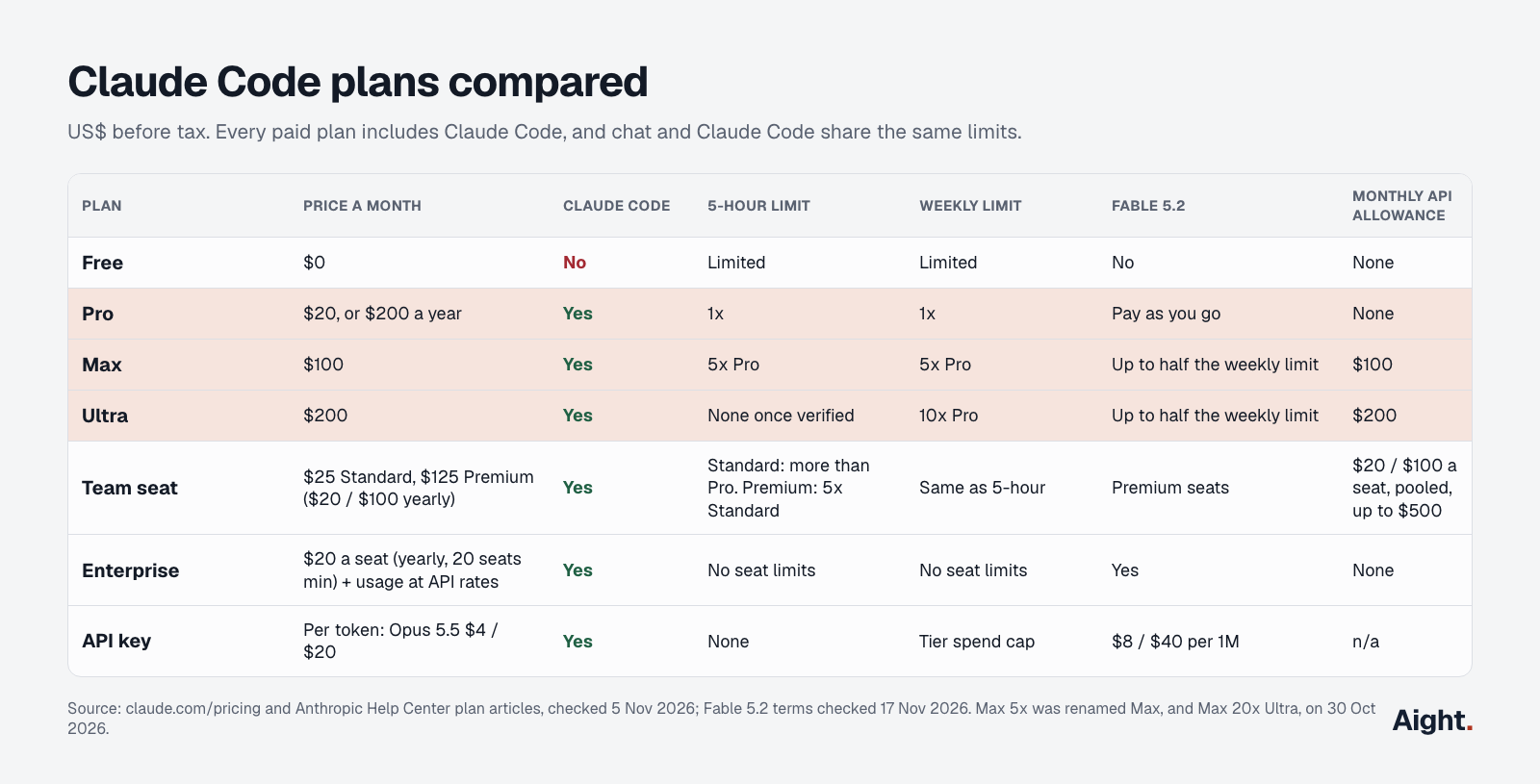
A Claude Code subscription is a Claude subscription: the same plan covers chat on the web, desktop and mobile, and Claude Code in the terminal, IDE and desktop app, all drawing from one usage pool. These are the Claude Code plans on Anthropic's pricing page, before tax.
| Plan | Price | Claude Code | Usage limits |
|---|---|---|---|
| Free | $0 | Not included | Limited, every 5 hours and every week |
| Pro | $20 a month, or $200 a year (about $17 a month) | Included | A 5-hour limit and a weekly limit (the base unit, 1x) |
| Max | $100 a month | Included | 5x Pro, every 5 hours and every week |
| Ultra | $200 a month | Included | 10x Pro every week; no 5-hour limit once the account is verified |
| Team, Standard seat | $25 a seat a month, $20 billed annually | Included | More than Pro |
| Team, Premium seat | $125 a seat a month, $100 billed annually | Included | 5x a Standard seat |
| Enterprise | $20 a seat a month billed annually, 20-seat minimum, plus usage at API rates | Included | No seat limits; admins set spend limits |
| API key (Claude Console) | Per token, Opus 5.5 at $4 / $20 per 1M | Pay as you go | Monthly spend cap by tier: $500, $1,000 or $200,000 |
So how much is Claude Code for one developer? The lowest Claude Code price is $200 a year for annual Pro. Max and Ultra are billed monthly only.
Max and Ultra got their current names on 30 October 2026, when Anthropic renamed Max 5x to Max and Max 20x to Ultra at the same prices. Guides that still list "Max 5x" and "Max 20x" describe the same two plans, except that Ultra has since dropped the 5-hour limit for verified accounts.
Is Claude Code free?
No. Claude Code is free to install, but it won't run without a paid Claude plan, a Team or Enterprise seat, or an API account that pays per token. Anthropic's plan comparison lists Claude Code as not included on Free, and the authentication docs offer Pro, Max or Ultra, Team or Enterprise, the Claude Console, or a cloud provider as sign-in options. Free isn't one of them.
On Claude Code free tier availability, the answer is short: there is no Claude Code free tier and no trial you can start on your own. The routes to free Claude Code that do exist:
- A guest pass. Eligible Pro, Max and Ultra subscribers can send a seven-day Pro trial that includes Claude Code, from the
/passescommand. The recipient must be new to paid Claude plans and enters payment details, and the trial turns into a $20 Pro plan unless it's cancelled. - A plan someone else pays for: a Team or Enterprise seat at work, or a university's Claude plan.
Claude Code isn't open source either. Its GitHub repository states "All rights reserved" and points to Anthropic's Commercial Terms, so there's no self-hosted free edition. For agents that run on lower-cost or open models, see Claude Code alternatives, and the Claude Code install guide covers setup once you have a plan.
How the usage limits work
Pro and Max have two meters. The 5-hour session limit starts with your first message and resets in full five hours later. The weekly limit resets at a fixed day and time assigned to your account, whenever you started. Ultra keeps only the weekly meter once the account is verified, and Max and Ultra add a separate weekly meter for Fable 5.2, Anthropic's top model. Anthropic's usage-limit article also reserves the right to add weekly or monthly caps.
Everything shares one pool. A long research chat in the Claude app uses the same allowance as a refactor in the terminal.
Anthropic publishes multipliers, not token counts. The pricing page says how fast you reach a limit depends on the model, the length of the conversation and the size of the files. Claude Code defaults to Opus 5.5 on every plan, so switching routine work to Sonnet with /model sonnet stretches the limit.
The most detailed public measurement comes from SemiAnalysis, which moved each plan's meter one token type at a time. Its 5 October 2026 report found every Claude tier gives the same value per dollar, and its team put the $200 plan at about $12,000 a month of Opus 5.5 at API prices on an agentic workload. Scaled by Anthropic's multipliers, that's roughly $1,200 a month for Pro and $6,000 for Max, if you use the full weekly limit every week. Treat those as ceilings: on 22 October SemiAnalysis reported Anthropic A/B testing limits worth about 20% less a month on some accounts, and several GitHub issues since mid-October report weekly limits draining faster for unchanged work.
To see where you stand, run /usage in Claude Code. On a plan it shows the limit bars and what used them (skills, subagents, MCP servers), with suggestions such as trimming a large CLAUDE.md. On claude.ai, the same bars are under Settings > Usage, and an Ultra account with no "Current session" bar is verified.
When you hit a limit, Claude Code says which one. Switching models doesn't reset a session or weekly limit, because they cover all models. You can wait (Claude Code 2.1.234 and later can resume the task after the reset), upgrade, which takes effect immediately, or turn on pay-as-you-go overflow billed at API rates with a monthly spend limit, which /usage-credits opens in the browser.
Claude Pro vs Max for Claude Code
The Claude Pro vs Max choice is about limits, not value. Each plan gives the same usage per dollar, so Max is five Pro plans in one account, and Ultra holds ten Pro plans' weekly usage.
| Pro | Max | Ultra | |
|---|---|---|---|
| Price | $20 a month, or $200 a year | $100 a month | $200 a month |
| 5-hour limit | 1x | 5x Pro | None once verified |
| Weekly limit | 1x | 5x Pro | 10x Pro |
| Fable 5.2 | Pay-as-you-go only | Up to half the weekly limit | Up to half the weekly limit |
| Monthly Claude API allowance | None | $100 | $200 |
| Wrap-up after a 5-hour limit | Up to once a week | Each time | Not needed once verified |
The wrap-up allowance, which Anthropic is rolling out gradually, lets Claude Code finish a step it's partway through when the session limit hits, instead of stopping mid-edit.
Move from Pro to Max when the 5-hour limit stops you more than once or twice a week. Pay-as-you-go overflow is the other way past a limit, and it settles the question in dollars: Max costs $80 more than Pro, so if you'd spend more than $80 a month on overflow at API rates, Max costs less. The same test applies from Max to Ultra at a $100 gap.
Ultra suits two cases: parallel agents that empty Max's weekly limit, or long unattended runs that the 5-hour window keeps cutting off. New subscribers keep a temporary 5-hour limit until Anthropic verifies the account from its account and payment history.
The $100 and $200 API allowances don't pay for interactive Claude Code. They cover the Claude API, the Agent SDK and claude -p runs made with an API key from the Console organization you link to the plan, so they suit scripts and CI jobs. They expire at the end of each billing cycle.
Paying per token with an API key
The alternative to a plan is a Claude Console account with prepaid usage. Sign in to Claude Code with /login and choose the Console, or set ANTHROPIC_API_KEY. The Claude Code API key guide walks through both. Claude Code creates a "Claude Code" workspace in the Console for tracking, and you can put a workspace spend limit on it.
Prices per million tokens, from Anthropic's pricing page:
| Model | Input | 5-minute cache write | 1-hour cache write | Cache read | Output |
|---|---|---|---|---|---|
| Fable 5.2 | $8.00 | $10.00 | $16.00 | $0.20 | $40.00 |
| Opus 5.5 (default) | $4.00 | $5.00 | $8.00 | $0.20 | $20.00 |
| Sonnet 5.5 | $2.00 | $2.50 | $4.00 | $0.10 | $10.00 |
| Haiku 5.5, prompts up to 100K | $0.10 | $0.125 | $0.20 | $0.01 | $0.50 |
Four details decide what you actually pay:
- Opus 5.5 is the default on the API too. Sonnet 5.5 costs exactly half, token for token.
- With an API key, Claude Code caches the main conversation for five minutes. After a longer pause, the next request writes the whole context to the cache again. Setting
promptCacheTtlto1hcosts 1.6x per write but survives coffee breaks. - Thinking is billed as output, and it can't be switched off on Opus 5.5, Sonnet 5.5 or Haiku 5.5. Lower it with
/effortinstead. - The Start, Build and Scale tiers have monthly spend caps of $500, $1,000 and $200,000. At the cap, requests return 429 until 00:00 UTC on the 1st.
On Amazon Bedrock and Google Cloud's Agent Platform, the cloud provider bills you per token instead. There, Claude Code's sonnet alias still points to Sonnet 4.5, which Anthropic lists at $3 / $15, so name Sonnet 5.5 explicitly. The Claude API pricing guide covers Batch, long context and the other models.
For unattended runs, claude -p --max-budget-usd 5.00 "..." stops a run at an estimated spend. The check happens after each call returns, so one call can overshoot: a GitHub issue shows a $1 cap stopping at $1.38.
Monthly bills for light, daily and heavy use
Every step Claude Code takes (reading a file, running tests, editing) is one model call, and each call resends the conversation so far. Most of that is a cache read at a twentieth of the input price; the new part is a cache write; the reply and its thinking are output.
The assumptions
| Scenario | Active days a month | Calls a day | Calls a month | Average context per call | Output per call |
|---|---|---|---|---|---|
| Light: a few evenings | 6 | 60 | 360 | 40,000 tokens | 600 |
| Daily: one session, most weekdays | 20 | 300 | 6,000 | 60,000 tokens | 600 |
| Heavy: three or four agents in parallel | 22 | 1,200 | 26,400 | 90,000 tokens | 700 |
In every scenario, 92% of each call's context is a cache read and 8% a five-minute cache write, the default with an API key. Subagents and background requests aren't counted.
The bills
| Scenario | API, Opus 5.5 | API, Sonnet 5.5 | Opus per active day | Plan that should hold it |
|---|---|---|---|---|
| Light | $12.73 | $6.36 | $2.12 | Pay per token, or Pro if you also use Claude chat |
| Daily | $282.24 | $141.12 | $14.11 | Pro, or Max once the 5-hour limit gets in the way |
| Heavy | $1,757.18 | $878.59 | $79.87 | Max or Ultra |
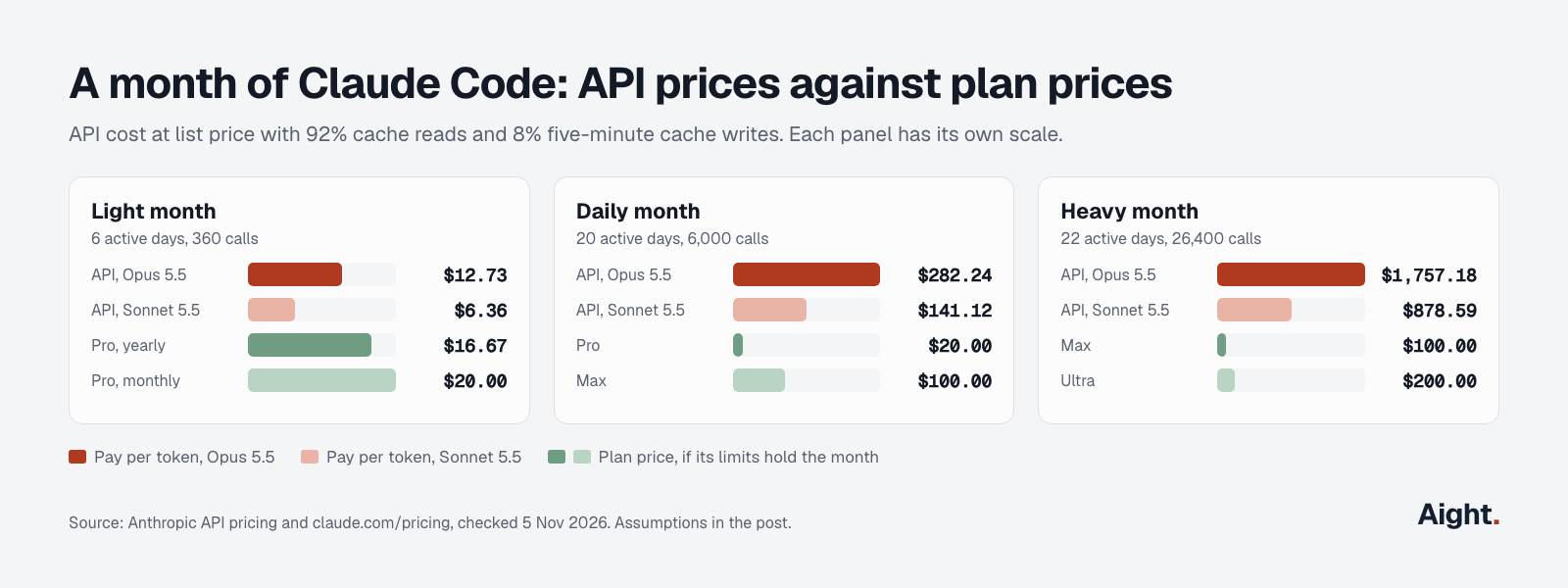
The daily scenario lands close to Anthropic's own figures: about $13 per developer per active day across enterprise deployments, $150 to $250 per developer a month, and under $30 per active day for 90% of users. The heavy month, at $79.87 a day, is top-decile use.
Here is the daily bill on Opus 5.5, line by line:
| Line | Tokens a month | Price per 1M | Cost |
|---|---|---|---|
| Cache reads | 331.2M | $0.20 | $66.24 |
| Cache writes, 5-minute | 28.8M | $5.00 | $144.00 |
| Output and thinking | 3.6M | $20.00 | $72.00 |
| Total | $282.24 |
Cache writes are half the bill though they're 8% of the tokens. They come from new tool output and from the cache expiring during pauses, and like cache reads they grow with the size of the context, so /clear between unrelated tasks cuts both lines.
The heavy month on Opus is also past the Build tier's $1,000 cap, so on that tier the API stops around the 13th active day.
To redo the math with your own numbers, take the token counts from /usage after a typical day:
PRICES = {  # US$ per 1M tokens: input, 5-minute cache write, cache read, output
    "opus-5.5": (4.00, 5.00, 0.20, 20.00),
    "sonnet-5.5": (2.00, 2.50, 0.10, 10.00),
}

def monthly_api_cost(model, active_days, calls_per_day, context_tokens,
                     write_share=0.08, output_tokens=600):
    _, write, read, out = PRICES[model]
    calls = active_days * calls_per_day
    per_call = (context_tokens * (1 - write_share) * read
                + context_tokens * write_share * write
                + output_tokens * out) / 1e6
    return round(calls * per_call, 2)

print(monthly_api_cost("opus-5.5", 6, 60, 40_000))                       # 12.73
print(monthly_api_cost("opus-5.5", 20, 300, 60_000))                     # 282.24
print(monthly_api_cost("opus-5.5", 22, 1_200, 90_000, output_tokens=700))  # 1757.18
Subscription or API: the break-even
At Anthropic's $13 per active day, annual Pro pays for itself after 1.3 active days a month, monthly Pro after 1.5, Max after 7.7 and Ultra after 15.4. Past those points the plan costs less than the API, provided its limits hold your usage. Per-token billing wins only for occasional use, and for automation that you'd rather bill to a workspace with its own spend limit.
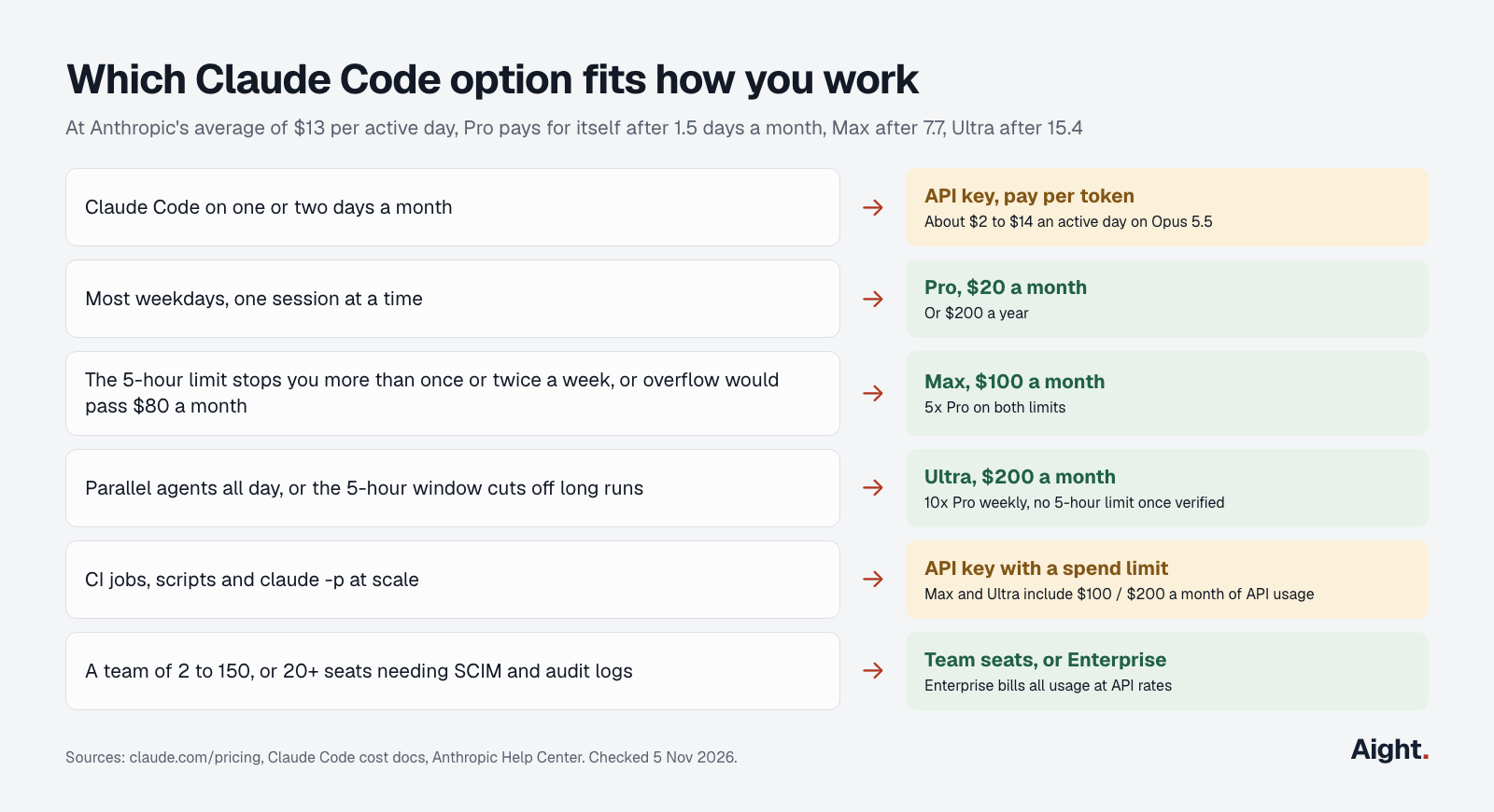
- Claude Code on one or two days a month: pay per token with an API key.
- Most weekdays, one session at a time: Pro at $20, or $200 a year.
- The session limit stops you more than once or twice a week, or overflow would pass $80 a month: Max at $100.
- Parallel agents all day, or the 5-hour window cuts off long runs: Ultra at $200.
- CI jobs and scripts: an API key with a workspace spend limit. On Max and Ultra, the monthly API allowance covers this.
Team and Enterprise pricing for Claude Code
Team plans run from 2 to 150 seats, and every seat includes Claude Code. Standard seats get more usage than Pro; Premium seats get five times a Standard seat, and you can mix the two. Team also pools a monthly Claude API allowance of $20 per Standard seat and $100 per Premium seat, capped at $500, which, like Max's, doesn't cover interactive Claude Code.
Enterprise works differently. The seat ($20 a month, billed annually, 20-seat minimum) covers access only, and every token is billed at API rates with no per-seat limits. Self-serve Enterprise buys usage upfront, and seats can't be removed mid-term.
For ten developers:
| Setup | Monthly cost | Limits |
|---|---|---|
| Team, 10 Standard seats, monthly | $250 | Each more than Pro |
| Team, 10 Premium seats, monthly | $1,250 | Each 5x Standard |
| Team, 5 Standard and 5 Premium, annual | $600 | Mixed |
| Enterprise, 20-seat minimum | $400 in seats plus about $1,500 to $2,500 of usage at Anthropic's average | None per seat; admin spend limits |
Team is the lower-cost route for most groups. Enterprise makes sense when you need SCIM, audit logs, HIPAA-ready configuration or no per-seat caps, and you're ready to pay for usage on top.
Extra charges to watch
A plan's price isn't always the whole bill. These charge at API rates on top of it:
- Overflow past a limit, once you turn it on. It's prepaid, with an optional monthly spend limit and auto-reload.
- Fast mode, which runs Opus 5.5 at $8 / $40 per million tokens and on plans is always billed outside the included usage.
- Fable 5.2 on Pro, which is pay-as-you-go only.
- Ultrareview, the cloud code review: three free runs per account, then typically $5 to $25 a review.
- US-only inference on the API or Enterprise, at 1.1x standard rates.
The most common surprise is simpler. If ANTHROPIC_API_KEY is set in your shell, Claude Code uses the key instead of your subscription once you approve it, and bills the API. Run /status to see the login method, and unset the variable if it shows an API key.
Is there a Claude Code student discount?
No. Anthropic has no student price for Pro, Max or Ultra and no working Claude Code student discount codes. Its Pro plan article says there is no standard discounted pricing for individual plans, and that support can't issue one-off discounts or coupons. Sites that list student promo codes aren't Anthropic.
What students can actually use:
- A university plan. Claude for Education is sold to institutions and covers students at discounted rates, so check whether your school has one before paying.
- The Claude Campus program. Students who lead a Claude Builder Club get a $3,600 stipend and pass on resources such as Claude API usage to members. Applications ran from 1 to 12 September, and the program is closed for Fall 2026.
- A guest pass from a subscriber: seven days of Pro, including Claude Code.
- Annual Pro at $200, which works out at about $17 a month.
Academic research groups can also apply for the Team plan for scientists, which Anthropic offers at a discounted rate after verification.
What developers report
- Anthropic's product lead for Claude subscriptions, Mike Overell, said that when weekly limits came to the old Max 20x, they were set at 10x Pro; only its 5-hour limit was 20x (X, 30 Oct 2026, link).
- "If anything this is more honest than the original." (a Hacker News commenter on the Ultra rename, 30 Oct 2026, link)
- A Max subscriber reported 94% of a week's allowance gone in under 48 hours, all from Claude Code, and said support could confirm the split but not inspect the metering (GitHub issue #105240, 26 Oct 2026, link).
- An Ultra subscriber measured one 5-hour session using about half of the weekly limit and asked Anthropic to publish the intended ratio (GitHub issue #106274, 30 Oct 2026, link).
- In a controlled test on a Max plan, the same workload run headless with
claude -pused about 1.8x more of the 5-hour window than the interactive CLI (GitHub issue #97074, 25 Sep 2026, link). - SemiAnalysis reported an Anthropic A/B test that gave some accounts about 20% less monthly value and about 20% more per 5-hour window; another tester, Paweł Huryn, replied that his 1 October measurement already matched the lower figure (X, 22 and 23 Oct 2026, link, link).
To run Claude Code against a local model with no per-token bill, see Ollama with Claude Code.
Claude Cowork, the same agent design aimed at documents, spreadsheets and research, is a separate choice from Claude Code: Claude Cowork vs Claude Code compares the two.
Where Aight fits
Claude Code itself can't run on Aight. It speaks Anthropic's Messages API, and Aight documents an OpenAI-compatible Chat Completions API. And for daily Claude Code use, no per-token route competes with a plan: priced at Aight's effective rate, the daily scenario's tokens come to $264.28, against $100 for Max.
Aight fits the per-token side of the same work. If you run Claude models from tools that take an OpenAI-compatible base URL, such as Cline's OpenAI Compatible provider or Aider, or from your own scripts, Aight sells Claude Opus 5.5 and Sonnet 5.5 at Anthropic's list prices, as listed on its models page. A $100 recharge costs $103 with the 3% processing fee and adds $110 of balance, about $0.94 per $1 of list-price usage. Each key can have a monthly cap that returns 403 key_cap_reached, and a list of allowed models, so a runaway script stops at its own limit. Haiku 5.5 is listed too, at Anthropic's $0.10 / $0.50.
The same key also reaches GPT, Gemini and DeepSeek models. If you're weighing OpenAI's agent, see the Codex pricing breakdown.
FAQ
Does Claude Code share limits with the Claude app?
Yes. Chats on the web, desktop and mobile apps and Claude Code in the terminal, IDE and desktop app all draw from the same 5-hour and weekly limits. A long chat session leaves less for coding that week.
Can the $100 API allowance on Max pay for Claude Code?
Not for interactive sessions. The allowance goes to a linked Claude Console organization and covers API calls, the Agent SDK and claude -p runs that use an API key from that organization. It doesn't cover Claude Code in the terminal, IDE or desktop app, or runs started by the Claude Code GitHub Action.
What happens when Claude Code hits a usage limit?
Claude Code tells you whether it's the 5-hour or weekly limit and when it resets. You can wait, upgrade with immediate effect, or turn on pay-as-you-go overflow at API rates. Recent versions can also resume the interrupted task automatically after the reset.
Why did Claude Code bill the API when there's a subscription?
Usually because ANTHROPIC_API_KEY is set in the environment, which takes priority over the subscription once approved. Run /status to check the login method, unset the variable, and sign in again with /login.
Can Claude Code be paid for annually?
Only Pro and Team offer annual billing: Pro at $200 a year and Team seats at $20 or $100 a month billed annually. Max and Ultra are monthly only, and Enterprise is annual only.
Sources
- Anthropic, Plans and pricing: plan prices, feature table, usage and Claude Code FAQ
- Anthropic, API pricing and Rate limits and spend caps
- Anthropic Help Center: What is the Pro plan?, What is the Max plan?, What is the Ultra plan?, What is the Team plan?, What is the Enterprise plan?, Enterprise plan billing
- Anthropic Help Center: Use Claude Code with your Pro, Max, or Ultra plan, Use Claude Code with your Team or Enterprise plan, How do usage and length limits work?, Extra usage for paid plans, Monthly API allowance for Max, Ultra, and Team, Agent SDK with a Claude plan, Guest passes, Paying for API usage
- Claude Code docs: Manage costs, Model configuration, Prompt caching, Authentication, Fast mode, Ultrareview, Commands, CLI reference, Changelog
- Anthropic, claude-code on GitHub and @anthropic-ai/claude-code on npm; issues #97074, #100111, #105240, #106274
- Anthropic on X: Claude, 30 Oct 2026 and Mike Overell, 30 Oct 2026
- Anthropic, Claude Campus program, Claude for Education, Team plan for scientists
- SemiAnalysis, Anthropic Subscriptions Offer 5x+ More Value Than OpenAI and posts on X of 7 Oct 2026 and 22 Oct 2026; Paweł Huryn, post on X, 23 Oct 2026
- Hacker News, Claude 20x is now Ultra without the 5-hour limit
- Tool docs: Cline OpenAI Compatible, Aider with OpenAI-compatible APIs
- Aight, Models and pricing, API reference, Refund policy
Checked on 5 November 2026. Updated 17 November 2026: Fable 5.2 on the plans and in the price table; Claude Code 2.1.326 changes nothing else compared here.