In Claude vs ChatGPT, Claude is the better pick for coding and long documents, and ChatGPT is the better pick for everyday use, images and voice. Claude's models lead every independent coding benchmark checked here, and Claude Opus 5.5 ranks second for creative writing on Arena, 68 points above GPT-6 Astra. ChatGPT gives far more for free, has an $8 plan, makes images and GIFs, and its Instant chat has no message cap. Both paid plans start at $20 a month.
For web research ChatGPT is slightly ahead; for writing, it depends on taste and the benchmark you trust. This Claude vs ChatGPT comparison covers the apps first (the Claude AI vs ChatGPT question most people search, sometimes as Claude vs Chat GPT), then API prices for developers. Everything below is in US dollars and was checked on 10 November 2026, the day after Anthropic released Claude Fable 5.2.
The short answer
- Coding: Claude. Claude Opus 5.5 and Sonnet 5.5 beat GPT-6 Astra and GPT-6.1 Sol on all three Vals AI coding benchmarks and on WebDev Arena. OpenAI's models do each task for much less money, which matters if you pay per token.
- Writing: Claude, narrowly. Arena voters rank Opus 5.5 second of all models for creative writing; GPT-6 Astra is 39th. An LLM-judged benchmark (EQ-Bench) puts GPT-6 Astra first, so the gap is a matter of style.
- Research and long documents: ChatGPT for web answers, Claude for long files. On Search Arena, GPT-6 Astra and GPT-6.1 Sol score about 17 points above Claude Opus 5.5. Claude's paid plans read up to 1M tokens of context; ChatGPT Plus caps the thinking model at 256K.
- Everyday use: ChatGPT. Unlimited Instant chat on every plan, image generation on every plan including Free, voice with video from Go, and interactive answers (Intelligent UI). Claude makes charts and diagrams but no photos or illustrations.
- Price: equal at $20, $100 and $200. ChatGPT adds Go at $8 and Pro 500 at $500; Claude adds annual billing on Pro ($17 a month). ChatGPT Free and Go may show ads; Claude has none on any plan.
Claude vs ChatGPT plans and prices
Both companies sell a free plan, a $20 plan and two power-user tiers at $100 and $200. The differences are at the edges and in what each price includes.
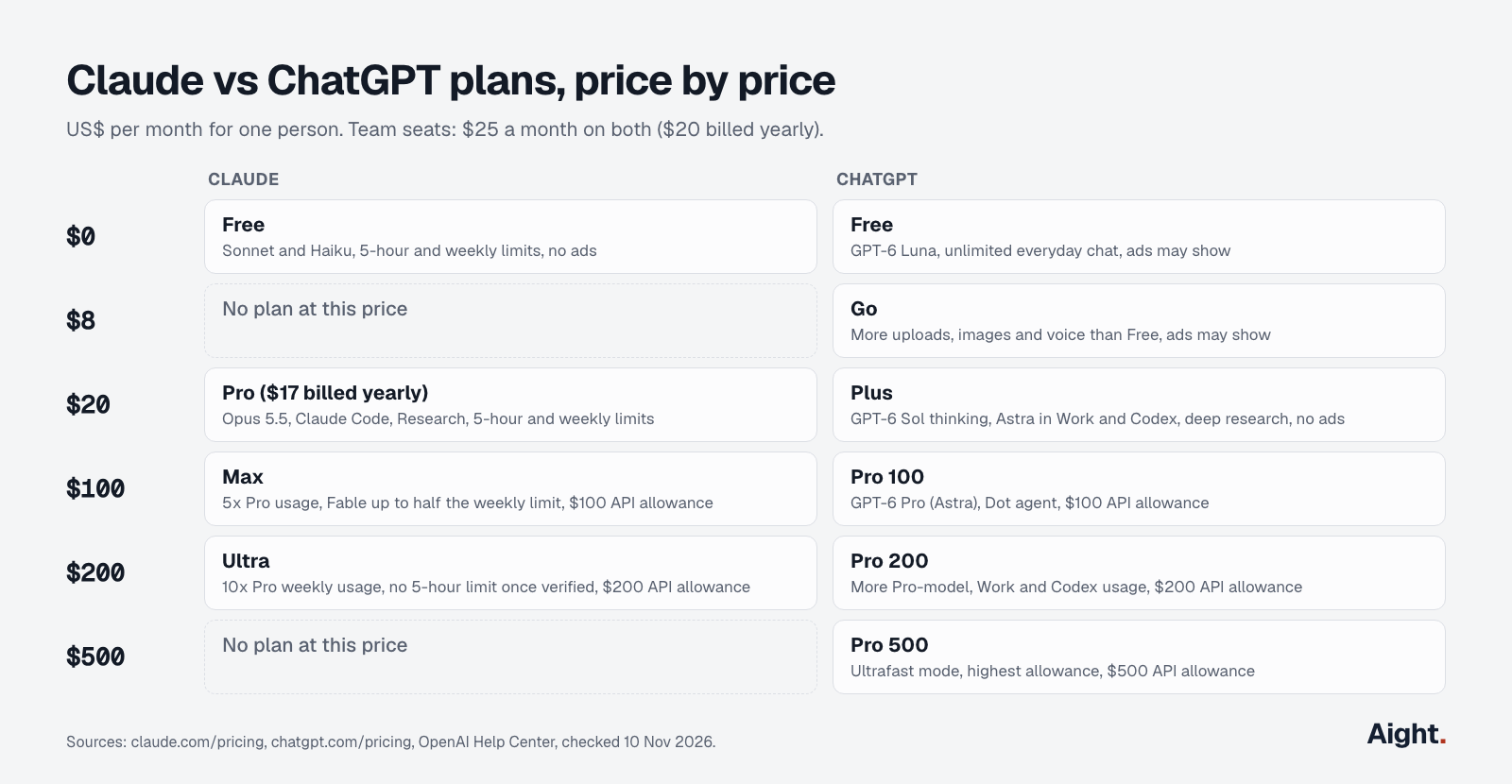
| Price a month | Claude | ChatGPT |
|---|---|---|
| $0 | Free: Sonnet and Haiku models, limits every 5 hours and every week | Free: GPT-6 Luna, unlimited everyday chat, limited images, deep research and Codex; ads may show |
| $8 | No plan | Go: more uploads, images, voice and memory than Free; ads may show |
| $20 | Pro ($17 billed yearly): adds Opus 5.5, Claude Code, Research, Chrome and Microsoft 365 add-ins | Plus: GPT-6 Sol at Medium and High thinking, GPT-6 Astra in Work and Codex, deep research, no ads |
| $100 | Max: 5x Pro usage, Fable included up to half the weekly limit, $100 a month of API usage | Pro 100: GPT-6 Pro (powered by Astra), Dot agent, $100 a month of API usage |
| $200 | Ultra: 10x Pro weekly usage, no 5-hour limit on verified accounts, $200 of API usage | Pro 200: more usage than Pro 100, $200 of API usage |
| $500 | No plan | Pro 500: Ultrafast mode, the highest allowance, $500 of API usage |
| Teams | Team: $25 a seat ($20 yearly); Premium seats $125 ($100 yearly) | Business: $25 a seat ($20 yearly), 2 seats minimum |
| Enterprise | $20 a seat a month plus usage at API rates, 20 seats minimum | Contact sales |
Sources: Claude pricing, OpenAI's Codex pricing page (which lists every ChatGPT plan in US dollars), and the help articles on Plus, Go and Pro tiers. Plus, Go and Pro are billed monthly only; OpenAI offers no annual discount on personal plans.
Three details decide the $20 tier for most people:
- What runs out first. Claude Pro has a 5-hour limit and a weekly limit, shared by chat, the desktop app and Claude Code. ChatGPT Plus never limits Instant chat, and from December, Plus, Pro and Business move to one token-based allowance shared by ChatGPT and Codex, with Instant chat excluded (OpenAI).
- Which top model you get. Claude Pro includes Opus 5.5, Anthropic's recommended "daily driver". ChatGPT Plus gives GPT-6 Sol at Medium and High thinking in chat; Extra High and GPT-6 Pro (Astra) in chat start at the Pro tiers (OpenAI).
- Fable on Pro. Anthropic's 9 November announcement says Fable is included "for up to 50% of weekly usage limits for Pro plans", while the pricing page still lists Fable on Pro as paid by usage at API rates. Check Settings > Usage in your account.
On privacy, both let you opt out of training on all consumer plans. On ads, OpenAI says they may appear on Free and Go, not on Plus or higher. Anthropic pledged in February 2026 to keep Claude ad-free.
Which models you actually get
| Claude app | ChatGPT app | |
|---|---|---|
| Free | Sonnet and Haiku | GPT-6 Luna |
| $20 | Opus 5.5, Sonnet 5.5, Haiku 5.5; Fable 5.2 per the note above | GPT-6 Sol (Instant to High); GPT-6 Astra and GPT-6.1 Sol in Work and Codex |
| $100 and up | Adds Fable 5.2 up to half the weekly limit | Adds GPT-6 Pro (Astra) and Extra High in chat |
| Context in chat | Up to 1M tokens, varies by model | Plus: 54K Instant, 256K thinking; Pro: 128K and 400K |
OpenAI's GPT-6 launch post of 7 October says Free and Go run on GPT-6 Luna, and the pricing table agrees; one help article still says GPT-5.6 Luna. Context figures are from chatgpt.com/pricing and claude.com/pricing.
ChatGPT vs Claude coding comparison
Claude wins on pass rate, and OpenAI wins on cost per task. On Vals AI's Terminal-Bench 4.0 run (66 hard terminal tasks, the same agent harness for every model), Claude Opus 5.5 solves 65.15% against 59.60% for GPT-6 Astra, OpenAI's best. GPT-6.1 Sol solves 55.05% for $1.72 a test, about a seventh of Opus 5.5's $12.04.
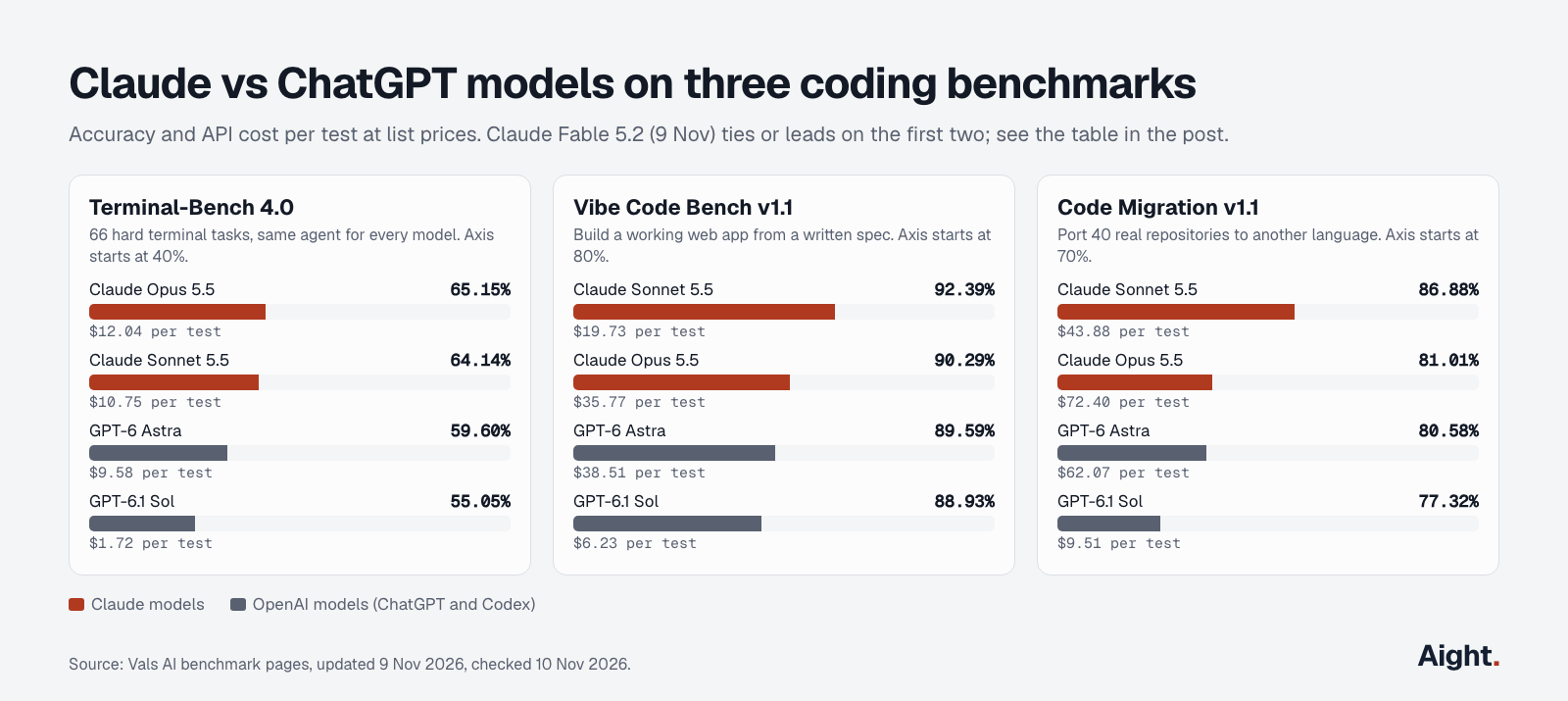
| Benchmark (date) | Best Claude | Opus 5.5 | Sonnet 5.5 | GPT-6 Astra | GPT-6.1 Sol |
|---|---|---|---|---|---|
| Terminal-Bench 4.0, Vals (9 Nov) | Fable 5.2 and Opus 5.5, 65.15% | 65.15%, $12.04 | 64.14%, $10.75 | 59.60%, $9.58 | 55.05%, $1.72 |
| Vibe Code Bench v1.1, Vals (9 Nov) | Fable 5.2, 93.77% | 90.29%, $35.77 | 92.39%, $19.73 | 89.59%, $38.51 | 88.93%, $6.23 |
| Code Migration v1.1, Vals (9 Nov) | Sonnet 5.5, 86.88% | 81.01%, $72.40 | 86.88%, $43.88 | 80.58%, $62.07 | 77.32%, $9.51 |
| WebDev Arena, votes (8 Nov) | Opus 5.5, 1818 (#1) | 1818 | 1774 (#2) | 1767 (#4) | 1743 (#6) |
| Artificial Analysis index, max effort (10 Nov) | Fable 5.2, 65 | 59 | 55 | 57 | 55 |
Dollar figures are Vals' API cost per test at list prices. Fable 5.2 also sits above Opus 5.5 on WebDev Arena (1832), but on an automated score with no rank yet. The Artificial Analysis index covers more than coding; it's here because it is the broadest single score.
Two caveats. Terminal-Bench 4.0 is near its ceiling: a Preference Model audit found problems in 60 of 65 tasks it checked and argued the benchmark "is closer to solved than its leaderboard suggests". And vendor numbers differ from independent runs: Anthropic reports 66.4% for Opus 5.5 on Terminal-Bench 4.0, against Vals' 65.15%.
In the apps, coding means Claude Code and Codex. Claude Code is on every paid Claude plan and shares the chat limits; Codex is included even on ChatGPT Free and Go in limited form, and on Plus it runs GPT-6 Astra and GPT-6.1 Sol. OpenAI estimates 15 to 160 local Codex messages per 5 hours on Plus with GPT-6.1 Sol, or 5 to 45 with Astra (Codex pricing). The agents themselves, with sandboxing, limits and monthly cost, are compared in Codex vs Claude Code, and model picks by coding job are in best LLM for coding.
Claude vs ChatGPT for writing
Claude is the safer pick for prose, and ChatGPT gives you more control over its voice. The benchmarks split:
| Writing benchmark | Claude | ChatGPT models | Who judges |
|---|---|---|---|
| Arena creative writing (9 Nov) | Opus 5.5: 1518, #2 | GPT-6 Astra: 1450, #39; GPT-6.1 Sol: 1449, #41 | People voting blind |
| EQ-Bench Creative Writing v3 | Fable 5.1: 2155.3; Opus 5.5: 2050.9 | GPT-6 Astra: 2176.9, #1; GPT-6 Sol: 2126.0 | An LLM grader |
On Arena, where people pick the better of two anonymous answers, Opus 5.5 trails only Gemini 4 Argon (1525), and Sonnet 5.5 (1465) also beats every GPT-6 model. On EQ-Bench, an LLM grader prefers GPT-6 Astra's longer, more varied stories. Anthropic's Sonnet 5.5 announcement says it writes more clearly than the previous generation, but that is the maker's claim.
What changes the result in practice:
- ChatGPT has personalization settings for tone and warmth; on Claude you steer style through your instructions and prompt.
- Claude's long context lets you paste a whole manuscript, style guide and notes in one chat on a paid plan. ChatGPT Plus cuts an Instant chat at about 40 pages.
- Claude Free gives you Sonnet; ChatGPT Free gives you GPT-6 Luna, OpenAI's smallest GPT-6 model.
For short marketing copy and emails, either is fine. For long-form work you'll edit for days, Claude's context and Arena ranking favor it.
Research and long documents
For web research ChatGPT's models are slightly ahead; for reading your own long files, Claude is. On Search Arena (8 Nov), where people vote on answers that use live web search, GPT-6 Astra scores 1231 and GPT-6.1 Sol 1230, against 1213 for Claude Opus 5.5 at medium effort. Older models top the board: GPT-5.6 Sol at 1258 and Claude Opus 4.6 at 1252, within each other's margin of error.
The plans differ more than the models:
- Deep research: ChatGPT includes a limited version on Free and Go, full on Plus, and the most on Pro. Claude's Research is on Pro and up, not Free.
- Context: Claude's plans list up to 1M tokens of context; ChatGPT's thinking model takes 256K on Plus and 400K on Pro. A 600-page contract bundle fits in one Claude chat and not in one ChatGPT Plus chat.
- Answers: GPT-6 Instant starts answering web-search questions 44% sooner on average than GPT-5.6 Instant, by OpenAI's measure, and can reply with charts and interactive tables.
If your research is mostly "find and summarize what's on the web", ChatGPT Plus is the better $20. If it's "read these 30 PDFs and compare them", Claude Pro is.
Everyday use: images, voice and apps
ChatGPT does more things; Claude does fewer, with no ads.
| Feature | Claude | ChatGPT |
|---|---|---|
| Image generation | No; draws charts and diagrams as code | Yes, all plans (Images 2.6, with GIFs, since 4 Nov) |
| Voice | Voice mode on all plans | Voice on all plans; voice with video from Go |
| Free chat limit | 5-hour and weekly limits | Unlimited Instant chat |
| Memory | On by default, Free included; chat search on paid plans | Memory on all plans, more on paid |
| Built-in apps | Artifacts, Claude Design, Slides, Docs, connectors | Intelligent UI, Sites, plugins, scheduled tasks |
| Agents | Hand off and schedule tasks (Pro and up), Claude in Chrome | ChatGPT Work, Dot always-on agent (Pro) |
| Ads | None | May show on Free and Go |
Sources: Claude pricing, Anthropic's article Can Claude produce images? ("Claude doesn't generate photos or illustrations the way image-generation tools do"), memory and chat search, chatgpt.com/pricing and OpenAI's Images 2.6 post.
ChatGPT's scale also shows: OpenAI reports more than 1.2 billion weekly users. If you'll use one assistant for family recipes, travel plans and pictures, ChatGPT Free or Go covers more of that than Claude Free.
Usage limits: how each one cuts you off
Claude counts everything against one pool: chat on web, desktop and mobile, plus Claude Code. Pro gets "at least 5x more usage per 5-hour session than Free", Max 5x Pro, and Ultra 10x Pro's weekly usage with no 5-hour limit once the account is verified. There's no fixed message count; long chats, big files and Opus or Fable use it up faster. At the limit you wait, upgrade, or pay for more usage at API rates (Claude pricing FAQ).
ChatGPT never limits Instant chat on any plan. Thinking levels, uploads, images, deep research and Codex have their own allowances, and at a Thinking limit ChatGPT may continue with another model. From December, everything on Plus, Pro and Business except Instant chat, Codex included, draws from one allowance measured in tokens.
So the plans fail differently. On Claude Pro, a long Claude Code session can leave you waiting to chat; on ChatGPT Plus, plain chat keeps working when the thinking and Codex allowances run out. Heavy coders on either side end up on the $100 or $200 tiers; Claude Code pricing and Codex pricing work through those numbers.
For builders: the same prompts on the Claude API and the OpenAI API
At the same list price, the Claude API costs about 54% more for the same text, because Claude's tokenizer counts more tokens. The matching tiers are priced identically per token:
| Tier | Claude API (per 1M tokens, in / out) | OpenAI API (per 1M tokens, in / out) |
|---|---|---|
| Small | Haiku 5.5: $0.10 / $0.50 up to 100,000-token prompts, $0.50 / $2.50 above | GPT-6 Luna: $0.10 / $0.50 up to 272K, $0.20 / $0.75 above |
| Mid | Sonnet 5.5: $2 / $10 | GPT-6.1 Sol: $2 / $10 up to 272K, $4 / $15 above |
| Top | Opus 5.5: $4 / $20; Fable 5.2: $8 / $40 | GPT-6 Astra: $10 / $50 up to 272K, $20 / $75 above |
| Cache read | Sonnet 5.5 $0.10, Opus 5.5 $0.20 | GPT-6.1 Sol $0.10, Astra $1.00 |
| Batch | 50% off | 50% off (and Flex) |
Prices from Anthropic and OpenAI, checked 10 November 2026. The catch is the token count. An independent comparison, token-count-compare (run of 12 October 2026), counted 31 files (prose, code in 10 languages, JSON, logs) at 44,794 tokens on every GPT model and 68,940 on Claude Opus 5.5, 1.54 times as many. Anthropic says all Claude models from 4.7 on use the new tokenizer, so the costs below apply the same ratio to Sonnet 5.5 and Haiku 5.5, which the comparison didn't measure.
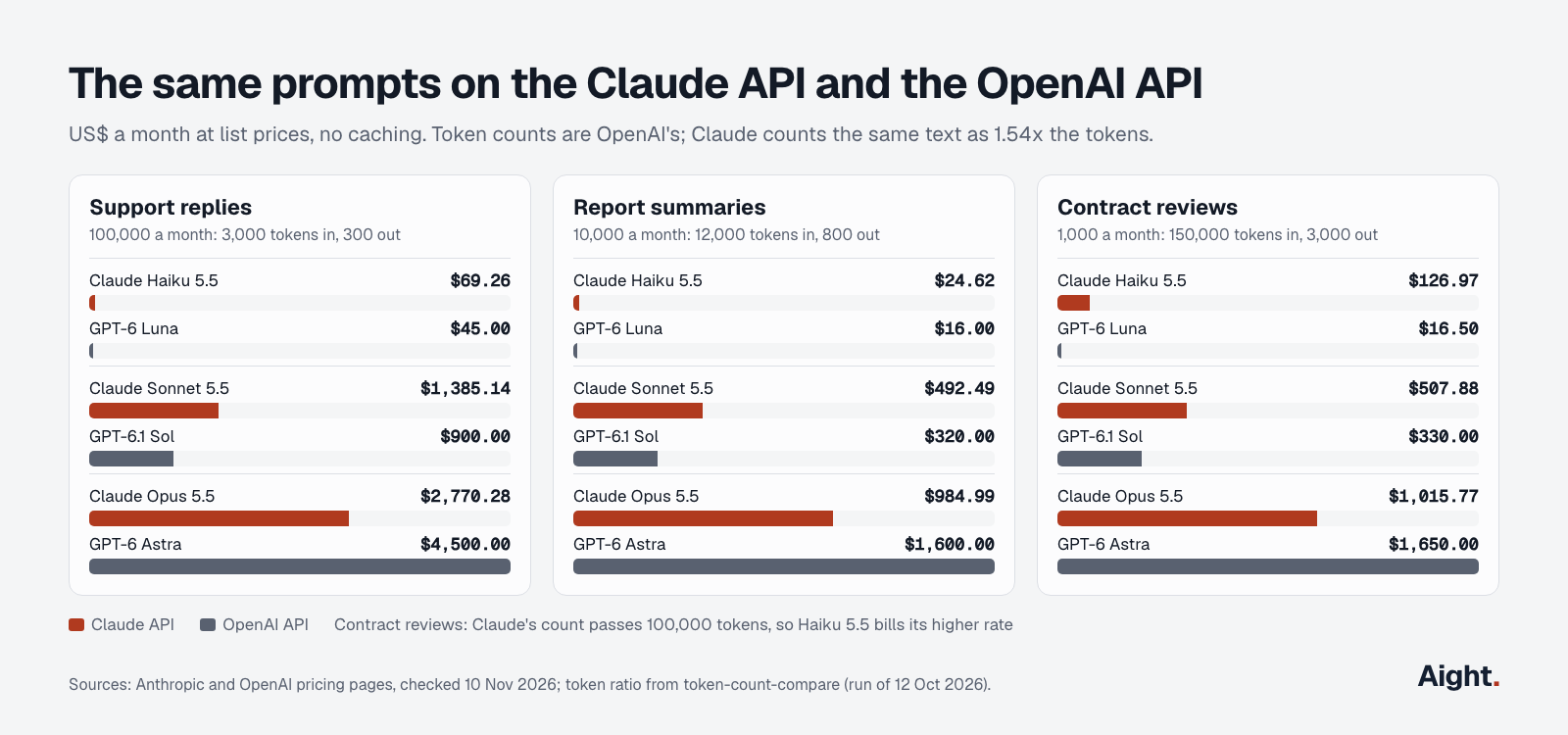
Three jobs, token counts in OpenAI tokens, list prices, no caching, reasoning tokens left out:
| Job | Haiku 5.5 | GPT-6 Luna | Sonnet 5.5 | GPT-6.1 Sol | Opus 5.5 | Fable 5.2 | GPT-6 Astra |
|---|---|---|---|---|---|---|---|
| 100,000 support replies (3,000 in, 300 out) | $69.26 | $45.00 | $1,385.14 | $900.00 | $2,770.28 | $5,540.56 | $4,500.00 |
| 10,000 report summaries (12,000 in, 800 out) | $24.62 | $16.00 | $492.49 | $320.00 | $984.99 | $1,969.98 | $1,600.00 |
| 1,000 contract reviews (150,000 in, 3,000 out) | $126.97 | $16.50 | $507.88 | $330.00 | $1,015.77 | $2,031.54 | $1,650.00 |
What the table shows:
- Like for like, OpenAI costs less: GPT-6.1 Sol is 35% below Sonnet 5.5, and GPT-6 Luna 35% below Haiku 5.5 on short prompts.
- Haiku 5.5's 100,000-token threshold bites sooner than it looks. A 150,000-token contract in OpenAI's count is about 231,000 Claude tokens, so every request pays Haiku's higher rate and costs 7.7 times what GPT-6 Luna does.
- At the top, Opus 5.5 costs less than GPT-6 Astra, since Astra's per-token price is 2.5 times Opus's. Fable 5.2 costs about 23% more than Astra.
- Output length and reasoning differ by model, so measure your own prompts. The Vals cost-per-test column above, which includes reasoning, is the better guide for agents: GPT-6.1 Sol solved Terminal-Bench tasks at $1.72 each against $10.75 for Sonnet 5.5.
The script that produced the table, so you can swap in your own volumes:
# Same prompts on the Claude API and the OpenAI API, list prices checked 10 Nov 2026.
# Token counts are OpenAI's; Claude counts the same text as 68,940 / 44,794 = 1.539x.
CLAUDE_X = 68_940 / 44_794

PRICES = {  # input, output per 1M; (threshold, input above, output above); is_claude
    "Claude Haiku 5.5": (0.10, 0.50, (100_000, 0.50, 2.50), True),
    "GPT-6 Luna": (0.10, 0.50, (272_000, 0.20, 0.75), False),
    "Claude Sonnet 5.5": (2.00, 10.00, None, True),
    "GPT-6.1 Sol": (2.00, 10.00, (272_000, 4.00, 15.00), False),
    "Claude Opus 5.5": (4.00, 20.00, None, True),
    "Claude Fable 5.2": (8.00, 40.00, None, True),
    "GPT-6 Astra": (10.00, 50.00, (272_000, 20.00, 75.00), False),
}

def monthly_cost(model, tokens_in, tokens_out, requests):
    p_in, p_out, tier, is_claude = PRICES[model]
    if is_claude:
        tokens_in, tokens_out = tokens_in * CLAUDE_X, tokens_out * CLAUDE_X
    if tier and tokens_in > tier[0]:
        p_in, p_out = tier[1], tier[2]
    return requests * (tokens_in * p_in + tokens_out * p_out) / 1e6

for model in PRICES:
    print(f"{model:18} ${monthly_cost(model, 150_000, 3_000, 1_000):,.2f}")
# Claude Haiku 5.5   $126.97
# GPT-6 Luna         $16.50
# Claude Sonnet 5.5  $507.88
# GPT-6.1 Sol        $330.00
# Claude Opus 5.5    $1,015.77
# Claude Fable 5.2   $2,031.54
# GPT-6 Astra        $1,650.00
To count tokens for your own prompts without code, the token cost calculator prices them across models. Per-token detail, caching and Batch are in the Claude API pricing and OpenAI token pricing guides.
If Gemini is on your list too, Claude vs ChatGPT vs Gemini compares all three. For research that depends on live web sources, Perplexity vs Claude compares a search engine that cites its sources with Claude.
Where Aight fits
The apps are subscriptions; Aight doesn't replace them. For a person who chats, writes and codes, Claude Pro or ChatGPT Plus at $20 is far better value than paying per token.
Aight fits the builder case above, where you'd otherwise keep two API accounts. Aight is one OpenAI-compatible API, so one key and one prepaid balance reach claude-sonnet-5-5, claude-opus-5-5, gpt-6.1-sol, gpt-6-astra and gpt-6-luna at the makers' list prices (Sonnet 5.5 and GPT-6.1 Sol both $2.00 / $10.00 on the models page). That makes it easy to run the same prompt on both and compare your own bill. Each recharge adds 10% extra to your balance, so a $100 recharge (plus 3% processing outside India) gives $110 of usage, and keys take a monthly spend cap and an allowed-model list.
Two limits: Aight documents Chat Completions, embeddings and the model list only, with no Batch API, so Batch jobs cost less going direct to Anthropic or OpenAI. And the catalog doesn't list Claude Fable 5.2 yet.
What people report
- "Claude is still not able to generate pixel images." (a Hacker News commenter who said non-technical people favor ChatGPT's modes and Intelligent UI, 8 Nov 2026, link)
- "That ChatGPT offers personalization options (Base style, warmth, enthusiasm) and Claude doesn't" (a Hacker News commenter who dislikes Claude's default prose, 24 Oct 2026, link)
- A Hacker News commenter who ran Fable 5.2 on a code review said it used up their Claude 5-hour limit in half an hour and reported seven serious bugs (10 Nov 2026, link)
- A Hacker News commenter who ran Fable 5.2 and Opus 5.5 on the same prompt found Fable's answer cleaner and better written, but kept Opus 5.5 for implementation work (10 Nov 2026, link)
- "Claude Artifacts and ChatGPT sites are one of the most useful features." (a Hacker News commenter on ChatGPT Sites, 3 Oct 2026, link)
The Fable reports point to the trade-off at the top of Claude's lineup: stronger answers that use the plan's limits much faster.
FAQ
Is Claude better than ChatGPT?
For coding and long documents, yes: Claude models lead every independent coding benchmark checked here, and Claude's paid plans take up to 1M tokens of context. For images, voice, free use and quick web answers, ChatGPT is better. At $20 a month they cost the same.
Is Claude free like ChatGPT?
Yes, both have free plans. Claude Free gives Sonnet and Haiku with limits every 5 hours and every week, and no Opus, Research or Claude Code. ChatGPT Free gives unlimited Instant chat on GPT-6 Luna plus limited images, deep research and Codex, and may show ads.
Can Claude generate images like ChatGPT?
No. Anthropic says Claude doesn't generate photos or illustrations; it can draw charts, diagrams and interactive visuals as code. ChatGPT generates images on every plan, including GIFs since Images 2.6 on 4 November 2026.
Which is better for students?
ChatGPT Free covers more for $0: unlimited everyday chat, study mode and some deep research. Claude Free suits essay drafting and long readings, within its 5-hour limits. Anthropic says it has no standing discounts on individual plans; both companies sell campus-wide plans to universities (Claude for Education, ChatGPT Edu).
Should you use both Claude and ChatGPT?
Yes, and many people pay for one and use the other's free plan. A common split is Claude for writing and coding, ChatGPT for images, voice and quick questions. For developers, a single OpenAI-compatible API key can reach both model families, which makes side-by-side testing easier.
Is Claude safer or more private than ChatGPT?
Both let you opt out of training on all consumer plans. The visible difference is ads: Claude has none, and ChatGPT may show them on Free and Go, though OpenAI says ads don't change answers and advertisers don't see chats.
Sources
- Anthropic: Claude pricing, API pricing, Introducing Claude Fable 5.2 and Mythos 5.2 (9 Nov 2026), Introducing Claude Opus 5.5 (22 Sep 2026), Introducing Claude Sonnet 5.5 (28 Sep 2026), Claude is a space to think (4 Feb 2026)
- Claude Help Center: About the Pro plan, Can Claude produce images?, Chat search and memory
- OpenAI: ChatGPT pricing, Codex pricing (plan prices in US$), API pricing, GPT-6 and Intelligent UI for everyone (7 Oct 2026), Introducing Images 2.6 (4 Nov 2026)
- OpenAI Help Center: What is ChatGPT Plus?, What is ChatGPT Go?, About ChatGPT Pro tiers, GPT-6 and other models in ChatGPT, Understanding ChatGPT and Codex usage limits, Ads in ChatGPT
- Vals AI: Terminal-Bench 4.0, Vibe Code Bench v1.1, Code Migration v1.1 (all updated 9 Nov 2026)
- Arena: WebDev, Creative writing, Search
- EQ-Bench Creative Writing v3; Artificial Analysis model leaderboard; Preference Model, Terminal Bench 4 is saturated (19 Oct 2026)
- williamliu-ai, token-count-compare (run of 12 Oct 2026)
- Hacker News comments: 50415411, 50226169, 50436100, 50435964, 49941666
- YouTube: OpenAI, Introducing GPT-6 in ChatGPT with Intelligent UI; Alex Grankin, Claude Pro vs ChatGPT Plus (18 Oct 2026)
- Aight: models, API reference, token cost calculator
Checked on 10 November 2026. Updated 17 November 2026: Aight's current model list.