Claude API status is published at status.claude.com (status.anthropic.com redirects there): look at the component named "Claude API (api.anthropic.com)", or run curl -s https://status.claude.com/api/v2/status.json. During an incident, Claude requests fail with HTTP 529 overloaded_error, 500 api_error or 504 timeout_error, and these are worth retrying or sending to another model.
Don't wait for the page to turn red. For 11 Claude API incidents between 24 August and 27 October 2026 where Anthropic stated when the impact began, the first status post came 7 to 27 minutes later (median 13). Your own error rate is the faster signal.
Below: the status pages for Claude, OpenAI, Gemini and DeepSeek, what each error looks like, outages since August, the uptime numbers, and tested Python failover code.
Check Claude API status in 30 seconds
- Read the error. A 529, 503, 500 or 504, or a timeout, points at the provider. A 400, 401, 403 or 404 points at your request or key. A 429 is a rate limit or quota, covered in API rate limit exceeded.
- Ask the status page from a terminal:
curl -s https://status.claude.com/api/v2/status.json | jq -r .status.description
curl -s https://status.claude.com/api/v2/components.json | jq -r '.components[] | "\(.status)\t\(.name)"'
curl -s https://status.openai.com/api/v2/components.json | jq -r '.components[] | "\(.status)\t\(.name)"'
The first line prints "All Systems Operational" or the incident level. The second and third print each component as operational, degraded_performance, partial_outage or major_outage. OpenAI's page runs on incident.io but serves the same Statuspage-style JSON.
- Send the smallest possible request yourself, and try a second model. Most Claude incidents hit one or two models, so a working Haiku request while Sonnet fails tells you what to route around:
curl -sS -o /dev/null -w "%{http_code}\n" https://api.anthropic.com/v1/messages \
  -H "x-api-key: $ANTHROPIC_API_KEY" -H "anthropic-version: 2023-06-01" \
  -H "content-type: application/json" \
  -d '{"model":"claude-haiku-5-5","max_tokens":1,"messages":[{"role":"user","content":"hi"}]}'
200 means that model answers for you. A 401 means the API is reachable but the key is wrong.
- If the page is green and your errors keep climbing, check whether the problem is regional. Anthropic's 10 September incident hit only traffic entering through the US Midwest, OpenAI's 22 October incident hit users in India, Japan and Korea, and its 20 October authentication errors affected users near Illinois and were posted a day later.
Status pages for Claude, OpenAI, Gemini and DeepSeek
| Provider | Status page | Machine-readable | Alerts you can subscribe to |
|---|---|---|---|
| Anthropic (Claude) | status.claude.com | /api/v2/status.json, summary.json, components.json, incidents/unresolved.json (docs) | Email, SMS, Slack, Microsoft Teams, webhook, RSS and Atom (/history.rss) |
| OpenAI | status.openai.com | /api/v2/status.json, summary.json, components.json, incidents.json | Email, RSS and Atom (/feed.rss); Slack and SMS are switched off |
| Google Gemini API | aistudio.google.com/status | None found | None found; check the developer forum |
| Gemini on Vertex AI | status.cloud.google.com | /incidents.json | Atom feed (/en/feed.atom) |
| DeepSeek | status.deepseek.com | No JSON API (/api/v2/ returns 404) | Email, per-component email, RSS and Atom (/history.rss) |
A few details that matter when you wire these up:
- Claude's page splits the API from claude.ai, Claude Code and the Console. An incident on claude.ai alone, such as the connector errors of 28 October, doesn't touch
api.anthropic.com. - OpenAI's "APIs" group covers 14 components, including Chat Completions, Responses, Embeddings, Batch and Realtime. Watch the ones you call.
- Google's AI Studio page has a tier filter and says free-tier requests "use sheddable capacity" while billed traffic runs at critical priority. On the free tier, a 503 can be your tier being shed while the page shows green.
- The status page can fail too. On 14 August 2026 status.claude.com itself was unreachable for about three hours because of an invalid certificate.
What each error looks like during an incident
These are the errors to expect when the provider is the problem. Rate-limit 429s and their retry rules are in the rate limit guide.
| Provider | Status and type | What it means | Retry the same model? |
|---|---|---|---|
| Anthropic | 529 overloaded_error, message "Overloaded" | API overloaded "across all users" | Briefly, then fail over |
| Anthropic | 500 api_error | Unexpected internal error | Yes, with backoff |
| Anthropic | 504 timeout_error (also on some 500s) | Timed out before the response started | Use streaming for long requests |
| OpenAI | 500 "The server had an error while processing your request" | Server-side failure | Yes, after a short wait |
| OpenAI | 503 service_unavailable_error, code server_is_overloaded | Model out of capacity | After Retry-After, then fail over |
| Gemini | 503 UNAVAILABLE ("temporarily overloaded or down") | Capacity, often on one model or the free tier | Backoff, then another model |
| Gemini | 500 internal, 504 DEADLINE_EXCEEDED | Server error or deadline | Yes; raise the client deadline for 504 |
| DeepSeek | 503 Server Overloaded | "Overloaded due to high traffic" | Yes, after a brief wait |
| DeepSeek | 500 Server Error | Server-side failure | Yes, after a brief wait |
Sources: Anthropic's errors page, OpenAI's error codes, Google's troubleshooting and API errors pages, and DeepSeek's error codes.
The Anthropic body is the same shape on every error:
{"type": "error", "error": {"type": "overloaded_error", "message": "Overloaded"}, "request_id": "req_..."}Three cases catch people out:
- A streamed Claude response can fail after it has started. Anthropic's streaming docs show an
event: errorcarryingoverloaded_errorafter the HTTP 200. Inanthropic2.5.0 this raises a plainAPIStatusErrorwithstatus_code200, notOverloadedError, so code that branches on status codes misses it. Checke.body["error"]["type"]. - Overload can arrive as a 429. Google's report on the 27 February 2026 Vertex AI incident says customers saw "overload (429 and 503) errors", so on Gemini a 429 isn't always about your quota.
- Slow is a failure too. OpenAI's 30 September incident warned of "elevated latency or timeouts", and both the
openai3.45.0 andanthropic2.5.0 Python SDKs default to a 600-second timeout with 2 retries. One stuck request can hold a worker for half an hour before your fallback runs.google-genai2.34.0 sets no timeout at all unless you pass one (in milliseconds).
Recent outages, with dates
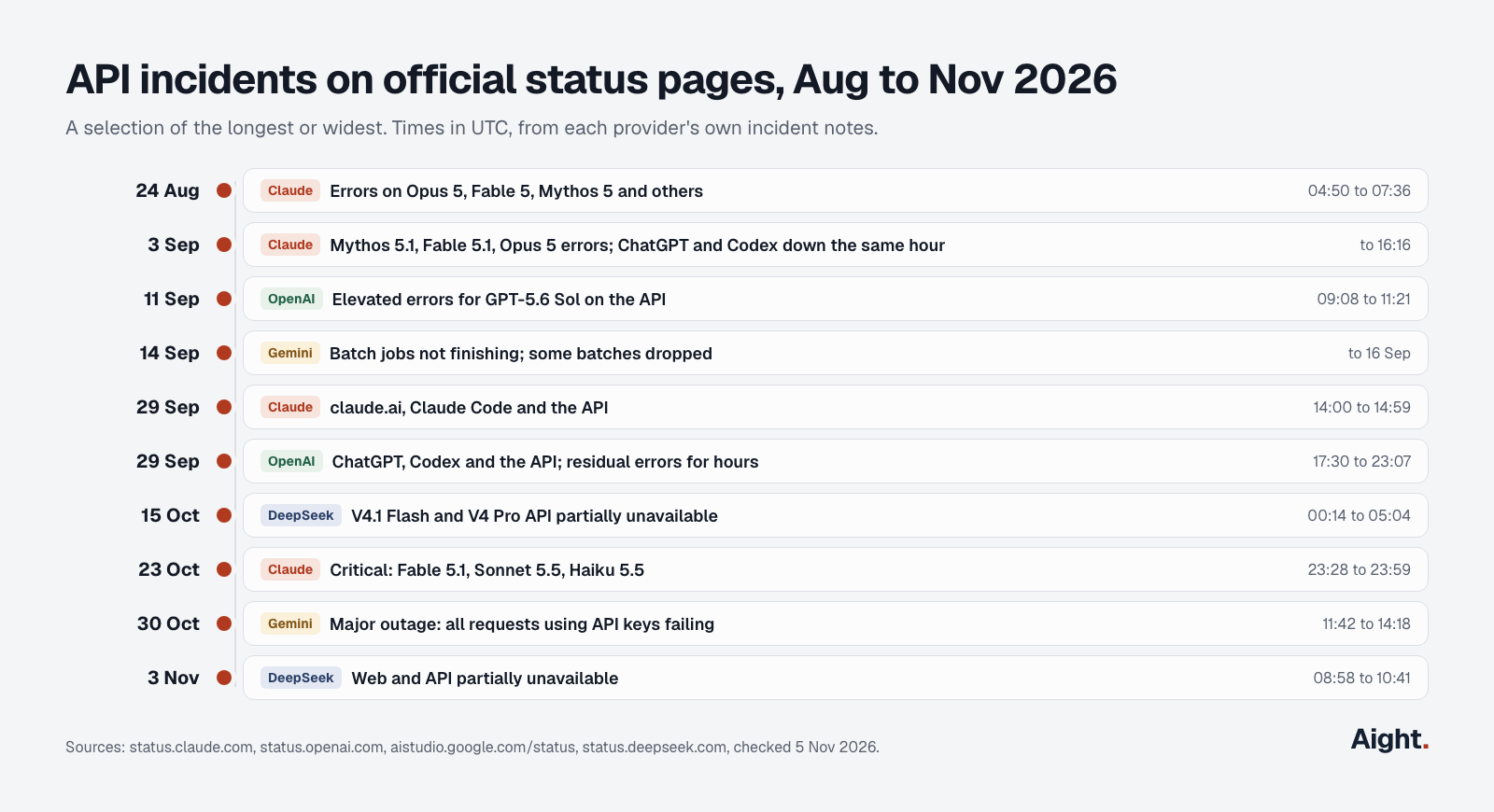
From each provider's own incident notes, times in UTC:
| Date (2026) | Provider | What the status page said | Impact window (UTC) |
|---|---|---|---|
| 24 Aug | Claude | Elevated errors on Opus 5, Fable 5, Mythos 5 and other models | 04:50 to 07:36 |
| 3 Sep | Claude | Errors on Mythos 5.1, Fable 5.1 and Opus 5 | Posted 13:26, ended 16:16 |
| 11 Sep | OpenAI | Elevated errors for GPT-5.6 Sol on the API, fixed by adding capacity | 09:08 to 11:21 |
| 14 to 16 Sep | Gemini | Batch requests not finishing in 24 hours; some batches dropped and not charged | About 1.5 days |
| 29 Sep | Claude | Errors on claude.ai, Claude Code, Cowork and the API | 14:00 to 14:59 |
| 29 Sep | OpenAI | Errors across ChatGPT, Codex and the API after a feature rollout | 17:30 to about 23:07 |
| 15 Oct | DeepSeek | V4.1 Flash and V4 Pro API partially unavailable | 00:14 to 05:04 |
| 23 Oct | Claude | Critical: Fable 5.1, Sonnet 5.5, Haiku 5.5 and fast-mode Opus 5.5 | 23:28 to 23:59 |
| 30 Oct | Gemini | Major outage: "All requests using API keys are currently failing" | Posted 11:42, resolved 14:18 |
| 3 Nov | DeepSeek | Web and API partially unavailable | 08:58 to 10:41 |
Two patterns stand out for failover planning.
Most Claude incidents are model-specific. Of the 31 incidents on status.claude.com that touched the API component between 5 August and 27 October, 15 named one or two models, 10 hit three or more, and 3 took the API down with claude.ai and Claude Code (14 August, 16 August and 29 September). The other 3 were a latency problem in the US Midwest, a connector issue and a billing delay. The two Sonnet 5.5 incidents on 27 October named no other model, so a second Claude model would have kept answering.
Providers do fail on the same day, but rarely in the same minutes. On 3 September Claude, ChatGPT and Grok all had errors within the same two hours and a Hacker News thread asked why. OpenAI's write-up blamed a routing configuration change, and its incident listed ChatGPT and Codex, not the API. On 29 September Claude's API failed from 14:00 to 14:59 and OpenAI's from about 17:30, so a Claude-to-OpenAI fallback would have worked through both.
Uptime numbers from the status pages
The 90-day uptime figures, 7 August to 4 November 2026:
| Component | Shown uptime | How the page counts it | Raw minutes behind it |
|---|---|---|---|
| Claude API | 99.77% | Major outage in full, partial outage at 30% | 923 partial, 17 major |
| OpenAI Chat Completions | 100% | Full and partial outage count; degraded performance counts as up | 886 degraded, 0 outage |
| OpenAI Responses | 100% | Same | 3,336 degraded, 0 outage |
| OpenAI "APIs" group | 99.97% | Same, across 14 components | Partial outage on 2 days |
| DeepSeek V4.1 Flash API | 99.58% | Partial outage in full; degraded not counted | 546 partial, 334 degraded |
| DeepSeek V4 Pro API | 99.76% | Same | 307 partial, 4 full, 274 degraded |
| Gemini API | Not shown | 60 days of colored bars |
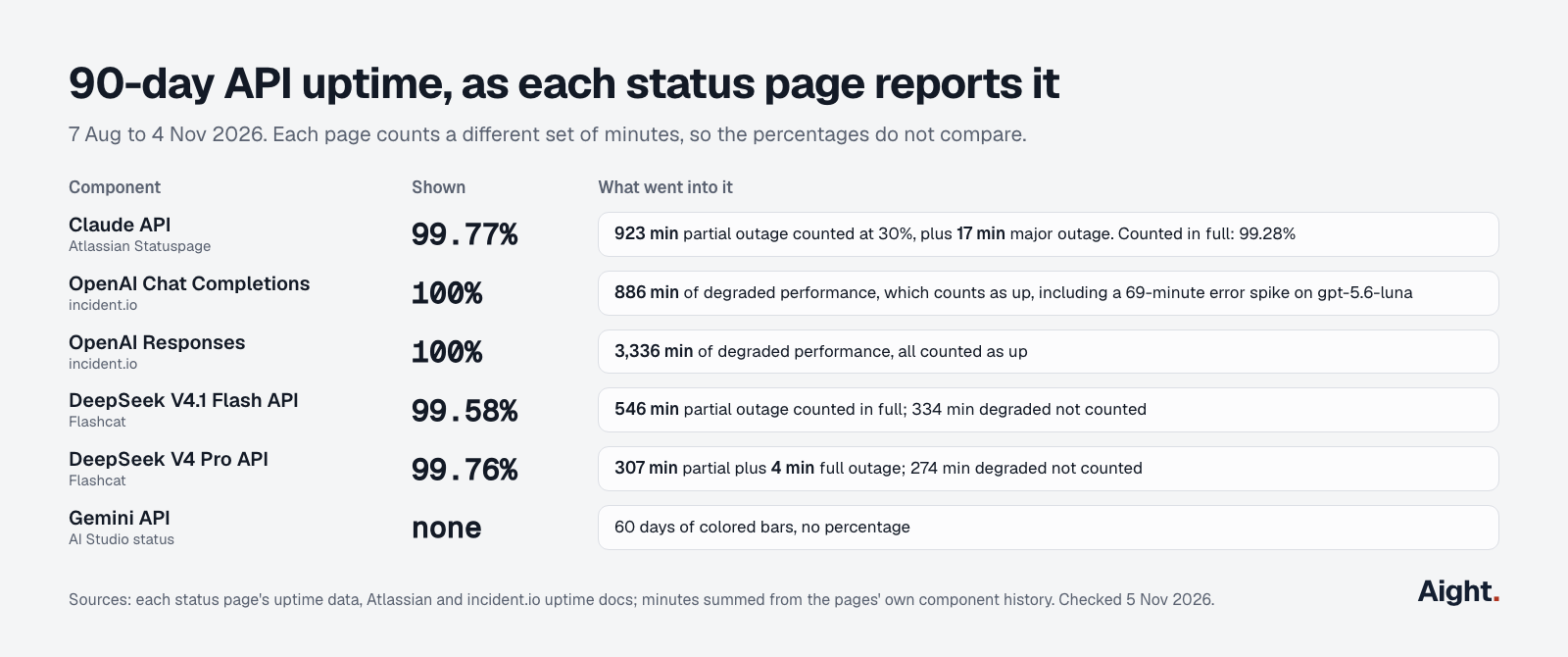
These numbers measure how each company labels its incidents, not your success rate. Atlassian's uptime formula counts partial outages as "30% as bad" as major ones; recount the Claude API's minutes with partial outages in full and it falls to 99.28%. incident.io, which runs OpenAI's page, treats degraded performance as up, and OpenAI filed its error spikes there: the 69-minute "Elevated error rates for gpt-5.6-luna API requests" on 21 October left Chat Completions at 100%. DeepSeek's figures match partial outages counted in full and degraded time ignored (worked out from its own component history; the page doesn't say). OpenAI's footer adds that availability is "reported at an aggregate level across all tiers, models and error types".
Use the incident list instead: how often your model breaks, for how long, and whether it was one model or the whole API.
How to fail over to another model in code
The pattern: a short timeout, one quick retry inside the SDK, then the next route on a list. Same provider first (a different model), then other providers. A small circuit breaker skips a route that keeps failing, so requests stop waiting on it.
import os
import time

import anthropic
import openai

TIMEOUT = 30.0  # seconds per attempt; both SDKs default to 600

clients = {
    "anthropic": anthropic.Anthropic(max_retries=1, timeout=TIMEOUT),
    "openai": openai.OpenAI(max_retries=1, timeout=TIMEOUT),
    "deepseek": openai.OpenAI(
        base_url="https://api.deepseek.com",
        api_key=os.environ["DEEPSEEK_API_KEY"],
        max_retries=1,
        timeout=TIMEOUT,
    ),
}

# Same provider first (many incidents hit one or two models), then other providers.
ROUTES = [
    ("anthropic", "claude-sonnet-5-5"),
    ("anthropic", "claude-opus-5-5"),
    ("openai", "gpt-6.1-sol"),
    ("deepseek", "deepseek-flash"),
]

# Errors that mean "this route is unhealthy right now": timeouts, connection
# failures, 5xx (529 overloaded included) and 429. Other 4xx mean the request
# itself is wrong, so they are raised instead of hidden behind a fallback.
FAILOVER = (
    anthropic.APIConnectionError, anthropic.InternalServerError, anthropic.RateLimitError,
    openai.APIConnectionError, openai.InternalServerError, openai.RateLimitError,
)


class Breaker:
    """Skip a route for `cooldown` seconds after `threshold` failures in a row."""

    def __init__(self, threshold=3, cooldown=60.0):
        self.threshold, self.cooldown = threshold, cooldown
        self.fails, self.open_until = {}, {}

    def available(self, route):
        return time.monotonic() >= self.open_until.get(route, 0.0)

    def success(self, route):
        self.fails[route] = 0

    def failure(self, route):
        self.fails[route] = self.fails.get(route, 0) + 1
        if self.fails[route] >= self.threshold:
            self.open_until[route] = time.monotonic() + self.cooldown
            self.fails[route] = 0


breaker = Breaker()


def call(provider, model, system, user):
    if provider == "anthropic":
        r = clients[provider].messages.create(
            model=model, max_tokens=1024, system=system,
            messages=[{"role": "user", "content": user}],
        )
        return "".join(b.text for b in r.content if b.type == "text")
    r = clients[provider].chat.completions.create(
        model=model,
        messages=[{"role": "system", "content": system}, {"role": "user", "content": user}],
    )
    return r.choices[0].message.content


def ask(system, user):
    errors = []
    for route in ROUTES:
        if not breaker.available(route):
            continue  # open circuit: don't wait on a route that just failed
        try:
            text = call(*route, system, user)
        except FAILOVER as e:
            breaker.failure(route)
            errors.append(f"{route[1]}: {type(e).__name__} {getattr(e, 'status_code', '')}")
            continue
        breaker.success(route)
        return route[1], text
    raise RuntimeError("every route failed: " + "; ".join(errors))


model, text = ask("Answer in one sentence.", "What is a circuit breaker?")
Tested with openai 3.45.0 and anthropic 2.5.0 against a local server returning 529 overloaded_error for Sonnet 5.5, 500 api_error for Opus 5.5 and 503 server_is_overloaded with Retry-After: 1 for GPT-6.1 Sol. The first three calls each took about 1.9 seconds and were answered by deepseek-flash. After the third, all three breakers were open, and the next calls went straight to DeepSeek in under 10 ms.
What to adjust before production:
- Set the timeout from your own p99 latency, not the SDK's 600 seconds. Long reasoning calls need more than 30.
- Mind the order of the list. On 23 October the critical Claude incident hit Sonnet 5.5 and Haiku 5.5 together, so a Haiku fallback for Sonnet would have failed with it.
- Check that every route can do the job. GPT-6.1 Sol needs the Responses API for tool calls (Chat Completions works for plain text), and prompts tuned for one model can read differently on another. Test the fallbacks with real prompts before the outage, not during it.
- Watch the cost of each rung. Claude Sonnet 5.5 and GPT-6.1 Sol both list at $2.00 / $10.00 per million tokens, while Opus 5.5 is $4.00 / $20.00, so the Opus rung doubles the price of the requests it handles. The Claude API pricing guide has the full list.
- For streams, fail over only before the first token. After that, either restart the whole answer on the next route and discard the partial one, or show the error. Check
e.bodyforoverloaded_erroras described above. - Production breakers usually trip on a failure rate over a sliding window, not N failures in a row. Log and alert on every failover, so a silent fallback doesn't hide a week of errors.
- Don't add retries on top of retries. OpenAI's write-up on 29 September says "failed checks generated additional attempts", and that extra traffic was part of what exhausted its network capacity. Keep the SDK at one retry when your own loop handles the rest.
Paying to avoid overload errors
Some providers sell priority capacity, which cuts overload errors without code changes:
- Gemini's Priority inference (preview, Interactions API) costs 75% to 100% more than standard. When Priority limits are exceeded, overflow runs at standard rates "instead of failing with a 503 or 429". The
x-gemini-service-tierresponse header shows which tier served the request. - Anthropic's Priority Tier is now listed as legacy: its service tiers page says capacity commitments "are no longer available for purchase" and points to sales for guaranteed capacity.
- On Gemini, moving from the free tier to a billed project moves you from sheddable to critical-priority capacity, according to the AI Studio status page.
What developers report
- "529 Overloaded · Retrying in 4s · attempt 6/10" (Claude Code user, GitHub issue on anthropics/claude-code, 3 Sep 2026, the day of Claude's multi-model incident, link)
- "Status pages of tech firms being useless is basically a tradition at this stage" (Hacker News commenter during the 3 September outages, link)
- A Google AI Developers Forum thread opened at 06:37 UTC on 30 October reported about two hours of "Failed to generate content" across Gemini models; the status page entry appeared at 11:42 UTC, and a Google staff member marked it fixed at 15:17 UTC (link)
- An unpaid Gemini API pilot got repeated 503
UNAVAILABLEerrors on gemini-3.5-flash-lite, even for a minimal text request; the reply put it down to temporary overload (Google AI Developers Forum, 29 Sep 2026, link) - OpenAI's root-cause write-up for 29 September: a feature rollout set off repeated internal checks, and "failed checks generated additional attempts" until shared network capacity ran out (OpenAI status)
Failover through Aight
Aight is one OpenAI-compatible API for 138 models, so the route list above can become model IDs on one client: claude-sonnet-5-5 and gpt-6.1-sol at $2.00 / $10.00 and DeepSeek-V4.1-Flash at $0.30 / $1.20 per million tokens, on one prepaid balance, with no second set of keys or SDK. Requests that fail on Aight's side aren't charged, and a per-key monthly cap stops a fallback loop from overspending. The one-key setup guide covers the client change.
Know what each route depends on. The models page shows Claude running through Anthropic, so a status.claude.com incident reaches Claude on Aight too. GPT-6 and DeepSeek models run on Microsoft Azure, and Gemini on Vertex AI, so OpenAI's, DeepSeek's and AI Studio's status pages don't describe those routes.
Where direct is better: Aight doesn't publish a status page or uptime figure, and it adds one more service between you and the model. Keep a direct provider key as the last route. The AI gateway explainer covers the trade-off.
FAQ
Is the Claude API down right now?
Check the "Claude API (api.anthropic.com)" component on status.claude.com, or run curl -s https://status.claude.com/api/v2/status.json. If it shows operational but your requests fail with 529 or 500, send a one-token request to a second model: the page has posted incidents a median of 13 minutes after they began.
What does Claude error 529 overloaded mean?
HTTP 529 overloaded_error means Anthropic's API is temporarily overloaded across users, not that you hit your own limit. Retry once or twice with backoff, then move the request to another model. It can also arrive mid-stream as an event: error after an HTTP 200.
Is status.anthropic.com the same as status.claude.com?
Yes. status.anthropic.com returns a 301 redirect to status.claude.com, which covers claude.ai, the Console, the Claude API, Claude Code, Claude Cowork and Claude for Government as separate components.
How can you get alerts when the Claude API is down?
On status.claude.com, use Subscribe to Updates for email, SMS, Slack, Microsoft Teams or a webhook, or add https://status.claude.com/history.rss to a feed reader. You can subscribe to the Claude API component alone. Pair it with an alert on your own 5xx rate, which fires sooner.
Does a higher tier stop overload errors?
Not on the standard API. Anthropic's 529 hits all users during high traffic, and its Priority Tier is no longer sold. Gemini's billed tiers run at critical priority instead of the free tier's sheddable capacity, and its Priority inference downgrades overflow instead of returning 503.
Is OpenAI's 100% uptime real?
It's accurate under incident.io's rule, which counts degraded performance as up. Chat Completions had 886 minutes of degraded performance in the 90 days to 4 November 2026, including a 69-minute error spike on gpt-5.6-luna, and still shows 100%.
Sources
- Anthropic: Claude status, status API, Errors, Streaming, Service tiers, Models overview; incident notes for 24 Aug, 3 Sep, 22 Sep, 29 Sep, 23 Oct, 25 Oct and 27 Oct 2026 via
/api/v2/incidents.json - OpenAI: OpenAI status and incidents for 29 Sep, 11 Sep, 3 Sep and 30 Sep; Error codes, GPT-6.1 Sol
- Google: AI Studio and Gemini API status, Google Cloud Service Health and its 27 Feb 2026 Vertex Gemini API incident, Troubleshooting, API errors, Priority inference
- DeepSeek: DeepSeek status and history feed, Error codes, Models and pricing
- Uptime methods: Atlassian, Display historical uptime of components; incident.io, Status pages uptime calculation
- SDKs: openai 3.45.0, anthropic 2.5.0, google-genai 2.34.0 on PyPI; defaults read from each package's source and failover tested against a local server with fake keys
- Community: anthropics/claude-code #91817; Hacker News, 3 Sep 2026; Google AI Developers Forum threads of 30 Oct and 29 Sep
- Video: System Design Lab, Circuit Breaker Pattern Explained
- Aight: Models and pricing, API reference, Terms
Checked on 5 November 2026. Updated 17 November 2026: Aight's current model list.