OpenAI Whisper API pricing is $0.006 per minute of audio, or $0.36 an hour, for whisper-1. But whisper-1 shuts down on 26 February 2027, and its recommended replacement, gpt-transcribe, costs less: $0.0045 a minute, $0.27 an hour. Live transcription with gpt-live-transcribe costs $0.017 a minute ($1.02 an hour).
For 1,000 hours of recordings that means $360 on Whisper, $270 on gpt-transcribe and $1,020 if you transcribe the same audio live. Below are every OpenAI transcription model's price, the retirement dates, what the same 1,000 hours cost on Gemini, Deepgram, AssemblyAI and five other APIs, and the file limits that decide how you send audio. All prices are list prices in US dollars, checked on each provider's page on 5 November 2026.
OpenAI Whisper API pricing per minute and per hour
OpenAI's pricing page lists eight transcription and translation models. Two of them (whisper-1 and gpt-4o-transcribe-diarize) only appear under "All models", which is why many price lists skip them.
| Model | Use | Per minute | Per hour | Per 1,000 hours | Status |
|---|---|---|---|---|---|
gpt-transcribe | Recorded files | $0.0045 | $0.27 | $270 | Current, recommended |
gpt-4o-mini-transcribe | Recorded files | $0.003 | $0.18 | $180 | Shuts down 26 Feb 2027 |
gpt-4o-transcribe | Recorded files | $0.006 | $0.36 | $360 | Shuts down 26 Feb 2027 |
whisper-1 | Files, timestamps, subtitles, translation | $0.006 | $0.36 | $360 | Shuts down 26 Feb 2027 |
gpt-4o-transcribe-diarize | Files with speaker labels | $0.006 | $0.36 | $360 | Shuts down 26 Feb 2027 |
gpt-live-transcribe | Live audio | $0.017 | $1.02 | $1,020 | Current, recommended |
gpt-realtime-whisper | Live audio | $0.017 | $1.02 | $1,020 | Current, not recommended for new work |
gpt-realtime-translate | Live speech translation | $0.034 | $2.04 | $2,040 | Current |
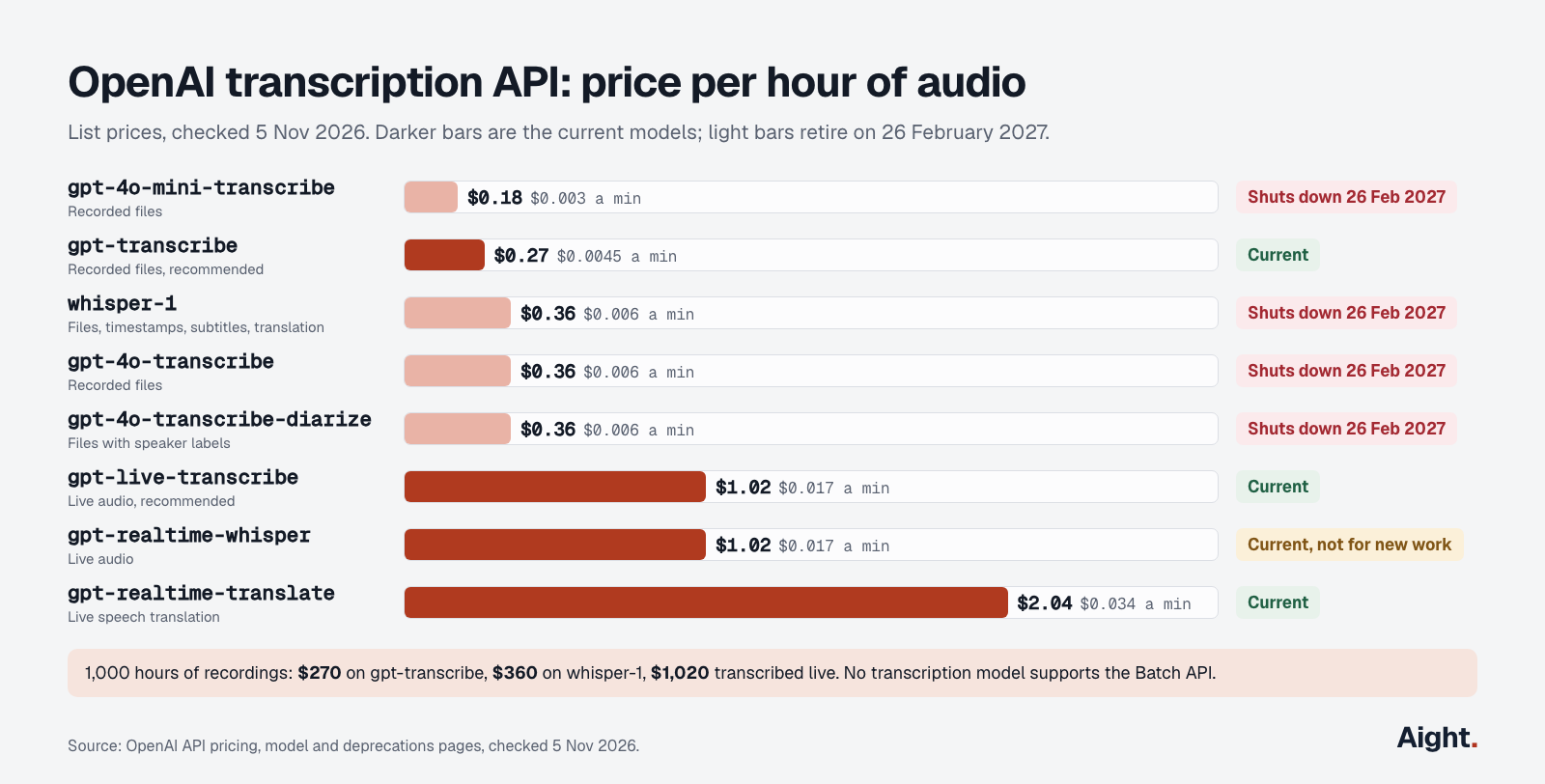
Two billing methods sit behind these numbers. gpt-transcribe, whisper-1 and the live models are billed by audio duration: the API reference returns a usage object of type duration with the seconds of input audio. The three gpt-4o models are billed by token ($2.50 / $10.00 per million for gpt-4o-transcribe, $1.25 / $5.00 for mini), and the per-minute figure is OpenAI's estimate, so a real bill can differ a little.
None of the transcription models supports the Batch API, so there is no 50% discount for work that can wait. Each model page shows v1/batch as unsupported.
gpt-transcribe is also the most accurate of OpenAI's file models on Artificial Analysis: a word error rate of 3.3%, against 4.0% for gpt-4o-transcribe, 4.1% for Whisper Large v2 (the model behind whisper-1) and 4.5% for gpt-4o-mini-transcribe. The lowest-priced model is the least accurate, and it retires with the others.
Whisper retirement: what shuts down on 26 February 2027
On 26 August 2026 OpenAI announced that whisper-1, gpt-4o-transcribe, gpt-4o-mini-transcribe and gpt-4o-transcribe-diarize leave the API on 26 February 2027, along with the /v1/audio/translations endpoint. One older snapshot goes sooner.
| Date | What happens | OpenAI's named replacement |
|---|---|---|
| 7 May 2026 | gpt-realtime-whisper and gpt-realtime-translate released | |
| 28 Jul 2026 | gpt-transcribe and gpt-live-transcribe released | |
| 26 Aug 2026 | Deprecation notice for the four older models | |
| 20 Jan 2027 | gpt-4o-mini-transcribe-2025-03-20 shuts down | gpt-4o-mini-transcribe-2025-12-15 |
| 26 Feb 2027 | whisper-1, gpt-4o-transcribe, gpt-4o-mini-transcribe, gpt-4o-transcribe-diarize shut down | gpt-transcribe or gpt-live-transcribe |
| 26 Feb 2027 | /v1/audio/translations shuts down | /v1/realtime/translations |
For plain transcripts the move is mostly a model ID change (plus languages in place of language) and a 25% price cut from Whisper. For three jobs it isn't, because OpenAI's transcription overview still points them at the retiring models:
- Speaker labels (
diarized_json) come only fromgpt-4o-transcribe-diarize. - Word timestamps and
srtorvttsubtitles come only fromwhisper-1. - File translation into English uses
whisper-1on/v1/audio/translations. The replacement,gpt-realtime-translate, needs a streaming session and costs $0.034 a minute, almost six times as much.
The guide's own warning: "changing only the model ID doesn't preserve every capability." As of 5 November, neither OpenAI's transcription guides nor its API reference document speaker labels or subtitle formats on gpt-transcribe. If you rely on them, price a second provider now rather than in February. The model shutdown post shows what a missing model returns.
Diarization and realtime transcription prices
Speaker labels cost $0.006 a minute on gpt-4o-transcribe-diarize, the same as Whisper, until 26 February 2027. The model needs chunking_strategy set for audio over 30 seconds, accepts up to four known-speaker reference clips of 2 to 10 seconds, and doesn't take a prompt, per the file transcription guide. Speaker labels aren't available in Realtime sessions at all.
Live transcription costs 3.8 times file transcription: $0.017 a minute on both gpt-live-transcribe and gpt-realtime-whisper. OpenAI's voice cost guide says streaming transcription and translation sessions "are billed by audio duration", not by token. Between the two live models, gpt-live-transcribe is the one to pick at the same price. The launch announcement on OpenAI's Developer Community forum gives it a 19.70% error rate across 22 Common Voice languages against 20.33% for gpt-realtime-whisper, and 9.60% against 11.65% on its real-world recording set.
What live text doesn't include, per the realtime transcription guide: gpt-live-transcribe "doesn't return word-level timestamps, speaker labels, or transcription confidence scores." It trades accuracy for delay through a delay setting from minimal to xhigh.
If you run a voice agent on the Realtime API, input transcription is a separate charge on top of the voice model's audio tokens. OpenAI recommends gpt-transcribe there, billed by audio duration.
What 1,000 hours of audio costs, OpenAI vs Gemini, Deepgram and AssemblyAI
For recorded files, gpt-transcribe at $270 per 1,000 hours sits in the middle of the market. Four providers in this table charge less and score a lower error rate, and two charge more. Pay-as-you-go list prices, checked 5 November 2026; word error rate (WER) is Artificial Analysis' AA-WER v2 across three datasets, lower is better.
| Recorded files | Per minute | Per hour | 1,000 hours | Speaker labels | WER |
|---|---|---|---|---|---|
| xAI Grok Voice Transcribe 2.0 | $0.0017 | $0.10 | $100 | diarize flag, no separate price listed | 2.3% |
| AssemblyAI Universal-2 | $0.0025 | $0.15 | $150 | +$0.02 an hour | not listed |
| Azure AI Speech batch | $0.0030 | $0.18 | $180 | Not checked | not listed |
OpenAI gpt-4o-mini-transcribe | $0.0030 | $0.18 | $180 | No | 4.5% |
| AssemblyAI Universal-3.5 Pro | $0.0035 | $0.21 | $210 | +$0.02 an hour | 3.0% |
| Mistral Voxtral Mini Transcribe 3 | $0.0035 | $0.21 | $210 | Not stated for v3 | 2.2% |
| ElevenLabs Scribe v2 | $0.0037 | $0.22 | $220 | Included, up to 32 speakers | 2.2% |
| Deepgram Nova-3 | $0.0043 | $0.26 | $258 | Included on files | 5.2% |
OpenAI gpt-transcribe | $0.0045 | $0.27 | $270 | No | 3.3% |
| Gemini 3.5 Transcribe | $0.0051 | $0.31 | $306 | Included, up to 8 speakers | 2.6% |
OpenAI whisper-1 | $0.0060 | $0.36 | $360 | No | 4.1% |
| AWS Transcribe batch | $0.0060 | $0.36 | $360 | Not checked | 4.1% |
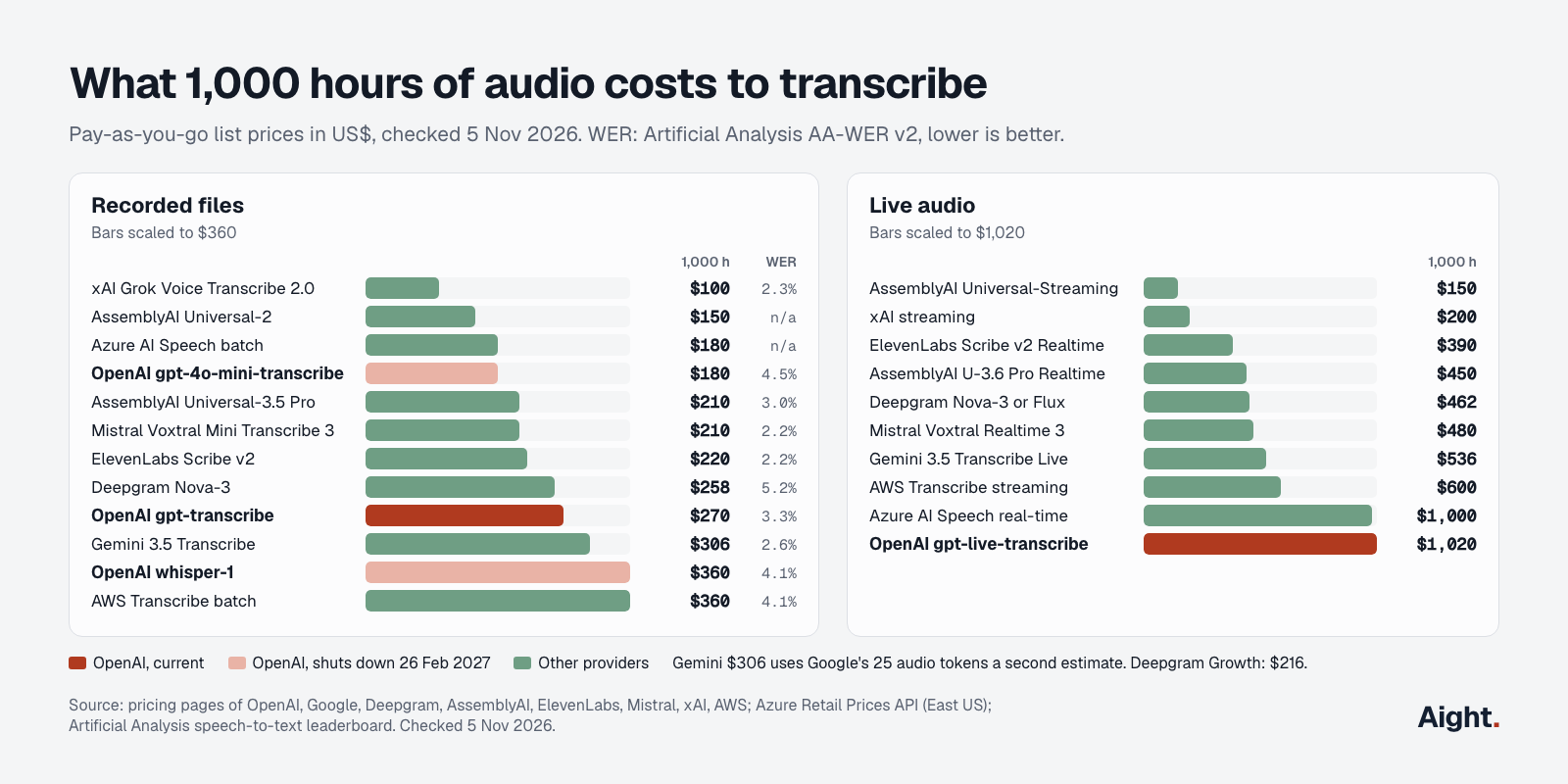
How each price works:
- Gemini 3.5 Transcribe is billed per token: $2.00 per million audio tokens in and $12.00 per million text tokens out. At Google's own estimate of 25 audio tokens a second and 175 text tokens a minute, that is $0.0051 a minute. Google's general audio guide counts 32 tokens a second, which would make it $0.0059. Diarization and word timestamps cap a request at 30 minutes instead of an hour, and the model has no Batch option. The Gemini API pricing post covers Google's other models.
- Deepgram charges $0.0036 on its Growth plan (from $4,000 a year prepaid), which brings 1,000 hours to $216. It bills per second with no rounding. Multilingual Nova-3 is $0.0052.
- AssemblyAI bills multichannel audio per channel, so a two-channel call recording counts twice. Speaker labels add $0.02 an hour on both models.
- xAI lists one speech-to-text rate, $0.10 an hour over REST. The speech-to-text docs offer speaker diarization and word-level timestamps as request options.
- ElevenLabs charges keyterm prompting at $0.05 an hour extra and bills "every second of audio you send, including pauses and silent stretches."
- AWS Transcribe bills per second with a 15-second minimum per request. The Azure price is the S1 batch meter from Microsoft's retail prices API for East US.
Live audio reverses OpenAI's position. At $1,020 per 1,000 hours, gpt-live-transcribe is the most expensive streaming option in this comparison:
| Live audio | Per hour | 1,000 hours |
|---|---|---|
| AssemblyAI Universal-Streaming, English or six-language Multilingual | $0.15 | $150 |
| xAI streaming | $0.20 | $200 |
| ElevenLabs Scribe v2 Realtime | $0.39 | $390 |
| AssemblyAI Universal-3.6 Pro Realtime | $0.45 | $450 |
| Deepgram Nova-3 or Flux, English | $0.46 | $462 |
| Mistral Voxtral Mini Transcribe Realtime 3 | $0.48 | $480 |
| Gemini 3.5 Transcribe Live | $0.54 | $535.50 |
| AWS Transcribe streaming | $0.60 | $600 |
| Azure AI Speech real-time | $1.00 | $1,000 |
OpenAI gpt-live-transcribe | $1.02 | $1,020 |
Free allowances help with testing, not with 1,000 hours: AssemblyAI includes up to 185 hours of file transcription, Deepgram gives $200 of usage, and Gemini 3.5 Transcribe is free on Google's free tier, where Google may use the data to improve its products. OpenAI lists no Free-tier rate limits for gpt-transcribe or gpt-live-transcribe, so they need a paid tier.
The model that costs least for each job
Price per minute only matters once a model can do the job. The cheapest option that can, per 1,000 hours:
| Job | OpenAI's model | OpenAI cost | Lowest-cost option in this post |
|---|---|---|---|
| Plain transcripts of recordings | gpt-transcribe | $270 | xAI, $100 (WER 2.3%) |
| Same, staying on OpenAI to February | gpt-4o-mini-transcribe | $180 | Retires 26 Feb 2027, WER 4.5% |
| Speaker labels on recordings | gpt-4o-transcribe-diarize | $360 to 26 Feb 2027 | xAI $100; ElevenLabs $220 included; AssemblyAI Universal-3.5 Pro $230 |
| Word timestamps or subtitles | whisper-1 | $360 to 26 Feb 2027 | xAI or ElevenLabs, word timestamps included |
| Live captions | gpt-live-transcribe | $1,020 | AssemblyAI Universal-Streaming, $150 |
| Translating recordings to English | whisper-1 | $360 to 26 Feb 2027 | OpenAI's gpt-realtime-translate after that, $2,040; no other translation API priced here |
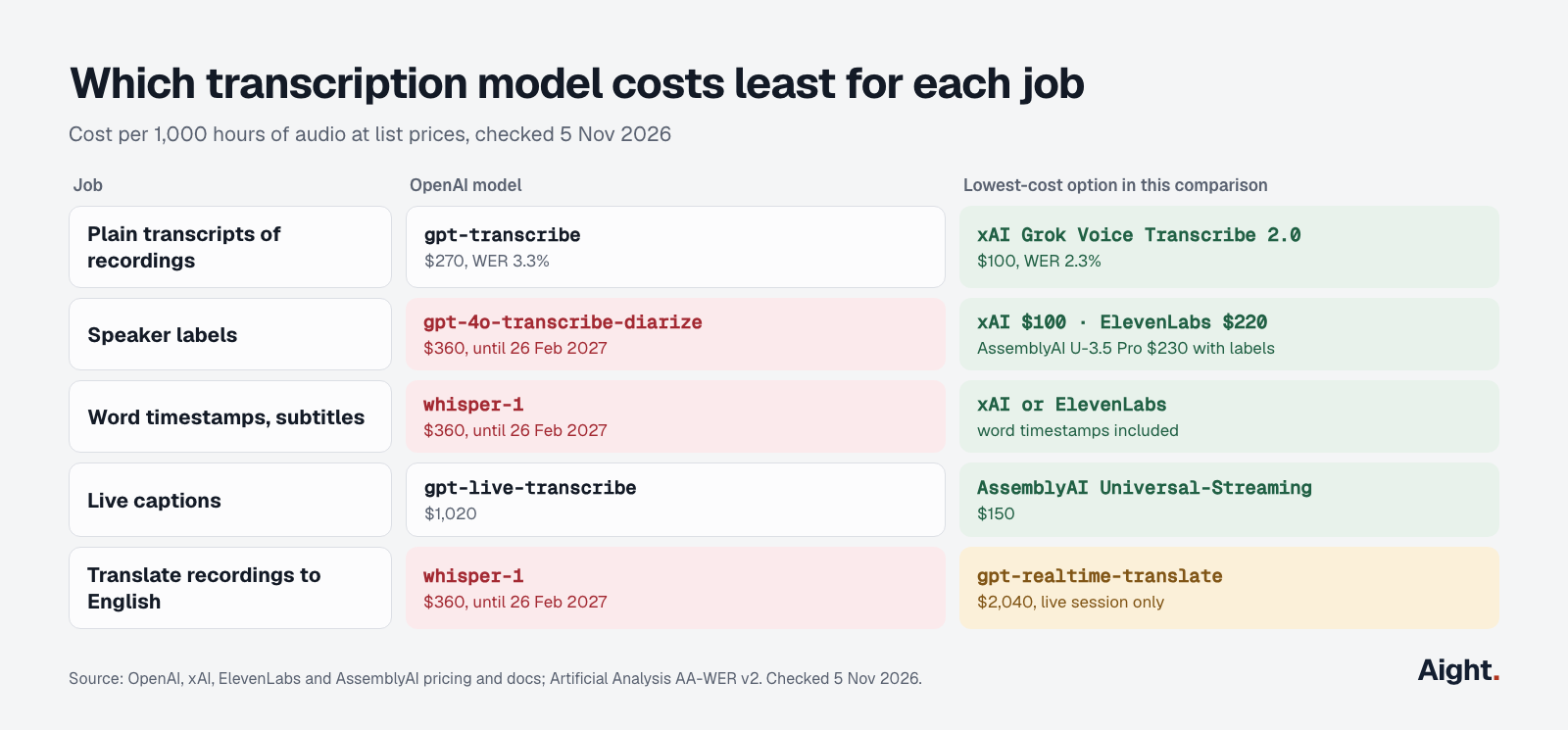
Two cautions before switching for price. A public benchmark may not match your audio, and OpenAI's own guide says to test accents, background noise, telephony audio, names and numbers, so run a sample of real recordings through two or three candidates. And gpt-4o-mini-transcribe saves $90 per 1,000 hours over gpt-transcribe only until February, after which the code has to change anyway.
File limits: 25 MB, formats and long recordings
The OpenAI transcription endpoint takes files "up to 25 MB" in mp3, mp4, mpeg, mpga, m4a, wav or webm, per the file transcription guide. The API reference also lists flac and ogg. Anything larger has to be compressed or split. Other limits worth knowing:
| Provider | Upload limit | Longest audio per request |
|---|---|---|
| OpenAI | 25 MB | Not stated; gpt-4o models cap output at 2,000 tokens |
| Gemini 3.5 Transcribe | 20 MB inline, larger through the Files API | 1 hour, 30 minutes with diarization or timestamps |
| xAI | 500 MB | Not stated |
| ElevenLabs | 3 GB | 10 hours |
| Gemini 3.5 Transcribe Live | Streaming | 10 minutes per session |
Artificial Analysis notes that gpt-4o-transcribe and gpt-4o-mini-transcribe can't reliably handle full-length recordings, so its tests split long files into roughly 9-minute chunks for them. It doesn't do that for gpt-transcribe.
Size, not length, is the documented OpenAI constraint. Speech re-encoded as mono 16 kHz MP3 at 32 kbps takes 14.4 MB an hour, so about 104 minutes fit under 25 MB. Test accuracy at that bitrate on your own audio before you rely on it. OpenAI's guide also warns against cutting a file mid-sentence, which loses context.
How to keep transcription cost down
The levers, roughly in order of what they save:
- Don't stream what you can record. The same hour costs $1.02 live and $0.27 as a file on OpenAI.
- Move off
whisper-1andgpt-4o-transcribenow.gpt-transcribeis 25% less and more accurate, and the old models stop working on 26 February 2027. - Cut long silences. Duration-billed models charge for the seconds you upload, so a recording with long pauses costs more than its speech.
- Use
promptandkeywordsongpt-transcribeinstead of a second text-model pass to fix product names. - Put transcription in its own OpenAI project with a hard spend limit, which returns a 429 at the cap. The OpenAI spend limit guide covers the settings.
Check your usage tier before a large backlog. OpenAI's rate-limits guide sets a $500 monthly usage limit on Build (after $5 of total purchases) and $5,000 on Launch (after $100). 1,000 hours in one month on gpt-transcribe fits under Build; the same hours live don't.
These ffmpeg commands (tested on ffmpeg 9.0.2) shorten every pause longer than a second to about one second, convert to mono 16 kHz at 32 kbps, and split the result into 20-minute parts. In a test file, a 6-second gap shrank to about 1 second. Timestamps in the transcript then refer to the trimmed audio, not the original.
ffmpeg -i meeting.wav \
  -af "silenceremove=stop_periods=-1:stop_duration=1:stop_threshold=-45dB" \
  -ac 1 -ar 16000 -b:a 32k meeting.mp3
ffmpeg -i meeting.mp3 -f segment -segment_time 1200 -c copy part_%03d.mp3
To price a folder before sending it, this script reads each file's length with ffprobe and flags anything over 25 MB. It needs no API key. On a 60-minute file it printed $0.27 for gpt-transcribe, $0.18 for mini, $0.36 for Whisper and $1.02 live.
# transcription_cost.py: price a folder of recordings before you send it
# Usage: python3 transcription_cost.py ./recordings
import subprocess
import sys
from pathlib import Path

# US$ per minute of audio, OpenAI pricing page, checked 5 Nov 2026
PER_MINUTE = {
    "gpt-transcribe": 0.0045,
    "gpt-4o-mini-transcribe": 0.003,      # shuts down 26 Feb 2027
    "whisper-1": 0.006,                   # shuts down 26 Feb 2027
    "gpt-4o-transcribe-diarize": 0.006,   # shuts down 26 Feb 2027
    "gpt-live-transcribe": 0.017,         # live audio only
}
AUDIO = {".mp3", ".mp4", ".mpeg", ".mpga", ".m4a", ".wav", ".webm"}
LIMIT = 25 * 1000 * 1000  # 25 MB upload limit; stay under it in decimal megabytes


def seconds(path):
    out = subprocess.run(
        ["ffprobe", "-v", "error", "-show_entries", "format=duration",
         "-of", "default=noprint_wrappers=1:nokey=1", str(path)],
        capture_output=True, text=True, check=True,
    ).stdout
    return float(out)


files = sorted(p for p in Path(sys.argv[1]).iterdir() if p.suffix.lower() in AUDIO)
total = 0.0
for p in files:
    total += seconds(p)
    if p.stat().st_size > LIMIT:
        print(f"{p.name}: over 25 MB, compress or split it first")

minutes = total / 60
print(f"{len(files)} files, {minutes:,.1f} minutes ({minutes / 60:,.2f} hours)")
for model, price in PER_MINUTE.items():
    print(f"{model:28} ${minutes * price:,.2f}")
Then send each part to gpt-transcribe and log what you were billed for. In the OpenAI Python SDK 3.45.0 (4 November 2026), keywords and languages are regular arguments, and usage comes back with the billed seconds:
from openai import OpenAI

client = OpenAI()
with open("part_000.mp3", "rb") as audio:
    t = client.audio.transcriptions.create(
        model="gpt-transcribe",
        file=audio,
        prompt="Weekly sales call about the Q4 renewal pipeline.",
        keywords=["Acme Cloud", "ARR", "QBR"],
        languages=["en"],
    )
print(t.text)
print(t.usage)  # UsageDuration(seconds=..., type='duration'): the billed audio length
gpt-transcribe takes languages (a list) instead of language; don't send both. Keywords can't contain <, > or line breaks, or the whole request is rejected.
What developers report about the switch
- "there doesn’t seem to be any diarisation replacement mentioned in the migration guide" (an OpenAI Developer Community member on
gpt-4o-transcribe-diarize, 19 Oct 2026, link). The thread opened with a report thatgpt-transcribedidn't seem to support the diarized format; a forum moderator passed it to the team. - A builder who indexed 230 podcast episodes, about 145 hours, reported "Total cost: ~$33 using OpenAI's transcription and embedding APIs" (Show HN, 23 Sep 2026, link).
- "Swapping transcription models mid-stream cut processing costs noticeably without hurting search recall." (the same Show HN post, 23 Sep 2026, link)
- A Hacker News commenter waited over a week for Google Cloud billing to activate before trying Gemini 3.5 Transcribe: "Ended up with Soniox instead, took minutes to get started." (13 Oct 2026, link)
- On Mistral's older Voxtral models, a commenter noted "they don't hallucinate text when there's no speech" (Voxtral 3 thread, 20 Oct 2026, link).
- The launch announcement put
gpt-live-transcribe's semantic accuracy at 44.6% with free-form context against 38.5% without it, on a context-aware speech recognition benchmark (OpenAI Developer Community, 29 Jul 2026, link).
Where Aight fits
Not in the audio step. Aight's models page lists two OpenAI transcription models, gpt-4o-mini-transcribe and gpt-4o-transcribe-diarize, but its API reference documents only chat completions, embeddings and the model list, and OpenAI retires both models on 26 February 2027. Send audio straight to OpenAI or one of the providers above.
Aight fits the step after: turning transcripts into summaries, action items or CRM fields through Chat Completions. That step is small next to the audio. Summarizing 1,000 hours as 2,000 thirty-minute calls, at Google's estimate of 175 text tokens a minute, is about 11.5 million input and 1.4 million output tokens (with reasoning). On gpt-6-luna at $0.10 / $0.50, Aight's price and OpenAI's, that comes to $1.85, against $270 to transcribe the same audio on gpt-transcribe.
What one Aight key adds is control across models: a monthly cap per key that returns a 403 key_cap_reached, a list of allowed models, and the option to switch the summary model to Claude, Gemini or DeepSeek without new accounts. Every recharge adds 10% extra balance, about $0.94 per $1 of list-price usage after the 3% processing fee outside India. For whole-pipeline estimates, see how much an LLM API costs per month and the OpenAI token pricing reference.
FAQ
Is the OpenAI Whisper API free?
No. whisper-1 costs $0.006 per minute of audio on the API, and the other OpenAI transcription models are priced per minute too. The open-source Whisper model is free to run on your own hardware under the MIT license; you pay for the compute instead.
How much does Whisper cost per hour?
$0.36 an hour, or $360 for 1,000 hours, on whisper-1. The replacement gpt-transcribe costs $0.27 an hour. Deepgram also hosts Whisper Large at $0.0048 a minute, about $0.29 an hour.
Is OpenAI deprecating Whisper?
Yes. OpenAI announced on 26 August 2026 that whisper-1 and the /v1/audio/translations endpoint shut down on 26 February 2027, with gpt-transcribe or gpt-live-transcribe as replacements. Word timestamps and SRT or VTT subtitles have no documented replacement on the new models yet.
Can you use the Batch API for transcription?
No. None of OpenAI's transcription model pages list v1/batch as supported, so there's no half-price option. Gemini 3.5 Transcribe doesn't support Google's Batch API either.
Does OpenAI charge for silence in audio files?
On duration-billed models, the bill follows the length of the audio you upload, and the response's usage.seconds is the input audio's duration, pauses included. Trimming long silences before upload lowers the bill. ElevenLabs states the same rule outright: no discount for silence.
Is gpt-transcribe more accurate than Whisper?
On Artificial Analysis' benchmark, yes: 3.3% word error rate against 4.1% for Whisper Large v2, at 25% less per minute. The launch announcement also reports lower error rates for gpt-live-transcribe than gpt-realtime-whisper. Test on your own recordings: OpenAI's guide says names, numbers and domain terms need their own checks beyond word error rate.
Sources
- OpenAI API docs: Pricing, Deprecations, Changelog, Transcription overview, File transcription, Realtime transcription, Voice usage and cost, Rate limits, Create transcription reference
- OpenAI model pages: gpt-transcribe, gpt-live-transcribe, gpt-4o-transcribe, gpt-4o-mini-transcribe, gpt-4o-transcribe-diarize, whisper-1, gpt-realtime-whisper, gpt-realtime-translate
- OpenAI elsewhere: openai on PyPI (3.45.0), Whisper license, launch post and diarization thread on the Developer Community, YouTube: Introducing gpt-transcribe and gpt-live-transcribe, Live demo of 3 new OpenAI realtime audio models
- Google: Gemini API pricing, Gemini 3.5 Transcribe, Audio transcription guide, Audio understanding
- Deepgram, Pricing; AssemblyAI, Pricing; ElevenLabs, API pricing and Speech to text docs; Mistral, Pricing and Models
- xAI, Pricing and Speech to text; AWS, Amazon Transcribe pricing; Microsoft, Azure Retail Prices API (Azure Speech, East US)
- Artificial Analysis, Speech to Text leaderboard
- Hacker News: Castrag Show HN comment, Gemini 3.5 Transcribe billing comment, Voxtral 3 thread comment
- FFmpeg, Filters documentation (silenceremove)
- Aight: Models and pricing, API reference, Refund policy
Checked on 5 November 2026.