Zero data retention (ZDR) means the model provider stores none of your prompts or outputs once it has returned the response: nothing in abuse-monitoring logs, nothing saved as conversation state. No major LLM API works that way by default. OpenAI keeps API data for up to 30 days, Anthropic for 30 days and Google's Gemini API for 55 days, and getting zero takes a sales-approved agreement, except on Amazon Bedrock, where one account setting does it.
Even then, ZDR covers only stateless endpoints: batch jobs, uploaded files and stored conversations keep data, and Claude Fable 5 and 5.1 can't run under ZDR without a special arrangement. Every figure below comes from the providers' own pages on 5 November 2026.
What zero data retention means for an LLM API
An LLM provider can keep your content in three places, and ZDR is about the first two:
- Abuse-monitoring logs: copies of prompts and outputs kept so the provider can check them against its usage policy. This is the 30 or 55 days in the defaults.
- Application state: data a feature needs to work, such as a stored response you continue with
previous_response_id, a batch job, an uploaded file or a code container. - Caches: prompt-cache data held in memory or on local disk for minutes to 24 hours. Providers count short-lived caches as compatible with ZDR.
ZDR is not the same as "no training". Paid API traffic at OpenAI, Anthropic, Google, Microsoft and AWS isn't used for training by default, yet all of them except Bedrock keep some of it for monitoring. ZDR also never overrides the law: OpenAI keeps logs longer "if required by law", and Anthropic may keep flagged inputs and outputs for up to 2 years even under ZDR.
That carve-out has been used: in 2025 a court in the New York Times case ordered OpenAI to preserve API output it would otherwise have deleted after 30 days. Customers on ZDR endpoints weren't affected, and the obligation ended on 26 September 2025.
Default retention by provider
| Provider | What's kept by default | Trained on? | Zero data retention | How to get it |
|---|---|---|---|---|
| OpenAI API | Abuse logs up to 30 days; Responses stored 30 days unless store=false | No | Yes, approved accounts | Sales, then Data Retention tab |
| Anthropic Claude API | Inputs and outputs deleted within 30 days | No | Yes, approved organizations | Sales |
| Gemini API, paid | Prompts, context and output for 55 days; new projects also log requests for 55 days | No | Not offered; Google points to Google Cloud | Move to Google Cloud |
| Gemini API, free | Used to improve products; human review | Yes | No | Pay, or don't send sensitive data |
| Google Cloud (Vertex AI, now Gemini Enterprise Agent Platform) | Flagged prompts up to 90 days, plus 24-hour caches | No | Yes, by settings and terms | Cloud Master Agreement, cache settings |
| Azure (Foundry, Azure OpenAI) | Flagged prompts kept for human review; no period stated | No | Modified abuse monitoring | Form, managed customers only |
| Amazon Bedrock | Nothing for most models; OpenAI models keep flagged traffic up to 30 days | No | Yes, self-serve for most models | Data retention mode none |
| Claude Fable 5, 5.1 (any platform) | 30 days minimum | No | Only by Anthropic exception | Account team |
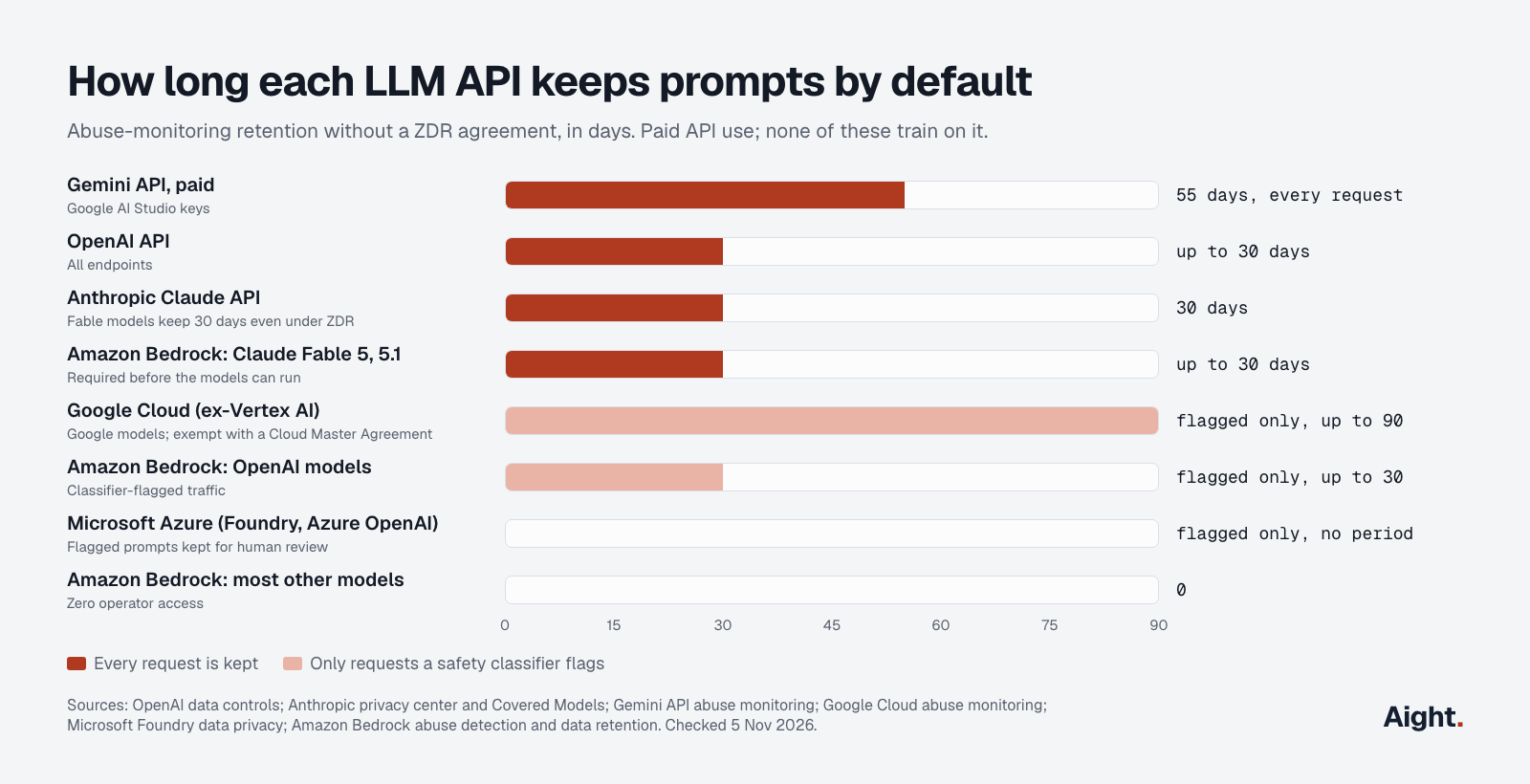
Two defaults changed recently. Since 26 October 2026, new paid Gemini API projects log Generate Content requests by default and keep them for 55 days, separately from abuse monitoring (logs policy); the Gemini API pricing guide covers the store=false switch. And Microsoft removed the "up to 30 days" figure from its abuse-monitoring docs; its pages now say flagged prompts may be stored for review without giving a period.
On the OpenAI side, both APIs also store conversation state: OpenAI's migration guide says "Responses are stored by default. Chat completions are stored by default for new accounts." The OpenAI API guide compares the two APIs. Set store=false whether or not you have ZDR.
Which providers offer ZDR, and how to request it
OpenAI
OpenAI's data controls page offers two controls, both "subject to prior approval by OpenAI": Zero Data Retention and Modified Abuse Monitoring. Both keep customer content out of abuse logs. ZDR also forces store to false on /v1/responses and /v1/chat/completions, even if a request sets it to true; Modified Abuse Monitoring keeps every feature working.
You ask through OpenAI's sales team. Once approved, a Data Retention tab appears under Settings, Organization, Data controls, set per organization and per project. Eligible endpoints include Chat Completions, Responses, embeddings, audio, moderation, Realtime and GPT Image generation.
Still logged under ZDR: images flagged as possible CSAM are kept for manual review, and OpenAI can, with written notice, make specific models ineligible for a customer.
Anthropic
Under Anthropic's ZDR arrangement, it "does not store customer prompts or responses at rest after the API response is returned" (API and data retention). You request it from Anthropic sales; it's enabled per organization, and a new organization under the same account needs its own enablement.
It covers the Messages and Token Counting APIs for eligible features and Claude Code used with a commercial organization's API keys. It doesn't cover the Console, Managed Agents, the Free, Pro, Max and Ultra plans, or the Team and Enterprise chat apps. ZDR organizations also can't call the API from a browser: cross-origin requests are rejected.
Without ZDR, the commercial retention policy (updated 1 July 2026) deletes API inputs and outputs within 30 days. With or without it, content flagged for a usage-policy violation can be kept for up to 2 years, and classifier scores for up to 7 years.
The Gemini Developer API has no ZDR. Google's ZDR page for it says paid traffic is logged for a limited period for abuse detection, and "If your workload requires guaranteed zero data retention or enterprise data processing agreements, use Vertex AI." Its abuse-monitoring page puts the period at 55 days.
On Google Cloud, which Google has renamed Gemini Enterprise Agent Platform, zero is reachable by settings and contract (ZDR guide, updated 4 November 2026):
- Abuse monitoring logs Google-model prompts only when classifiers flag them, for up to 90 days, and customers with a Google Cloud Master Agreement are exempt by default.
- Implicit caching is on by default, in memory and in durable storage, each deleted after at most 24 hours. Turn off the durable tier, or all caching, per project.
- Request-response logging to BigQuery is off by default; leave it off.
- Set
storeto false on the Interactions API, which defaults to true.
Turning off durable caching while keeping the in-memory cache is one call (from Google's guide):
curl -X PATCH \
  -H "Authorization: Bearer $(gcloud auth application-default print-access-token)" \
  -H "Content-Type: application/json" \
  https://us-central1-aiplatform.googleapis.com/v1/projects/PROJECT_ID/cacheConfig \
  -d '{"name": "projects/PROJECT_ID/cacheConfig", "disableCache": false,
       "retentionConfig": {"retentionType": "EPHEMERAL"}}'
Microsoft Azure
Azure calls its version modified abuse monitoring. Without it, prompts and completions that classifiers flag can be stored for human review by Microsoft staff in your resource's geography (data privacy). With it, nothing is stored for review, though automated checks still run on each request.
The catch: Microsoft's limited access page says modified abuse monitoring is "available only to customers and partners managed by a Microsoft account team or under an eligible program", through an application form.
Amazon Bedrock
Bedrock is the only major platform with self-serve ZDR. Its data retention modes run none, default, aws_review and a legacy provider_data_share, set per Region for the account or per project. Under none, "No request or response data is written to durable storage by AWS", Messages and Chat Completions requests are never retained, store=true on the Responses API is rejected and background mode is unavailable.
There's no console switch yet. Set it with the control-plane API in each Region you use:
curl -X PUT https://bedrock.us-east-1.amazonaws.com/data-retention \
  -H "Authorization: Bearer $AWS_BEARER_TOKEN_BEDROCK" \
  -H "Content-Type: application/json" \
  -d '{ "mode": "none" }'
A model that needs retention is then blocked rather than silently retaining: Claude Fable 5 and 5.1 require aws_review (30 days, possible human review by AWS), while Claude Opus 4.8 allows none. OpenAI's proprietary models keep classifier-flagged traffic for up to 30 days unless your AWS account team grants full ZDR.
Features that don't work under ZDR
Anything stateful falls outside ZDR. Some providers block those features; others let the request through and keep the data under the feature's own policy. Anthropic says the second plainly: under ZDR the API does not block ineligible features, and using one "is a choice to step outside your ZDR arrangement for that specific data."
| Provider | Outside ZDR (data kept) | Covered under ZDR |
|---|---|---|
| OpenAI | Batch, Files, Assistants and threads, Conversations, vector stores, fine-tuning, evals, custom voices (until deleted); store=true forced off | Chat Completions, Responses, embeddings, audio, image generation, Realtime, prompt caching |
| Anthropic | Batch (29 days), Files (until deleted), code execution and programmatic tool calling (up to 30 days), MCP connector, Agent Skills, Managed Agents, message threads (up to 1 hour in memory) | Messages, token counting, prompt caching, thinking, web search, web fetch, computer use, structured outputs (schema cached up to 24 hours) |
| Search grounding (30 days on the Gemini API, 3 days on Google Cloud), Maps grounding (30 days), Files API, explicit context caches, Live API session resumption (24 hours) | Stateless generate calls with store=false; in-memory implicit caching | |
| Amazon Bedrock | Responses store=true and background mode (rejected); Fable models (blocked) | Messages, Chat Completions, Responses with store=false |
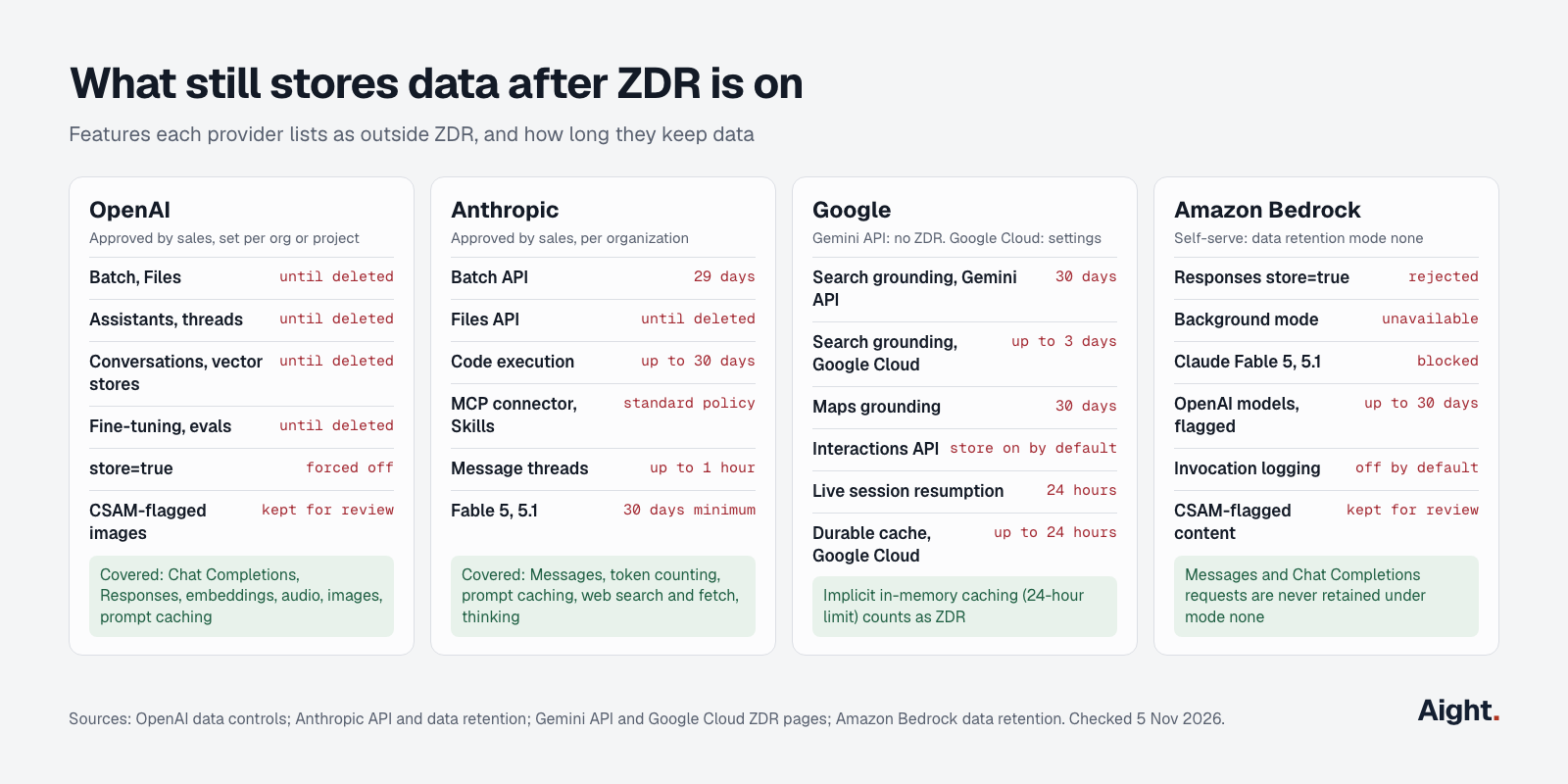
The practical effect on code is conversation state. With store off, OpenAI can't continue a response by ID, so you resend the history. Its reasoning guide says stateless responses carry reasoning as encrypted_content by default, so replaying every output item keeps the model's reasoning across turns. The request shape was checked with openai 3.46.0 and a placeholder key:
from openai import OpenAI

client = OpenAI()
history = [{"role": "user", "content": "Summarize the termination clause."}]

first = client.responses.create(model="gpt-6.1-sol", store=False, input=history)
history.extend(item.to_dict() for item in first.output)  # keeps encrypted reasoning
history.append({"role": "user", "content": "Now list the notice periods."})

second = client.responses.create(model="gpt-6.1-sol", store=False, input=history)
print(second.output_text)
Prompt caching survives ZDR at both OpenAI and Anthropic. OpenAI says "All prompt caching features are compatible with Zero Data Retention (ZDR)", and ZDR organizations default to in-memory caching rather than the 24-hour tier. Batch doesn't: at OpenAI and Anthropic, the 50% Batch discount and ZDR are mutually exclusive.
Models that require retention: Claude Fable and Google's Advanced AI
Anthropic designates its most capable models as Covered Models: Claude Fable 5 and Mythos 5 (from 9 June 2026), Fable 5.1 and Mythos 5.1 (from 31 August), and Fable 5.2 and Mythos 5.2 (from 9 November). They keep prompts and completions for at least 30 days on every platform that sells them, Bedrock, Google Cloud and Microsoft Foundry included (Covered Models). A ZDR organization calling Fable 5 gets a 400: "In order to access this model, your organization or workspace must have data retention enabled." The fix is a separate workspace switched to standard 30-day retention, leaving the others at zero.
Anthropic's 1 September announcement says misuse spread across sessions can't be caught if each request is discarded instantly. Its answer is Enterprise Frontier Safeguards (EFS), which keeps the monitoring data in the customer's own cloud storage, rolling out in phases from fall 2026. Until then, eligible customers get ZDR on Fable 5 and 5.1 for a limited time; on Bedrock that runs through 31 December 2026.
Google Cloud does the same under its Advanced AI Safety Addendum: Claude Fable and Mythos there log all prompts and responses for up to 30 days.
ZDR through an AI gateway
A gateway adds a second party that sees every prompt, so check its own logging and the retention at the provider behind it. The AI gateway guide covers the rest of what gateways do.
| Gateway | Own logging by default | ZDR routing | Cost |
|---|---|---|---|
| OpenRouter | Prompts not logged unless you opt in | Account setting, per guardrail, or provider.zdr per request | Included |
| Vercel AI Gateway | Prompt content deleted when the request completes | Team-wide, or zeroDataRetention per request | Per request free; team-wide $0.10 per 1,000 requests |
| Cloudflare AI Gateway | Logs prompts and responses; kept 3 days (Free) or 7 days (Paid) on new gateways | No provider filter; turn off logging per request with cf-aig-collect-log: false | Included |
OpenRouter's ZDR filter changed on 18 October 2026. Google now requires what OpenRouter calls Safety Retention on Gemini models served through Vertex: flagged prompts kept up to 90 days (ZDR guide). Self-serve accounts that never chose a setting were defaulted to allow it. On 5 November, OpenRouter's public list of ZDR-eligible endpoints held 1,111 endpoints, and every Gemini endpoint on it was a Safety Retention endpoint; with "ZDR only", no Gemini model is available. Claude appears on that list only through Bedrock and Google, and GPT-6 models only through Azure: OpenRouter's ZDR filter removes the first-party OpenAI and Anthropic endpoints.
Vercel's flag fails closed: with no ZDR provider for the model, the request returns a 400 no_providers_available (Vercel ZDR docs).
The OpenRouter alternatives comparison lists the data terms of other gateways.
How to check that ZDR is actually on
A contract clause is only as good as the setting behind it. Each platform has a way to read the current state:
- OpenAI: the Data Retention tab under Settings, Organization, Data controls shows ZDR or Modified Abuse Monitoring per project. A project set to "None" opts out even if the organization has ZDR.
- Anthropic: the Data retention page in the Console (
platform.claude.com/settings/privacy) shows the setting per workspace, including any workspace switched to 30-day retention for Fable. - Azure:
az cognitiveservices account show -n RESOURCE -g GROUPlists aContentLoggingcapability set tofalseonly when abuse-monitoring storage is off. - Bedrock:
GET https://bedrock.us-east-1.amazonaws.com/data-retentionreturns the account mode for that Region; check every Region you call. - Google Cloud:
GET .../v1/projects/PROJECT_ID/cacheConfigreturnsEPHEMERALordisableCache: truewhen durable caching is off.
Then audit the code: store=false on every call, no Batch or Files API for sensitive data, no Google search grounding. If you route through DeepSeek's own API, note that its privacy policy stores data in China and its API docs describe no retention control; the DeepSeek API pricing guide lists hosts that serve the same models elsewhere.
Where Aight fits
Aight doesn't store prompts or outputs: per its privacy policy they pass through its servers only while a reply is generated and aren't written to disk. It keeps request metadata (time, key, model, token counts, cost, status and IP address) for one year after your last activity, and stores prompts for 7 days only if you ask for debug logging.
That doesn't make Aight a ZDR route. Each model still runs on a host with its own retention: Claude on Anthropic's API, GPT models on Azure, Gemini on Google Cloud, others on Azure or Bedrock, as the models page shows. Aight's pages don't claim ZDR or modified abuse monitoring agreements with those hosts, so plan on each host's default from the table above.
If you need contractual ZDR, go direct: Bedrock with mode none, or an OpenAI, Anthropic or Google Cloud agreement in your own name. Where your requirement is "no storage at the gateway and no training", Aight's per-key allowed-models list lets you limit an app's key to models whose hosts you've reviewed, and anything else returns a 403.
What developers report
- "ZDR is a contract clause." (a Hacker News commenter, who listed court-order carve-outs and Anthropic's Fable exception as limits, 3 Nov 2026, link)
- "Not all zdr is the same zdr." (a Hacker News commenter, on Claude's Vertex and Bedrock endpoints keeping flagged content, 13 Oct 2026, link)
- An OpenRouter user found the account's privacy settings already switched to allow Safety Retention on Google models two days before the 18 October change, while other models still required ZDR (Hacker News, 16 Oct 2026, link)
- "is there any official guidance from the Google team on the ZDR request process" (a paid-tier Gemini API developer, in a forum thread of ZDR requests running from June to August, 13 Jul 2026, link)
- A healthcare developer asked Microsoft why "up to 30 days" had disappeared from Azure's abuse-monitoring docs; the Microsoft answer said "that specific wording has been updated or removed" and gave no new period (Microsoft Q&A, 19 Feb 2026, link)
FAQ
Does zero data retention mean nothing is ever stored?
No. Under every provider's ZDR terms, content can still be kept when the law requires it or when safety systems flag it: up to 2 years at Anthropic, and CSAM-flagged images at OpenAI. Short-lived caches of up to 24 hours also count as compatible with ZDR, and billing metadata such as token counts is always kept.
Is ZDR the same as not training on your data?
No. Paid API traffic at OpenAI, Anthropic, Google, Azure and Bedrock isn't used for training by default, but most of it is still stored for 30 to 55 days for abuse monitoring. ZDR removes that storage. Free tiers are different: Google uses free Gemini API traffic to improve its products.
Can you get ZDR on ChatGPT or a Claude subscription?
Not through a consumer plan. Anthropic's ZDR excludes Free, Pro, Max and Ultra, and the Team and Enterprise chat apps, though Claude Code on Enterprise has its own ZDR offering. OpenAI's ZDR applies to API organizations and projects. For ZDR, use the API with an approved organization.
Is ZDR required for HIPAA?
Not always. Anthropic offers HIPAA readiness as an alternative: you sign its standard BAA in the Console and the API blocks features the BAA doesn't cover. OpenAI's BAA customers can use eligible endpoints even under its Private Retention option. Check the BAA's list of eligible features either way.
Does prompt caching break ZDR?
No, at the major providers. OpenAI calls all its prompt caching ZDR-compatible and defaults ZDR organizations to in-memory caching; Anthropic holds cache data in memory for the cache lifetime. On Google Cloud, the durable cache tier stores data at rest for up to 24 hours, so turn it off if your policy forbids storage at rest.
Sources
- OpenAI: Data controls in the OpenAI platform, Prompt caching, Reasoning models, Migrate to the Responses API, Conversation state, openai on PyPI
- Anthropic: API and data retention, Commercial data retention, Covered Models, Enterprise Frontier Safeguards, Claude Code zero data retention
- Google: Zero data retention in the Gemini Developer API, Gemini API abuse monitoring, Gemini API terms, Data logging and sharing, Gemini Enterprise Agent Platform and zero data retention, Abuse monitoring, Name changes from Vertex AI, Google AI Developers Forum ZDR thread
- Microsoft: Data, privacy, and security for Foundry Models sold by Azure, Abuse monitoring, Limited access, Microsoft Q&A on abuse-monitoring storage duration
- Amazon Web Services: Bedrock data retention, Bedrock abuse detection, Data protection, Model invocation logging
- Gateways: OpenRouter Zero Data Retention and ZDR endpoints API; Vercel AI Gateway ZDR; Cloudflare AI Gateway logging and Workers Logs retention
- Mistral, Zero data retention; DeepSeek, Privacy policy
- Court order coverage: Simon Willison, OpenAI court order (5 June 2025); Engadget, preservation order ended
- Hacker News: comments 50350587, 50068780, 50117291
- Aight, Privacy policy, Models and pricing, API reference
Checked on 5 November 2026. Updated 17 November 2026: Fable 5.2 and Mythos 5.2 added as Covered Models.